 Blog
Best ELN for Chemistry: A 2026 Buyer's Guide
The best ELN for chemistry is the system that preserves chemistry-specific data without making bench documentation harder. When a reaction changes colour while a chemist's gloved hands are occupied, a powerful structure editor doesn't solve the immediate problem. For some laboratories, the right choice is a chemistry-focused ELN; for others, it's an official ELN paired with a separate capture layer.
By Multimod Labs.
Table of Contents
- Why Chemistry Labs Need a Different Way to Pick an ELN
- The Five Evaluation Criteria That Actually Matter
- How the Main Chemistry ELN Archetypes Compare
- Chemistry-Specific Features That Decide Daily Use
- Compliance, Audit Trails, and Where Capture Tools Stop
- Why an On-Device Capture Layer Changes the Trade-Offs
- Matching the Choice to Your Lab and a 30-Day Pilot Plan
Why Chemistry Labs Need a Different Way to Pick an ELN
Consider an illustrative bench situation: an addition is underway in the fume hood, the suspension thickens unexpectedly, and stirring becomes uneven. The chemist adjusts the addition, notices a transient colour, and decides to change the workup. The protocol remains unchanged on screen, but the actual experiment has diverged.
A notebook that captures only the planned procedure misses the important part. Yet leaving the hood to work through mandatory fields isn't necessarily practical either. The purchasing question becomes less about which platform has the longest feature list and more about where observations are lost.
Adoption doesn't mean uniform requirements
The NFDI4Chem community survey reported ELN use among 30% of respondents in 2026, compared with 18% in 2019. Adoption varied across organic chemistry (34%), materials science (33%), biological chemistry (26%), inorganic chemistry (23%), and physical chemistry (16%). Those differences argue against treating chemistry as a single workflow.
A synthetic group needs usable reaction records. A physical chemistry group may care more about measurements, calculations, and relationships between heterogeneous files. Neither should accept an unsuitable interface because another discipline uses it successfully.
| Documentation problem | What deserves priority |
|---|---|
| Observations disappear between hood and desk | Low-friction source capture |
| Reactions become disconnected documents | Structured chemistry records |
| Instrument files are difficult to recover | Raw-data links and searchable metadata |
| Records must support formal review | Controlled revisions and defined approvals |
| Researchers can't recover their work after leaving | Complete, usable exports |
Find the failure before buying the remedy
Chemistry documentation can fail at capture, organization, retrieval, or review. These are different problems, and replacing an entire notebook platform may be excessive when the missing element is a reliable experimental log.
Practical rule: Diagnose the point where information disappears before evaluating the software intended to preserve it.
At the glovebox, the immediate question may be how to preserve an observation without interrupting the manipulation. At the desk, it may be how to connect that observation to a structure, spectrum, or calculation. A sensible selection process tests both moments rather than assuming a good desktop demonstration proves bench suitability.
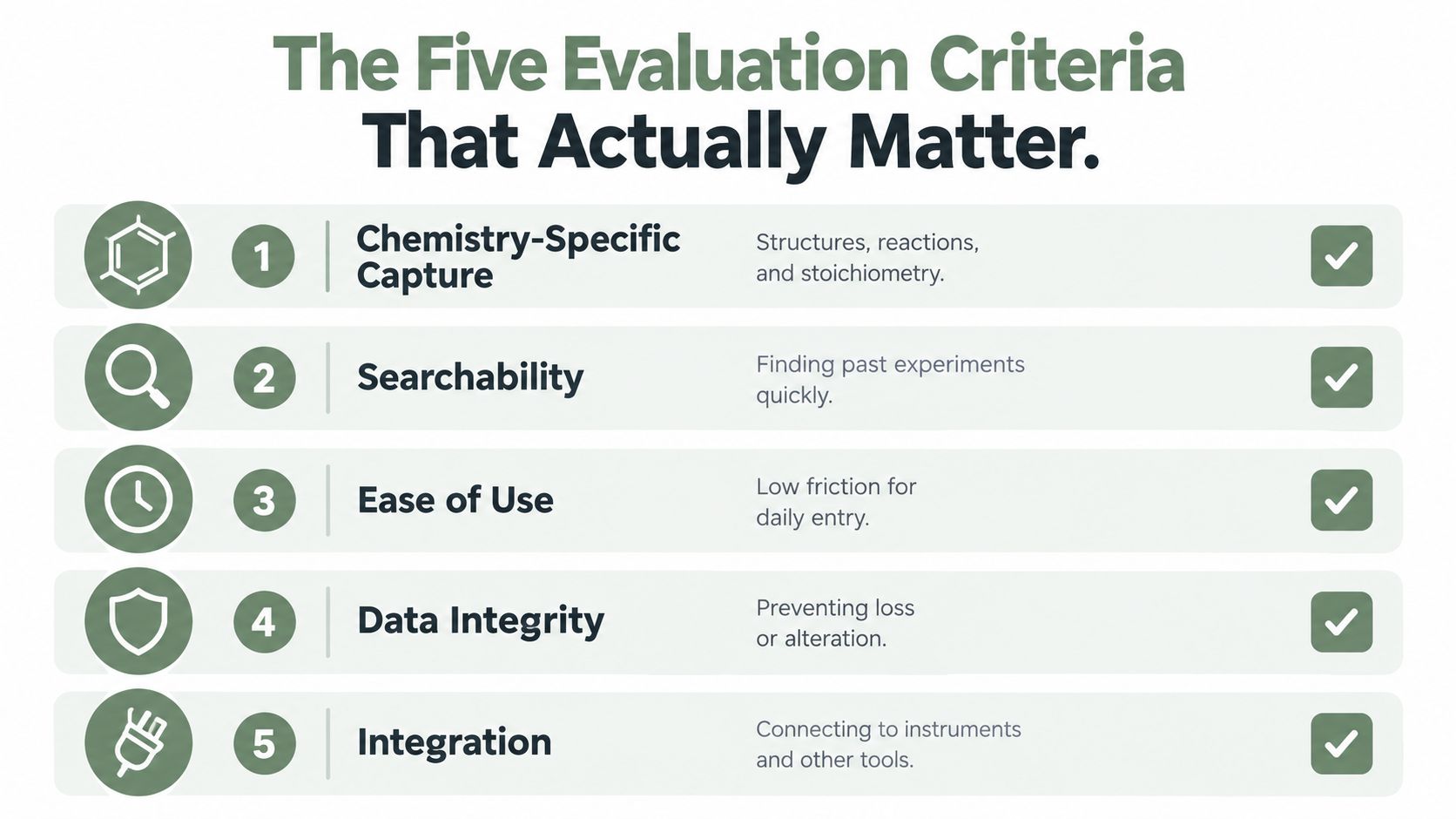
The Five Evaluation Criteria That Actually Matter
A chemistry group should agree on its evaluation criteria before accepting vendor demonstrations. Otherwise, the demonstration follows the vendor's strongest workflow rather than the laboratory's difficult one.
The checklist below provides a useful starting point, with searchability running through both chemistry capture and integration.
Chemistry and bench usability
Chemistry-specific capture means more than attaching a reaction scheme. The pilot should establish whether structures, reaction tables, stoichiometry, spectra, and compound identifiers remain usable throughout the record.
Bench friction deserves equal attention. A survey cited in a peer-reviewed ELN implementation guide found that 99% of respondents considered ease of use influential in ELN choice, with almost 80% rating it very important. The same guide identifies practical obstacles including unreliable Wi-Fi, limited bench space, and older laboratory hardware.
Test mobile and offline behaviour explicitly. A mobile page that opens successfully isn't proof that a chemist can capture, retrieve, and safely preserve an observation during interrupted connectivity.
Governance, portability, and fit
- Compliance posture: Require demonstrations of revision history, permissions, retention, and approval behaviour appropriate to the intended work. A compliance badge isn't an acceptance test.
- Privacy and exit cost: Examine processing location, account requirements, access, deletion, and recovery. Ask what remains usable after access to the service ends.
- Integration fit: Follow an instrument file into the experiment record, then find it again through a meaningful chemical or procedural search. Separate a working connection from a proposed integration.
A practical editorial rule is to reject a candidate that performs poorly against multiple essential criteria, unless another approved tool clearly covers those gaps. Non-negotiable requirements should remain pass-or-fail requirements, not disappear into an average score.
The strongest interface isn't necessarily the simplest-looking one. It's the interface that lets the scientist complete the necessary record without repeatedly leaving the experimental task or duplicating information elsewhere.
How the Main Chemistry ELN Archetypes Compare
Most selection exercises become clearer when laboratories compare archetypes before brands. An open-source chemistry platform, an enterprise notebook, a cloud-first team notebook, and a capture companion solve different parts of the documentation problem.
The table is a procurement framework, not a claim that every product in a category has identical capabilities. Without verified product-level pricing and demonstrations, assigning fixed price bands or declaring universal feature support would be misleading.
Chemistry ELN archetypes at a glance
| Archetype | Chemistry features | Bench friction | Compliance | Privacy and exit | Price band |
|---|---|---|---|---|---|
| Open-source chemistry platform, such as Chemotion | Test structure drawing, reaction tables, registration, and structure search | Test the actual deployment on bench hardware | Inspect implemented controls and local governance | Examine hosting responsibility and complete export | Verify licensing, hosting, and support costs |
| Enterprise ELN | Require the laboratory's reaction and analytical workflows in the demo | Test configured forms, not a demonstration workspace | Evaluate intended-use validation and controlled review | Examine permissions, retention, and migration terms | Obtain a deployment-specific quote |
| Cloud-first team ELN | Verify chemistry depth rather than assuming it | Test browser, mobile, and interrupted connectivity | Confirm which controls exist in the proposed edition | Review processing, deletion, and attachment export | Verify current terms and included capabilities |
| Lightweight capture companion | Preserve observations and evidence; don't assume chemistry calculation tools | Test capture during realistic manipulations | Keep formal approval in the appropriate system | Inspect local processing and handoff files | Verify app terms and handoff effort |
Chemotion appeared prominently among reported systems in the earlier NFDI4Chem survey. That makes it a reasonable candidate for investigation, not proof of superior productivity. Adoption indicates use within a surveyed community; it doesn't establish fit for another laboratory.
Choose the trade-off deliberately
For an academic group with access to technical support, an open-source chemistry platform may deserve evaluation. The question isn't merely whether software access is affordable, but who will maintain the deployment and preserve access when personnel change.
A large R&D organization should examine enterprise candidates through its configured workflow. A small team considering cloud-first software should scrutinize both chemistry depth and the practical consequences of losing connectivity.
Capture companions belong in a different comparison. They should be judged on whether they preserve otherwise-missed evidence and deliver a usable handoff, not whether they duplicate compound registration.
A capture tool and an official ELN shouldn't compete for the same job unless both actually perform it.
A laboratory may need only an official notebook. Adding another application is justified only when the handoff is clearer and less burdensome than the existing workaround.
Chemistry-Specific Features That Decide Daily Use
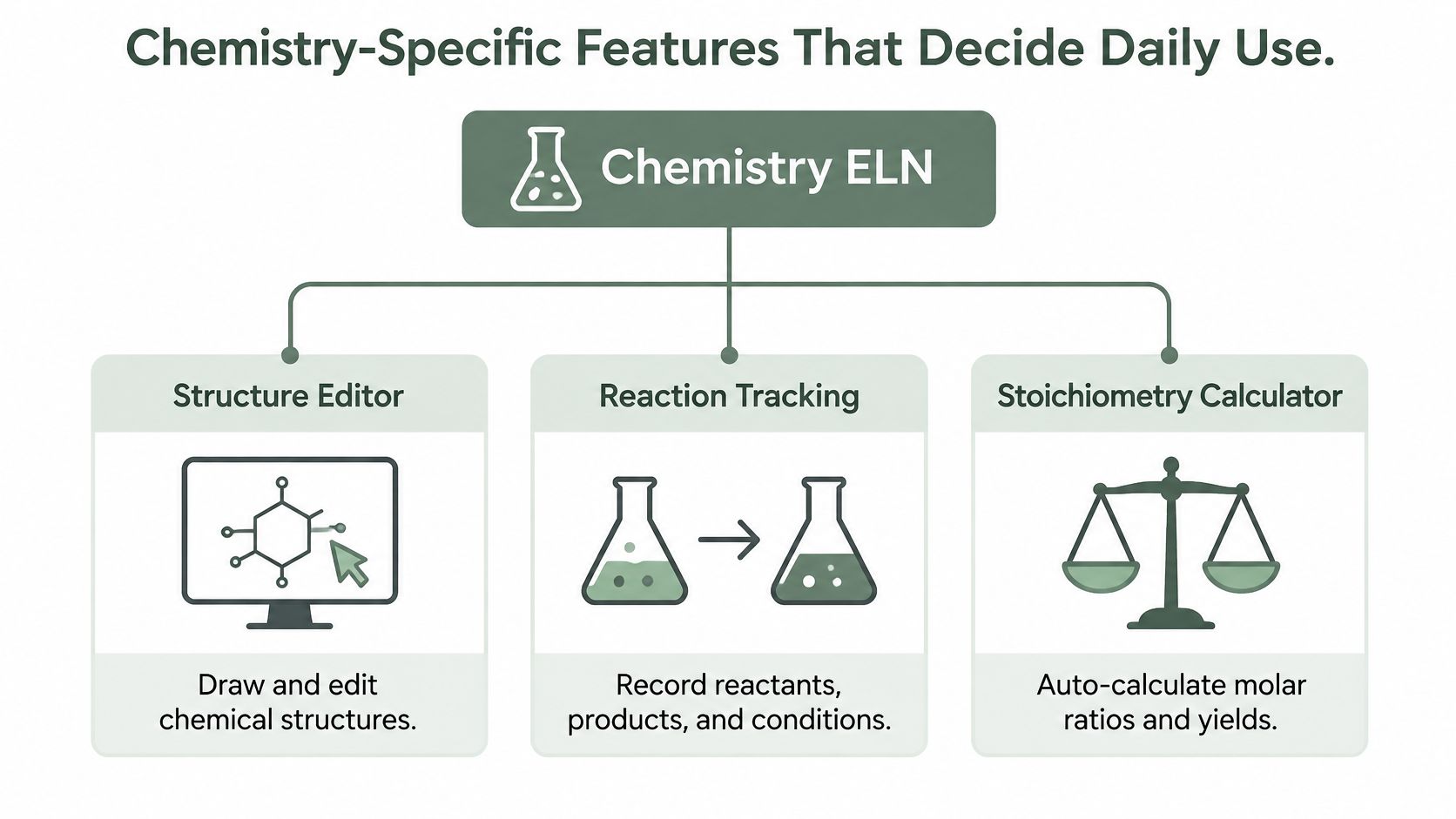
A reaction scheme pasted into a document is readable, but it isn't necessarily searchable chemistry. A useful chemistry ELN must preserve both the human-readable account and the structured information needed to retrieve and reuse it.
The feature relationships below help distinguish chemistry tooling from a general document store.
Test the record, not the toolbar
Chemistry research-data guidance from Aarhus University recommends persistent, machine-readable compound identifiers such as InChI, SMILES, or CIF, links to raw data, scripts, and results, and documentation of dates, materials, conditions, and instruments.
For synthesis, the pilot should follow a multistep experiment through structure entry, reaction tables, equivalents, and yield capture. The reviewer should inspect what happens when the experiment changes, not merely whether the original plan can be entered.
An illustrative test might include an interrupted addition, an altered workup, and a product carried forward without isolation. The notebook should let the scientist distinguish planned quantities, actual actions, measured results, and unresolved uncertainty.
A chemistry acceptance checklist
- Structures and identifiers: Enter the same compound through the supported identifier workflow and confirm that a later search retrieves the intended record.
- Stoichiometry and yields: Change a reagent quantity and inspect recalculation behaviour, units, assumptions, and any values requiring manual correction.
- Spectra and instrument files: Attach original files alongside interpreted results. Retrieve them without relying on the original author's folder knowledge.
- Compound registration: Check how the proposed workflow handles identity and references across related experiments.
- Export completeness: Open the exported record outside the application and inspect structures, attachments, metadata, and provenance.
Open exchange formats deserve attention alongside readable exports. Depending on the data and workflow, documented support for formats such as JSON, XML, or JCAMP-DX may be more useful than a polished PDF alone.
Analytical teams can extend the same evaluation into their analytical chemistry software workflow. The important question is whether another scientist can connect the reported result to the underlying acquisition and processing evidence.
A notebook passes this test when the chemistry survives retrieval and export. Attractive editing screens alone don't establish that.
Compliance, Audit Trails, and Where Capture Tools Stop
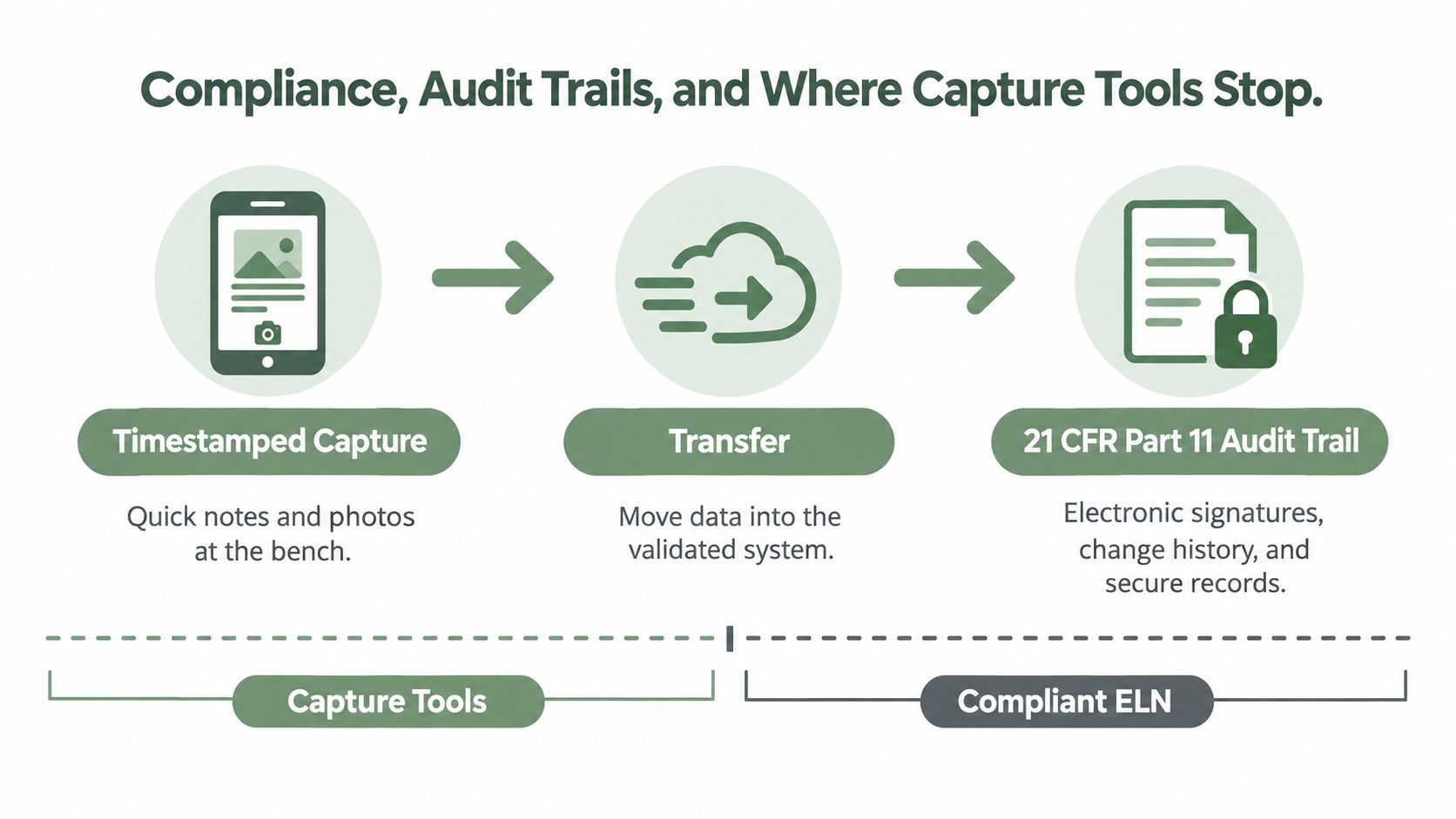
Timestamped capture isn't a regulated audit trail. That distinction matters whenever bench notes feed records used in regulated work.
The diagram illustrates the responsibility boundary, not an automatic route to compliance.
The FDA's electronic-records rule became effective on August 20, 1997, establishing criteria for trustworthy electronic records and signatures under applicable FDA recordkeeping requirements. Its controls include validation, access restrictions, record protection, training, and audit trails, as described in the FDA's Part 11 scope and application guidance.
What a timestamp doesn't establish
A timestamp can help establish when an observation was captured. By itself, it doesn't demonstrate that later changes remain visible, that the operator is securely identified, or that records remain protected throughout retention.
The Part 11 rule text reproduced in this technical reference specifies secure, computer-generated, time-stamped audit trails for record creation, modification, and deletion. Changes mustn't obscure earlier information, and audit-trail documentation must remain available for the required retention period.
Signed records also need the signer's printed name, signing date and time, and signature meaning, with the signature linked to its record. Those mechanics are addressed in FDA guidance on electronic records and signatures.
Separate the workflow events
- Raw capture: Preserve the original observation and its source context.
- Review and completion: Resolve unclear wording without disguising uncertainty or inventing missing facts.
- Approval: Apply the authorized review and signature process in the appropriate system.
- Export: Confirm which evidence, status information, and histories accompany the transferred record.
The following video can support discussion of the workflow boundary.
A timestamped PDF doesn't substitute for controlled change history. Likewise, moving a source note into a validated environment doesn't retrospectively validate the application that created it.
A practical audit-trail software evaluation should therefore require a demonstration of an actual correction, its attribution, the preserved previous information, and subsequent retrieval. Companion tools can support clearer contemporaneous documentation, but formal controls remain a separate requirement.
Why an On-Device Capture Layer Changes the Trade-Offs
At the hood or glovebox, opening a structured ELN can interrupt a manipulation. A capture layer can reduce that friction, provided it gives researchers a usable source record and does not leave them reconciling entries across two systems indefinitely.
The division of work should stay clear: the protocol describes the plan, the experimental log captures what happened, and the official notebook holds the reviewed record. Judge the extra layer by its bench friction, the effort needed to move or leave it, and what evidence survives the handoff.
A companion between protocol and record
Verbex: Voice Lab Notebook (iPhone and iPad app), made by Multimod Labs, is one option for this intermediate role. It is a private, on-device documentation app, not a replacement ELN, LIMS, QMS, inventory system, or autonomous scientific system.
The product's bench-documentation context is shown below.
In a pilot, test whether choosing Objective, Materials, Procedure, Observations, Conclusion, or a custom section takes one action at the bench. Capture a voice note mid-manipulation, then check whether its source context and timestamp remain intact in an entry that can be handed to the official ELN without retyping. Timers and images may help document a procedure, but they do not by themselves establish a complete audit trail.
For chemistry work, image handling also has limits. Supported material-label images captured in Materials can be processed on-device into structured entries when the text is legible enough. This is not general scientific image interpretation, and the app does not determine what an observation means.
Review & Complete creates a source-backed Organized draft. On supported devices, local Apple Intelligence processing may produce an ELN-style draft. The scientist still reviews and edits it before exporting PDF, DOCX, or Markdown for archiving or transfer. Treat that export as a handoff to manage, not automatic ELN synchronization.
Privacy doesn't remove the need for judgment
Processing occurs on the iPhone. The app requires no account and uses no cloud AI, cloud storage, advertising, analytics, or tracking. The distinction between local and remote processing is explained in this guide to on-device transcription.
On devices supporting Apple Intelligence, Ask can answer questions about the scientist's past experiments with citations to exact notes, entirely on device. It does not interpret results or make autonomous scientific decisions.
This arrangement may suit unpublished routes or sponsor-confidential observations, subject to institutional device and information policies. It does not provide regulated electronic signatures, validated system controls, or Part 11 audit trails, and it does not guarantee compliance or reproducibility.
Keep uncertainty in the source record. A readable draft should not turn an ambiguous observation into a confident conclusion.
The extra layer earns its place only when it makes capture easier and the transfer-and-review burden remains acceptable. If the approved ELN already works at the bench, another app can create duplicate records instead of reducing friction.
Matching the Choice to Your Lab and a 30-Day Pilot Plan
The right starting point depends on the laboratory's working conditions and responsibilities. The following profiles are decision examples, not claims about measured product performance.
Match the architecture to the work
| Laboratory profile | Sensible starting point | Main trade-off |
|---|---|---|
| Principal investigator with a small postdoctoral team | A maintainable team notebook or supported chemistry platform | Setup flexibility versus ongoing administration |
| CRO or analytical services team | A record system approved for client-confidential methods | Collaboration convenience versus information-governance requirements |
| Academic synthetic chemistry group with shared instruments | Chemistry-focused records with dependable raw-file references | Structured entry versus entry burden |
| Regulated process chemistry group within pharma | The organization's approved ELN environment | Controlled workflows versus bench flexibility |
A capture companion deserves consideration only where an observable capture gap remains. Regulated groups should approve the capture-to-record handoff before researchers place relevant source information in a separate application.
Run a bounded pilot
A 30-day pilot is a proposed evaluation schedule, not a performance benchmark. Voice Control Pro's guide to planning software pilots is an additional planning resource for teams organizing a bounded trial.
- Define real work: Select two representative experiments, including one with an anticipated documentation difficulty.
- Lock acceptance criteria: Identify essential chemistry, usability, governance, portability, and integration requirements before testing.
- Measure completion: Time creation of a complete reviewed record, including correction and handoff rather than only initial entry.
- Inspect the evidence: Check required metadata, raw spectra retrieval, meaningful searches, and whether another scientist can reuse the record.
- Test departure: Export complete records and attempt the intended import or archival workflow.
- Decide from use: Examine missing information, abandoned entries, duplicated work, and researcher willingness to continue.
The published chemistry ELN implementation research provides useful context for evaluating practical adoption rather than treating feature availability as success.
If bench capture is the unresolved bottleneck, the relevant next step is to download the iPhone and iPad capture app, free to download with the first 14 days free, and test it against those acceptance criteria.
Verbex offers private, on-device capture of voice notes, typed notes, timers, and images for human-reviewed handoff into an existing ELN workflow. Visit Verbal Experiment or Verbex to assess whether that companion approach addresses the laboratory's actual capture gap before replacing its official notebook.