 Blog
Blog
How to Keep a Lab Notebook: A Practical Guide
The bench is already moving when the note should happen. A flask is on the stir plate, a timer is running, a label is half-covered by a glove, and someone is asking whether the next aliquot changed color. That is the moment when good records are usually lost, not because the scientist didn't care, but because the work and the writing compete for the same hands.
A useful lab notebook solves that problem by separating immediate capture from later cleanup. It keeps the raw facts close to the bench, preserves what changed, and leaves room for a later review step without turning the experiment into a memory test.
Table of Contents
- The Hands-Busy Documentation Problem
- Building Your Experiment Entry Structure
- Applying ALCOA+ Principles Daily
- Choosing Between Paper and Digital Methods
- Creating a Sustainable Documentation Workflow
- Your Ready-to-Use Lab Notebook Template
The Hands-Busy Documentation Problem
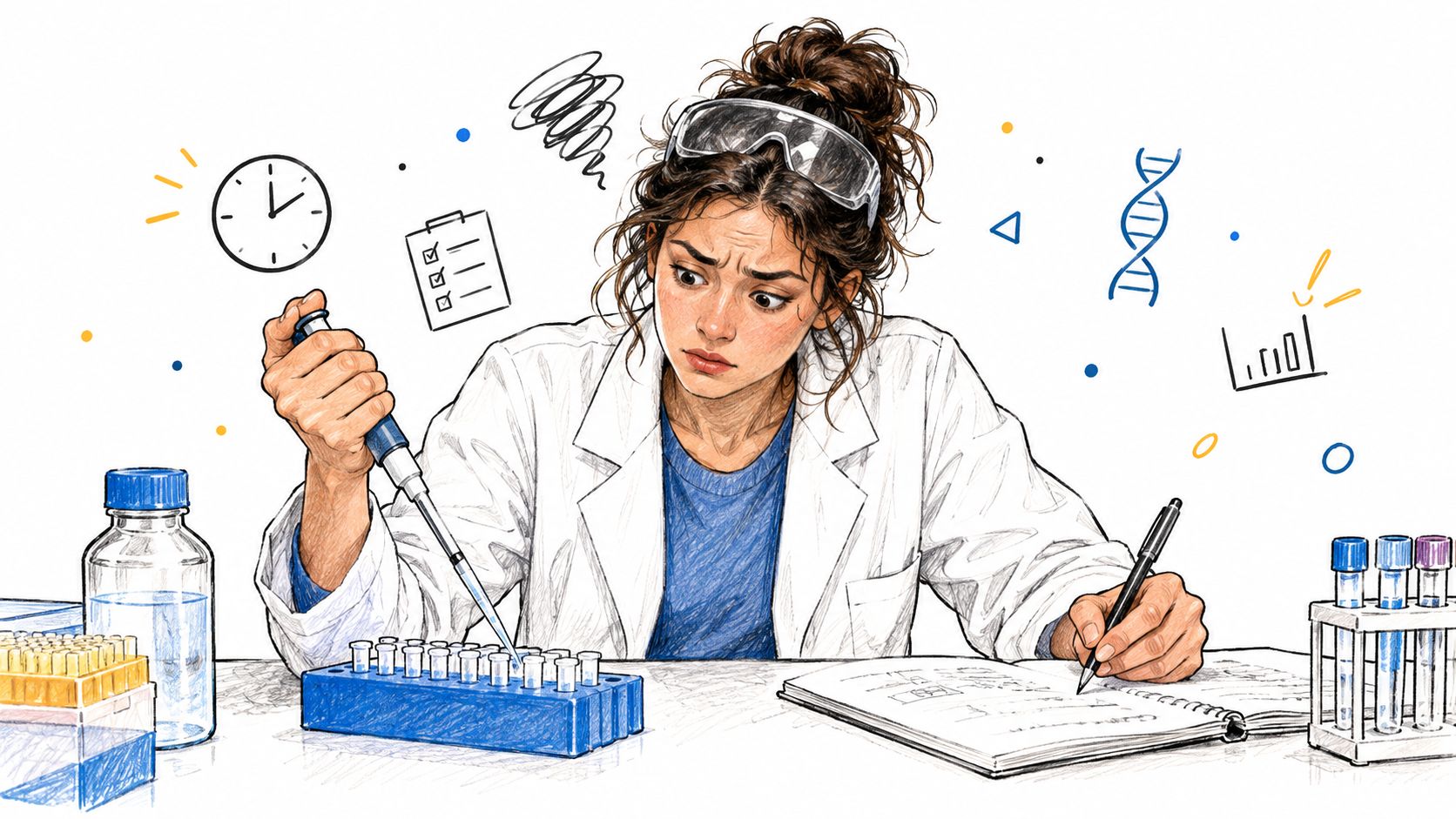
The centrifuge is running, the next tube is ready, and the instrument has started its method. Writing every detail feels impossible, so the scientist decides to record the run afterward. That decision seems harmless until the sample moves, the phone rings, the protocol changes, and the missing details must be rebuilt from memory.
FDA data-integrity guidance expects documentation to be made at the time work is performed (FDA data-integrity guidance). WHO laboratory records guidance likewise addresses creating records concurrently with activities that affect quality (WHO laboratory records guidance). Those requirements match the practical problem at the bench: the work creates information faster than a scientist can write polished prose.
What gets lost at the bench
The major decision usually survives. The small facts do not. A scientist may remember adding the reagent, but forget the order of additions, the temperature during a phase change, the rotor used for a spin, or that one tube waited longer than the others. Those details can determine whether another scientist can explain or reproduce the result.
Practical rule: record any detail that could change the result while the activity is happening.
Hands-busy work calls for a two-stage record. Capture a short, unmistakable fact first, then review and organize it once the immediate operation is complete. A voice memo can mark a deviation without stopping pipetting, while a typed note can formalize a correction during a safe pause. A photograph can preserve a label, instrument display, or visual change before it disappears. The guide to voice-first bench notes describes this capture approach.
The trade-off is speed versus completeness. A polished narrative written during the run can interrupt timing and handling. Brief contemporaneous capture, followed by a deliberate review, protects the raw record while still producing a readable entry. Review should clarify what happened, not fill gaps with assumptions.
Building Your Experiment Entry Structure
A lab notebook entry works best when it behaves like a traceability chain, not a story. The record should move from purpose to materials, from procedure to observations, then to raw data, calculations, and conclusion. That structure makes later review easier because every claim can be tied back to something captured at the bench.
Start with the minimum context that makes the run repeatable
The first lines need to identify the objective, the sample IDs, the reagent names, and the materials details that could change the outcome. For methods work, lot and expiry information matter because a different batch can behave differently. The PLOS reproducibility guidance emphasizes recording every detail that influences execution and retaining raw data for each figure (PLOS reproducibility guidance).
A clean entry often looks like this:
- Objective: what the experiment is trying to determine.
- Materials: reagent names, lot numbers, expiry dates, sample provenance.
- Procedure: numbered steps with the variable values that matter.
- Observations: time-stamped notes on what changed, not what was assumed.
- Raw data: file names, instrument exports, image references.
- Conclusion: what the result supports, plus the next action.
The strongest entries separate observations from interpretation. “Solution turned cloudy at 14:18” is an observation. “Precipitation likely started after mixing” is interpretation. Both can belong in the record, but they should not be blended into one vague line.
For organizing complex notes after the run, a useful companion resource is Documind research organization strategies, especially when a project produces many fragments that need a coherent structure.
Keep the chain visible from bench note to conclusion
The best entries make it easy to trace one result back to one source note, one file, and one calculation path. That means preserving the raw instrument export, the image, the calculation inputs, and the analysis settings together rather than burying them in a polished summary.
Verbex: Voice Lab Notebook (iPhone and iPad app) fits this workflow as one option for bench capture, since it supports voice notes, typed notes, timers, and photos, then organizes them into a structured record for review and export. It does not replace an official ELN, but it can sit in front of one as a capture layer.
A notebook that can't show where a conclusion came from is just a cleaner version of memory.
For teams that already have a documentation system, the practical question is not whether the entry looks elegant. It is whether another trained scientist could repeat the work using only the record and the source files.
Applying ALCOA+ Principles Daily
A wet-lab run rarely leaves spare attention for polished documentation. Your hands may be gloved, samples may be moving between steps, and an instrument may be finishing a read. Apply ALCOA+ by separating immediate capture from later review. Record the fact at the bench, then check structure and completeness once the run is stable.
The core record should be attributable, legible, contemporaneous, original, and accurate. ALCOA+ also covers completeness, consistency, endurance, and availability, as outlined in this ALCOA overview. The practical test is whether someone can identify what happened, who recorded it, when a change occurred, and why it was made.
Capture first, review second
During a busy step, write or dictate the minimum reliable detail: sample ID, action, observation, time, and any file or instrument reference. Do not delay a fact because the sentence is not polished. Mark uncertainty plainly, then resolve it during review rather than secretly reconstructing the event later.
A short review after the run should confirm that the entry still reflects the work. Check failed runs, deviations, and negative results, then compare units, sample IDs, file names, and timestamps across the record. This two-stage workflow keeps documentation practical without turning later editing into a rewritten history.
Corrections should preserve the original
NIH notebook guidance supports dating and initialing corrections, with an explanation for the change (NIH notebook guidance). Keep the original value visible. Add the corrected value clearly, identify yourself, record the date, and state why the change was needed.
Silent overwriting removes context. If a dilution was entered incorrectly, strike through the original once, add the accurate value, and link the correction to the relevant calculation or source file. In a digital system, use a controlled audit trail that records who changed the entry, when, and why, consistent with FDA Part 11 guidance.
Before closing the entry, ask:
- Completeness: Are failures and deviations included?
- Consistency: Do identifiers, units, and files agree?
- Reproducibility: Could another trained scientist follow the record without guessing?
The ALCOA guidance for laboratory records provides useful background for teams transferring bench notes into an ELN or another controlled system. The record should preserve the chain from immediate capture to reviewed conclusion.
Choosing Between Paper and Digital Methods
Paper notebooks and digital capture solve different problems. Paper is simple, durable in the sense that it does not depend on a battery, and easy to use when the bench is messy. Digital methods are better when search, attachment, timestamps, or file handling matter more than handwriting speed.
The right choice depends on the work, not on fashion. A chromatography day, a microbiology plating run, and a reaction screening session do not place the same demands on a record.
Use the medium that matches the failure mode
Paper fails when handwriting gets rushed, pages are hard to search, or raw files end up disconnected from the notes. Digital records fail when the system is slow, too structured for a live experiment, or used in a way that tempts someone to clean up the story before the facts are captured. In both cases, the core risk is the same: notes get detached from the experiment itself.
A good decision framework is simple:
- Choose paper when the lab needs the lowest-friction option and the records are reviewed later.
- Choose digital capture when photos, timestamps, file references, and search matter every day.
- Use a hybrid when bench capture needs to be fast but the official record still lives elsewhere.
For teams looking at the official notebook side of that choice, the internal discussion on electronic lab notebooks helps frame the handoff between capture and archive.
Keep the decision tied to the workflow
Labs sometimes overbuy systems because they want one tool to do everything. That usually backfires. A label photo, a timer, and a quick deviation note can be enough for the first capture, while the formal ELN entry happens later under review.
For a practical contrast with other lab purchasing decisions, the Celonyx Labs guide to syringes is a reminder that the right tool is the one matched to the immediate task, not the one with the longest feature list.
The documentation method should do one thing well. It should help the scientist preserve the bench reality before the record gets polished.
Creating a Sustainable Documentation Workflow
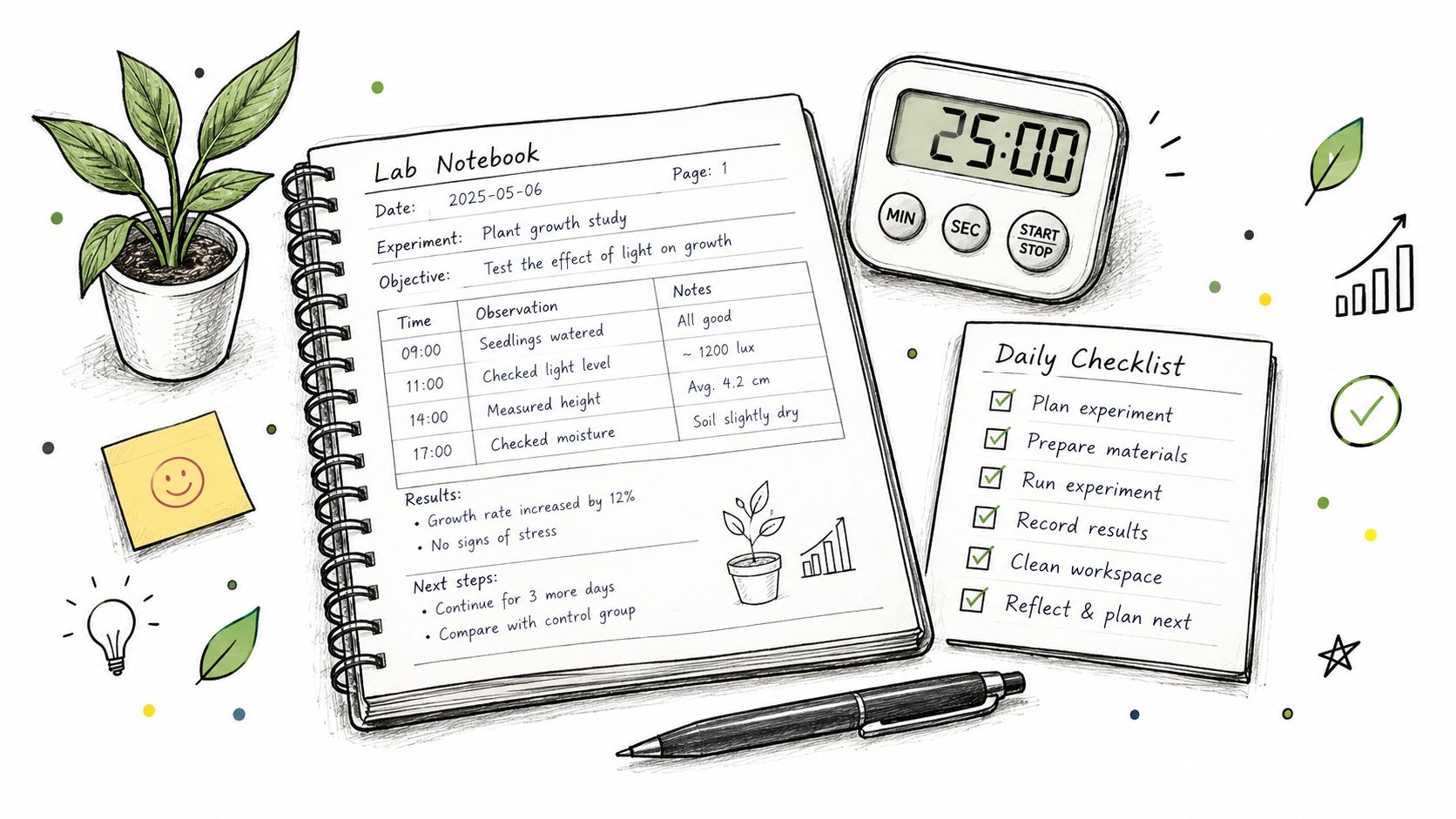
A run can go wrong while the scientist is handling a timer, pipette, sample rack, and instrument screen. The record fails when the observation is postponed until the bench is clear. A sustainable workflow separates immediate capture from later review, so the original event survives interruptions and the final entry remains readable.
Build a rhythm that survives interruptions
Start the record before starting the experiment. Create the entry, assign its experiment ID, and add the objective and sample IDs. Then capture events in real time, even if the first note is brief or rough.
A workable routine has two passes:
- Open the entry first. Add the date, experiment ID, objective, and sample IDs before the first step.
- Capture at the bench. Record timing, deviations, observations, and decisions as they occur.
- Mark uncertainty. Label estimates, assumptions, and details awaiting confirmation instead of presenting them as settled facts.
- Keep raw evidence connected. Add image names, instrument exports, file paths, and other references while they are still easy to identify.
- Review before closing. Check units, timestamps, file names, missing steps, and whether failed or aborted work remains visible.
The hands-busy paradox is real. Writing everything in polished prose can slow the work, while writing nothing leaves the record dependent on memory. Use short phrases, checkboxes, timestamps, and photo or file references during the run. Expand those notes during review without deleting or rewriting the original capture.
If a detail could change how the result is interpreted, record it immediately. Explanations can wait. The observation cannot.
Use reminders that fit the work
A timer can cue the next observation as well as measure incubation. Set it for a sampling point, a visual check, or the moment a deviation needs recording. A checklist can confirm that a material label was photographed, a change was logged, and raw files were attached before the run moves on.
Teams can also assign different record types to different purposes. The 7 types of process documentation offer a useful structure for deciding where an experimental instruction, deviation, decision, or result belongs. That separation keeps the notebook from becoming a mixture of procedure, commentary, and final interpretation.
Keep the source visible during review
Review should improve clarity, not clean up the history. Preserve the first capture, retain corrections as corrections, and make the relationship between the original note and the reviewed entry easy to follow. A later summary should point to the raw observation, image, file, or instrument export that supports it.
Set a defined review point, such as the end of the run or the end of the workday. At that point, fill gaps while the context is fresh, mark unresolved items, and record who completed the review. The workflow should be ordinary enough to use on a difficult bench day. If it depends on perfect attention, it will fail when the experiment becomes busy.
Your Ready-to-Use Lab Notebook Template
A strong template does not force every experiment into the same shape. It gives each run the same skeleton so the scientist can move quickly without losing key details. The goal is a record that remains readable later, even when the bench day was noisy and interrupted.
Template for a bench-ready entry
Header
- Date and time.
- Experiment ID.
- Scientist name or initials.
- Objective.
- Sample IDs.
Materials
- Reagent names.
- Lot numbers and expiry dates.
- Instrument ID or method version.
- Any condition that could affect the result.
Procedure
- Numbered steps.
- Volume, mass, temperature, speed, and timing where relevant.
- Any deviation from the planned method.
Observations
- Time-stamped notes.
- Visual changes.
- Unexpected events.
- Failed or aborted steps.
Raw data
- File names.
- Image references.
- Exported instrument files.
- Intermediate calculations and settings.
Conclusion
- What the data supports.
- What remains uncertain.
- Next action.
A short example is enough to show how it works. A reaction run might record the objective, the catalyst lot, the exact heating time, a color shift at a specific moment, the raw chromatogram filename, and a conclusion that separates the observed conversion from the interpretation. A cell-culture note might do the same with seeding density, incubation atmosphere, visual morphology, and the image file that shows the change.
The best template is the one that another trained scientist can read without needing a verbal correction afterward.
For readers who want a fast starting point, the free ELN Template Builder is a practical next step for lab notebooks, ELN records, data integrity, ALCOA+, GLP or GMP documentation, deviations, and equipment logs. A notebook becomes useful when it can be kept under pressure, not just admired after the fact.
If the bench keeps getting ahead of the notebook, Verbex gives scientists a private, on-device way to capture voice notes, typed notes, timers, and images while their hands are busy. It organizes those source captures into a structured record for review and export, which can help keep the raw experiment visible before anything gets polished for an ELN.