 Blog
Scientific Reports Information for Authors: What to Submit
Can a manuscript meet every formatting rule and still leave a reviewer unable to check how a result was produced? Scientific Reports authors can prevent that gap by treating each submission requirement as part of an evidence trail: preserve the records behind the work as it happens, then use them to support the manuscript.
Scientific Reports information for authors is easiest to apply when the journal's requirements are connected to the study's methods, data, figures, and declarations. The exact details can change, so authors should check the current instructions before submitting.
Table of Contents
- Scientific Reports Requirements at a Glance
- Article Types and Length Limits
- How Editors Judge Scientific Validity
- Match Your Study to a Reporting Guideline
- Write a Data Availability Statement That Holds Up
- Figures, Supplementary Files and AI Disclosure
- How to Submit Your Manuscript Step by Step
- Confirm Your Evidence Trail Before You Submit
Scientific Reports Requirements at a Glance
Every submission needs a Data Availability Statement, a reporting guideline matched to the study design, evidence behind its claims, and disclosure of AI use in the manuscript under the journal's policy. These aren't just items to add during final formatting. They connect what the paper says to the records that let readers and reviewers evaluate it.
| Requirement | What the journal requires | Where it appears |
|---|---|---|
| Data Availability Statement | Required in every submission; states where data can be found or why access is restricted | Separate section after the main text, before References |
| Reporting guideline | Chosen to match the study design, with its checklist completed | Methods, and a final audit of the full manuscript |
| Evidence for claims | “Data not shown” is discouraged; supporting data is deposited or supplied as Supplementary Information | Figures, supplementary files, and repository records |
| AI use | Must be disclosed under the journal's policy | Declarations in the manuscript |
The Data Availability Statement belongs at the end of the main text, immediately before References. If a result supports a claim, the material needed to assess it should be available through a repository or Supplementary Information, rather than hidden behind “data not shown.” The journal's submission guidance on data availability also makes clear that the availability statement is part of the submission record, not a substitute for keeping the underlying evidence organized.
A reporting guideline offers a different kind of check. It helps authors test whether the manuscript includes the details expected for its study design, while a claim-to-file trail helps them find the source material behind each result. Both work better when built during the study than when reconstructed near submission.
The sections below address article format and length, editorial review, reporting guidelines, data access, figures, AI disclosure, and the final submission workflow. Authors with a specific question can use the headings to find the relevant requirement.
Article Types and Length Limits
Scientific Reports publishes original research as either a standard Article or a Registered Report. The main difference is the stage at which the work is reviewed: a standard Article is usually submitted after the study is complete, while a Registered Report begins with review of the protocol before data collection.
For a standard Article, the journal doesn't impose strict overall word-count or page limits, but it gives authors a preferred scale. Manuscripts should ideally be no more than 11 typeset pages. The main text should normally stay below 4,500 words, excluding the Abstract, Methods, References, and figure legends. The reference list is recommended to be 60 references or fewer; that's guidance, not a strict cap, so a longer list should be justified by the work's scope. These thresholds are set out in the journal's author instructions for article length and references.
| Feature | Standard Article | Registered Report |
|---|---|---|
| Length guidance | About 11 typeset pages; main text normally below 4,500 words | Confirm length guidance in the current author instructions |
| Reference guidance | 60 references recommended, not strictly enforced | Confirm guidance in the current author instructions |
| When peer review happens | After the study is complete | Protocol reviewed before data collection |
| Data and materials | Covered by the Data Availability Statement | Confirm requirements in the current author instructions |
For a Registered Report, the protocol stage comes first, with results submitted later. The available guidance here doesn't specify its length or data requirements, so those details should be checked in the current instructions rather than inferred from the standard Article guidance.
A practical choice rule: if the experiment is finished, the standard Article is the usual route. If the design is still being planned and the authors want review before results exist, a Registered Report may fit. For help planning the flow of a manuscript, a paper organization guide for students can help clarify how sections relate, though journal-specific instructions still take priority.
How Editors Judge Scientific Validity
Scientific Reports publishes open-access work across the natural sciences, medicine, engineering, and psychology. Its editorial model centres on scientific validity. Editors ask whether the methods are appropriate and correctly conducted, whether the analysis supports the results, whether the conclusions avoid overstatement, and whether relevant prior work is cited. Think of the manuscript as a chain of evidence: each link, from design to measurement to claim, has to hold.
A manuscript can be neatly formatted and still stumble at a specific point. An observational study that reports a strong association may imply that one factor caused another, when the design supports only a connection. A sample exclusion may appear in the flow diagram without a stated reason. Those are the kinds of gaps external reviewers test.
After an initial editorial assessment, a manuscript normally goes to two or three external reviewers. The journal's editorial guidance reports that more than 90% of submissions handled by a typical Editorial Board Member are sent for external review, while the overall acceptance rate is about 50%. These figures offer context only. They do not predict the outcome for any individual paper. Passing initial scope and validity checks is necessary. External review can still catch a concrete problem, such as an unexplained sample exclusion that shifts the denominator behind a key result, and the authors may need to revise the analysis or the claim.
Pre-submission test: Can another researcher follow the Methods, identify the source of each result, and see how the conclusions are supported? If not, strengthen the evidence trail before polishing the prose.
Results writing is one place where that test matters. A guide to writing lab results can help authors separate observations from interpretation and keep the claims close to what the measurements show.
Match Your Study to a Reporting Guideline
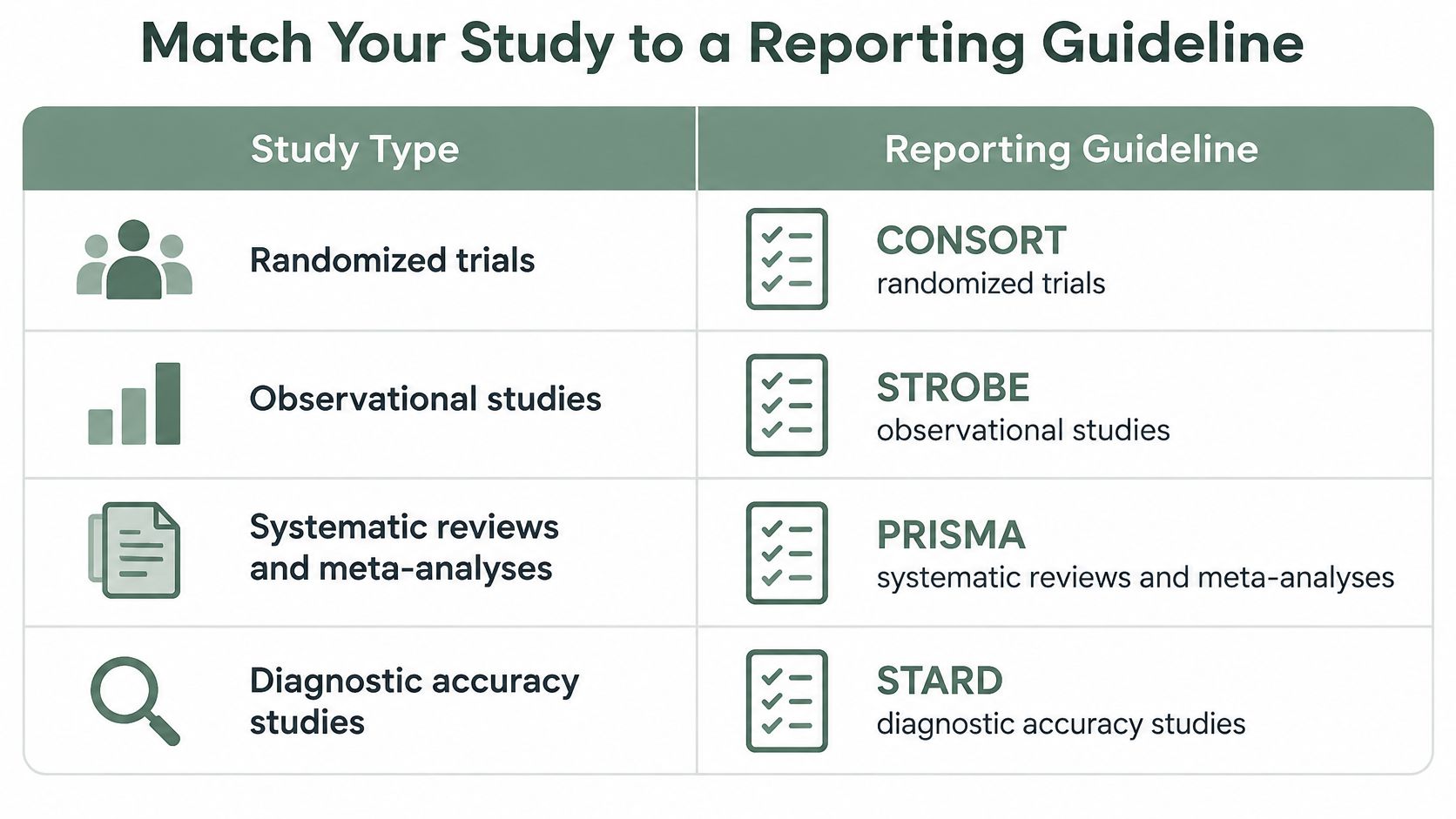
Start by matching the guideline to the study design. For common designs, the EQUATOR Network's reporting-guideline resources provide checklists and supporting Explanation and Elaboration documents. The checklist helps authors confirm coverage; the longer document clarifies what each item means and offers examples.
| Study design | Guideline | Use it for |
|---|---|---|
| Randomized trials | CONSORT | Allocation, interventions, and outcomes |
| Observational studies | STROBE | Cohort, case-control, and cross-sectional designs |
| Systematic reviews and meta-analyses | PRISMA | Search, selection, and synthesis of studies |
| Diagnostic accuracy studies | STARD | Test accuracy against a reference standard |
| Other designs | Find a relevant guideline through the EQUATOR Network | Check the EQUATOR Network for a match |
Use the guideline as a working tool, not a box to tick after the manuscript is finished:
- Choose the guideline before drafting. Match the design to a relevant checklist so the planned reporting requirements are visible while the Methods and Results take shape.
- Complete the checklist during preparation. Use the Explanation and Elaboration material when an item's meaning isn't clear; it can show what level of detail is needed.
- Audit the full paper. Check for missing information in the Abstract, Methods, Results, and supplementary files. The checklist improves coverage, but it doesn't dictate the manuscript's section order.
For wet-lab work, the Methods should say what was done and why, in enough operational detail for another researcher with access to the underlying data to understand how the analysis was produced. Record the experimental design; biological and technical replicates; controls; randomization or blinding where applicable; sample exclusions; reagent and instrument details; protocol deviations; and the statistical model.
Illustrative example: A cell-culture study uses three biological replicates, each run in technical triplicate. The Methods should state those numbers explicitly and name the test used for each comparison. That gives readers a clear account of what counts as an independent replicate and what the reported sample size represents. Keep the same distinctions in the source records so the manuscript can be checked against what was run.
Write a Data Availability Statement That Holds Up
A Data Availability Statement should give a reader a clear route to the material needed to interpret and verify the findings. It must appear as a separate section at the end of the main text, immediately before References. The Scientific Reports instructions for Data Availability Statements require one for every submission and set out what to include when access is restricted.
For openly released data, say where it is available. Name the repository and include the relevant accession code, or identify the Supplementary Information file containing the material. Use precise wording: “Data are available in repository X under accession Y” tells a reader more than “data are available on request.” If a claim relies on a processed dataset, make clear where the supporting files can be found.
Controlled access requires a fuller explanation. State why open release isn't possible, such as privacy, legal, or ethical restrictions, and describe how a reader can request access. Include contact details, an expected response timeframe, and any conditions imposed by a data-use agreement. Reviewers may request access to the underlying data for peer review, as long as sharing is consistent with applicable ethical and legal requirements.
Illustrative example: A human cohort dataset can't be posted publicly because its ethics approval restricts open release. The statement identifies that reason, names the data custodian and a response window for access requests, describes the data-use agreement, and points to de-identified summary data supporting the figures. This gives readers a route to assess the work without implying that participant-level information is unrestricted.
For a practical approach to organizing the access decision and its terms, a data management and sharing plan guide can help authors set out what will be shared and how. The final test is simple: for every figure, can a reader find the file it came from and the statement that governs access to that file?
Figures, Supplementary Files and AI Disclosure
A figure should lead back to a source: raw data, an instrument export, an analysis file, or a repository record. Keep those connections clear in the Data Availability Statement and Supplementary Information. Figure legends should define what's shown, including sample sizes, statistical tests, and scale bars where relevant. Check the current author instructions for file formats and resolution, and finalize supplementary files before submission so they match the manuscript being reviewed.
AI use isn't one category. Transcribing a researcher's own notes on a device, organizing observations, or checking language has a different confidentiality profile from asking a public model to interpret unpublished results. A cross-publisher analysis describes restrictions commonly placed on uploading submitted manuscripts and peer-review reports to public AI tools because of confidentiality, data-security, and intellectual-property risks. It also reports broad agreement that AI can't be named as an author and that its use should be disclosed, though policies differ between publishers and disciplines (cross-publisher analysis of AI policies). Authors should follow the current journal policy, disclose the tool and task, and remain responsible for checking every output against the source material.
| Material | Risk when sent to a public AI tool | Practical handling |
|---|---|---|
| Manuscript text | Confidentiality and authorship concerns; some publishers restrict uploads | Use only for language checks, and disclose |
| Unpublished raw data | High; may conflict with data-security and intellectual-property terms | Keep out of public tools |
| Figures | High if the results are unpublished | Don't upload unpublished images to public tools |
| Reviewer correspondence | High; confidential communication | Don't paste into public tools |
| Human-participant information | High; privacy and ethics constraints apply | Keep out of any external tool |
| Laboratory records | Medium; may contain unpublished results | Transcribe on device and verify against the source record |
When assessing a tool's privacy settings, AI workspace privacy checks can help frame questions about how work material is handled. Before using any tool, ask: Did an external tool see unpublished data? Did it generate scientific reasoning? Is the use disclosed?
How to Submit Your Manuscript Step by Step
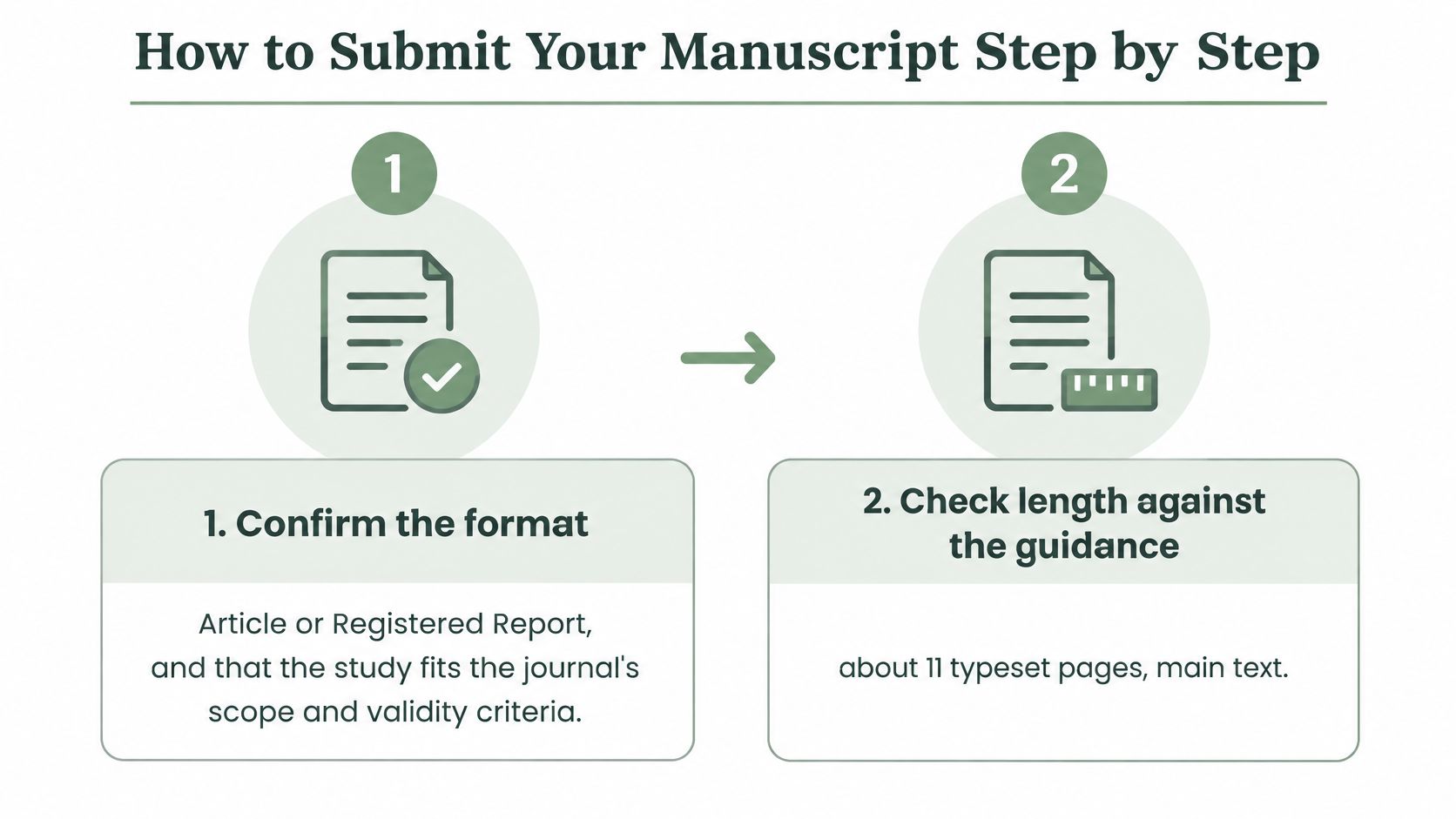
Confirm the format. Decide whether the manuscript is a standard Article or a Registered Report, and check that its subject and methods fit the journal's scope and validity criteria. A common slip is treating novelty as the main test of suitability rather than showing that the work is technically sound.
Check length against the guidance. For a standard Article, check the preferred scale of about 11 typeset pages, the usual main-text target below 4,500 words, and the recommended reference count. A common slip is counting the Abstract, Methods, References, or figure legends toward the main-text figure.
Match the reporting guideline. Choose one for the study design, complete its checklist, and use it to catch omissions across the manuscript and supplementary files. A common slip is selecting the guideline at the end, after important study details have been left out.
Write the Data Availability Statement. Place it before References and describe the repository or Supplementary Information, or give precise access terms if data is restricted. A common slip is saying data are available without naming a repository, contact, or access route.
Assemble figures and supplementary files. Check that each figure has a complete legend and a traceable source, then finalize the Supplementary Information. A common slip is omitting a sample size or statistical test from a legend, or uploading files that don't match the manuscript.
Complete the declarations. Enter the ethics approval reference, competing interests, funding details, and AI disclosure in the wording the current author instructions require. A common slip is leaving a declaration blank or giving different information in the submission system and the manuscript.
Upload the correct manuscript version. Enter the title, authors, affiliations, and article type in the journal's submission system, then check those fields against the paper. A common slip is overlooking that information entered in the system is part of the publication record.
Save the submitted evidence trail. Keep the exact files sent, identify their version, and list the raw data used for each figure. A common slip is retaining only the final manuscript, without the analysis files or record needed to answer later questions.
A complete submission has files that match the same manuscript version, and every claim can be traced to a source. A scientific writing guide for researchers can help with drafting, but the final check is whether the paper and its submitted files tell the same story.
Confirm Your Evidence Trail Before You Submit
What would you hand a colleague who asked how Figure 2B was produced? A chain of evidence: raw file, analysis file, protocol version, and analyst's name. An evidence trail works like a chain of custody for a sample, with a date and version at each handoff.
Build that trail during the study, not the week before submission. Keep a dated bench record that includes deviations, and use it to write Methods that describe what happened rather than the plan. If Figure 2B came from plate 4, the record should name plate 4, the plate-reader file, the spreadsheet that normalized the values, and the protocol version used that day.
Pick three figures at random and trace each back to its source. If one cannot be followed, repair the record before you submit.
For bench notes that will feed the record, Verbex's Review & Complete feature prepares a draft from the user's notes for the user to check, edit, and complete. The draft still has to be checked against the source files and the journal's requirements.