 Blog
Blog
Handling Unexpected Results at the Lab Bench
You're at the bench, and something just went sideways. The tube that should've stayed clear has gone cloudy, the gel lane looks wrong, or the color change landed in a place the protocol never promised. The first useful move isn't to panic or “fix” the result, it's to protect the evidence, because the most fragile part of an unexpected result is usually the context around it.
That matters because unexpected findings are not rare outliers in modern biomedical work. A 2025 analysis of over 90,000 NIH grants found that about 70% of resulting biomedical papers contained at least one outcome or research category that wasn't in the original proposal, which makes deviations a normal part of research rather than a sign that something has gone wrong with the scientist (Nature). The better habit is to shift from execution mode to investigation mode, keep the workspace safe, and preserve what actually happened before the bench gets reset and the memory starts doing damage control.
Table of Contents
- Assessing the Situation and the Reality of Bench Deviations
- Capturing Raw Evidence Before the Bench Is Cleared
- Distinguishing Technical Failures from Credible Null Results
- Designing Targeted Re-Runs and Control Strategies
- Preserving Anomalous Data for Internal Lab Use
- Integrating Source Records into ELN and Audit Workflows
Assessing the Situation and the Reality of Bench Deviations
A bad-looking assay can feel like a personal insult, but the bench doesn't care about pride. If a reagent is smoking, leaking, or making the room unsafe, that takes priority over every notebook page and every timeline. If the setup is physically stable, the next move is quieter: stop touching the system long enough to ask whether the odd result is a real signal, a technical artifact, or just a sign that the experiment wandered off script.
Secure the bench before you reinterpret it
The useful mental switch is simple, even if it's hard in the moment. First secure the workspace, then preserve the anomaly, then decide whether a rerun is justified. That order matters because once a glove wipes the surface, a tube gets tossed, or a plate gets rinsed, the strongest clue may be gone.
Practical rule: if the result is surprising, the evidence gets priority over the cleanup.
That stance fits the reality of research, not just good habits. The record of biomedical work shows that unexpected findings are common, and the final paper often stretches well beyond the original plan (Nature). Penicillin is the classic reminder: Fleming noticed an unexpected zone of inhibition around a mold contaminant, but the observation mattered only because he preserved it long enough for later purification and validation work to make sense of the anomaly (CDC).
Treat the deviation as a data object, not a nuisance
A junior postdoc often wants to “get back on protocol” as fast as possible. That instinct can be useful when the problem is obvious, but it's risky when the deviation itself may be the important observation. A cloudy buffer, a drifting readout, or a different incubation behavior might reflect biology, contamination, timing, batch effects, or an undocumented change in handling.
The safest habit is to ask three questions before restarting. What changed physically. What changed procedurally. What changed in the environment. If the answer isn't obvious, the result needs documentation, not dismissal. The later troubleshooting will be better if the first response was to keep the evidence intact and separate the observation from the emotion around it.
Capturing Raw Evidence Before the Bench Is Cleared
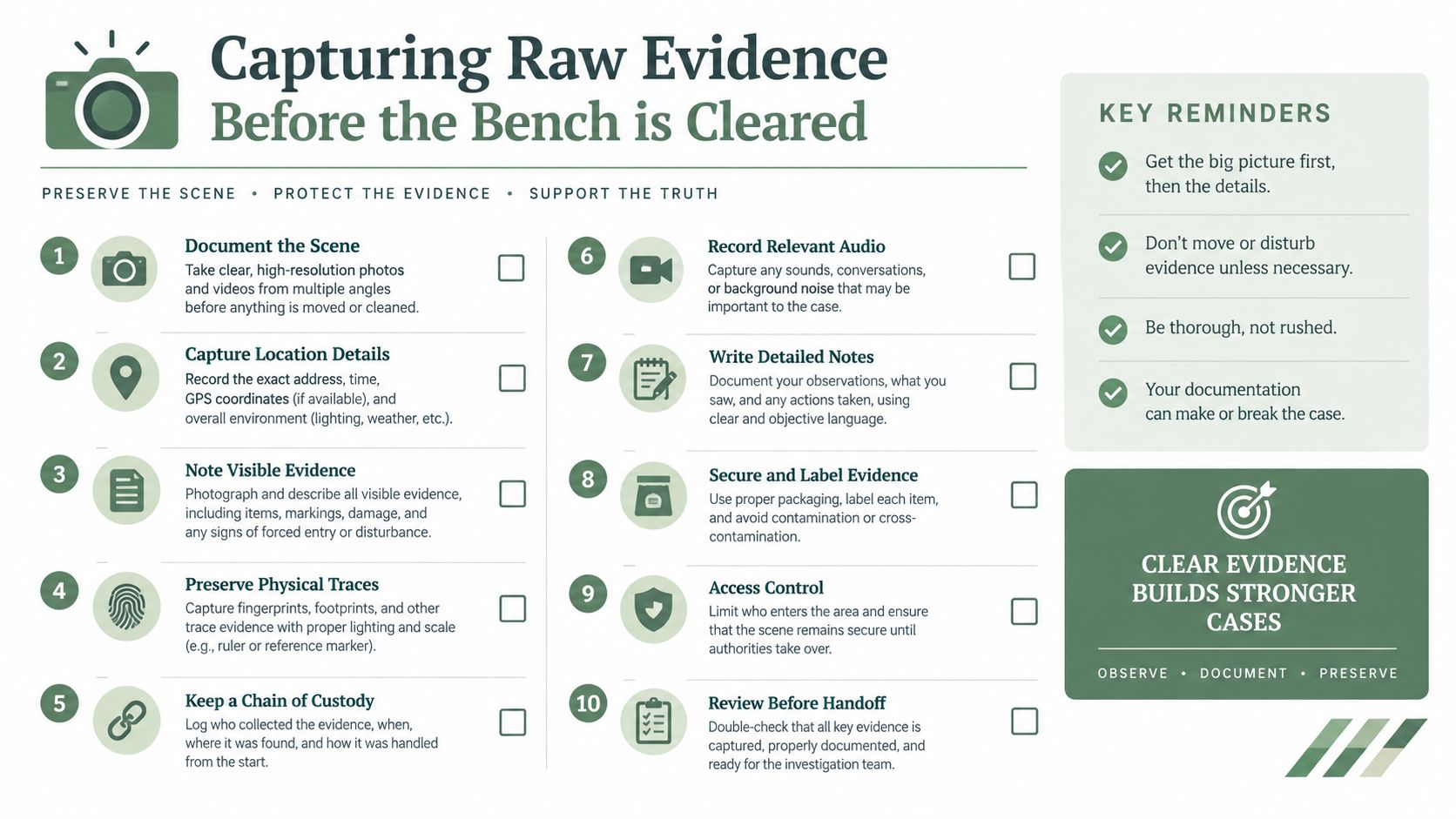
The critical loss in an unexpected result usually happens in the first minute after the surprise. Someone reaches for a wipe, someone else says “let's just repeat it,” and the source record disappears into memory. Raw capture has to happen before the bench is cleared, while the smell, the timing, the appearance, and the sequence are still real.
A fast capture routine should collect the same things a careful witness would preserve. Not just the final outcome, but the exact state of the material, the materials used, the order of actions, and anything unusual about timing, handling, or appearance.
Capture the source state, not a polished summary
The point of contemporaneous capture is to keep the original context from getting replaced by a better story later. The FDA defines an electronic audit trail as a secure, computer-generated, time-stamped record that reconstructs the creation, modification, and deletion of an electronic record, and it says those trails should capture who changed a record, when the change happened, and why (FDA audit trail guidance). That logic fits bench work even outside regulated settings: keep the first truth, then annotate it.
A practical capture sequence looks like this:
- Take a photo immediately if there's visible precipitate, color change, band distortion, label damage, or anything else the eye will forget later.
- Dictate a short voice note while hands are busy, including the exact moment the deviation appeared and what the material looked, felt, or behaved like.
- Log the timer state if the anomaly is tied to incubation, rest time, waiting, or delayed handling.
- Record the material identity so later reconstruction doesn't depend on memory, shorthand, or a half-legible tube label.
- Note the procedural deviation in plain language, even if it feels embarrassing or small.
- Mark environmental context if temperature, bench placement, or an instrument setting may matter.
A private, on-device lab documentation app like Verbex can fit this moment because it captures voice notes, typed notes, timers, and photos at the bench, then organizes them into a structured record for later review and export. That matters less as a product pitch than as a workflow fit: the source captures stay tied to timestamps instead of being reconstructed later from memory.
Use a source-backed structure right away
Raw notes get useful only when they're legible six hours later. That means sorting them into a simple structure while the event is still fresh. The fastest useful headings are Objective, Materials, Procedure, and Observations, with a Conclusion left open until the evidence is interpretable.
If the observation is especially unusual, a short internal record should include the lot, the timing, the exact step where the anomaly appeared, and any deviation from the expected path. The value is not literary polish. The value is being able to reopen the record later and see exactly what happened without guessing which details were added after the fact. For a fuller note-taking approach, the companion discussion on capturing tacit knowledge is worth reading in the same documentation habit.
Distinguishing Technical Failures from Credible Null Results
Not every unexpected result deserves a celebration, and not every flat result is a failure. The hard part is telling the difference between a true null and a compromised experiment that merely looks negative. Recent scholarship argues that negative findings should be reported when there's evidence they're likely to be true, because unfiltered nulls from technically compromised experiments can distort meta-analyses and create false scientific conclusions (St Andrews repository).
Ask what would have had to be true for the result to count
The cleanest filter is methodological, not emotional. Was the control behavior where it should've been. Did the reagent pass its usual check. Did the protocol run the way it was designed to run. If the answer is no, the result may still be useful, but it's not yet a credible null.
A result starts to look trustworthy when the surrounding evidence supports it. That means the controls behaved in a way that makes sense, the protocol didn't drift in a hidden way, and the observation survives the obvious technical objections. If those conditions are missing, the safest label is “inconclusive” rather than “negative.”
Don't let a broken assay wear the costume of a true null.
That distinction matters because unfiltered nulls can pull the lab in the wrong direction. A result that's only negative because of contamination, drift, a missed incubation window, or a reagent issue shouldn't be used to reshape the hypothesis. A result that remains negative after those questions are answered is much more valuable, because it can legitimately prune the next experiment.
Build the decision around evidence, not optimism
A practical decision framework can be blunt:
- Controls behaved as expected: the result may be credible.
- One or more controls failed: treat the run as compromised until proven otherwise.
- A protocol deviation occurred: document it explicitly before deciding whether it explains the outcome.
- Replication matches the same pattern: credibility rises, but only if the repeat used the same clean conditions.
- The observed null contradicts known failure points in the setup: the experiment probably isn't interpretable yet.
A structured record is what earns its keep. A note that only says “failed” is almost useless. A note that records the control status, the deviation, the run conditions, and the raw observation gives another scientist enough evidence to judge whether the experiment is informative. For a more formal version of this logic, the related discussion on system suitability testing is a useful companion.
Designing Targeted Re-Runs and Control Strategies
A full protocol rerun is often the reflex, but it's not always the smartest move. If one variable looks suspicious, a targeted rerun usually teaches more and wastes less. The point is to isolate the failure point without piling new uncertainty on top of old uncertainty.
Change one thing that can actually explain the anomaly
A rerun should answer a question, not just relieve anxiety. If a reagent lot is suspect, swap that lot and keep everything else fixed. If a centrifugation step might have altered the outcome, rerun that step under controlled conditions and compare the result directly. If timing looks suspicious, hold the timing constant and see whether the anomaly reproduces.
The useful habit is to make the rerun modular. Each control should map to one plausible source of error, such as:
- Reagent identity: verify whether the lot or source could be responsible.
- Timing: check whether delay or extended incubation changed the outcome.
- Handling: isolate whether pipetting order, mixing, or transfer technique mattered.
- Instrumentation: confirm whether drift or calibration could explain the shift.
- Environmental context: test whether temperature, humidity, or placement changed the behavior.
That style of rerun keeps the lab from turning a simple question into a full weekend of noise.
Preserve the original hypothesis while testing the weak point
A targeted rerun works best when the original question stays intact. If the initial result suggests a problem with one step, the follow-up should interrogate that step without changing the rest of the system. Adding extra tweaks just creates a new experiment with a confused purpose.
A protocol template helps here. A structured method record, such as the Lab Protocol System, can keep the method, change record, and deviation log separate enough that the rerun doesn't overwrite the original story. The useful part isn't the template itself, it's the discipline of capturing what changed before the re-run starts.
A good rerun note should end with a short decision. Repeat again under the same clean condition, revise the hypothesis, or stop treating the result as interpretable. If the evidence isn't strong enough to support a conclusion, the lab should say so plainly instead of forcing one.
Preserving Anomalous Data for Internal Lab Use
Labs lose more time to internal amnesia than they admit. The same odd result gets rediscovered months later because the old notes were too thin to reuse. A structured record of an anomalous or null experiment is often worth more to the lab than a half-formed manuscript, because it stops other people from walking the same dead end.
Make the record reusable, not just searchable
A reusable record doesn't need to be pretty. It needs enough metadata for someone else in the lab to decide whether the experiment is worth repeating. That usually means the exact timings, the materials used, the environmental context, the control outcome, the procedural deviations, and the raw observation that triggered the concern.
The second half of the job is internal sharing. Colleagues don't need a narrative that proves a point. They need a concise, timestamped account that tells them what failed, what was different, and what would need to be true for the result to matter. That kind of internal “anti-duplication” record lets the lab avoid repeating a weak path while keeping the uncertainty visible.
Treat nulls as assets when they're documented honestly
Researchers don't always publish null findings even when they value them. A 2025 survey of 11,069 researchers found that 53% had run projects producing mostly null results, but only 30% submitted them to a journal, and 82% said perceived lower acceptance rates were their greatest concern about sharing (Springer Nature). That gap is exactly why internal preservation matters. If the lab can't or won't publish a result, it still shouldn't lose the evidence.
A good internal record can support the next experiment in three ways. It can refine the method by showing what didn't work. It can shape a new hypothesis by exposing an unplanned pattern. It can prevent a different team from repeating the same uninformative setup. The point isn't to pretend every failure is meaningful. The point is to make sure the meaningful ones don't vanish just because they weren't paper-ready.
The reproducibility problem makes that discipline even more important. A systematic analysis in the NIH-hosted PubMed Central archive reported an average reproducibility rate of 63.2%, with a standard deviation of 22.9 percentage points and individual study estimates ranging from 22.2% to 97.0% (PubMed Central). That spread is a reminder that preserved conditions, deviations, and uncertainty aren't bookkeeping niceties, they're the difference between a reproducible method and a mystery.
Integrating Source Records into ELN and Audit Workflows
Bench capture only pays off when it can travel into the official record without losing the original sequence of events. FDA guidance on computerized systems says electronic records can be created, modified, maintained, archived, retrieved, or transmitted electronically, and it emphasizes that record changes must not obscure prior entries or the sequence of what happened (FDA Part 11 guidance). That principle is just as useful for research integrity as it is for formal compliance.
Keep the source record and the cleaned record distinct
The source record should hold the raw capture. The ELN or official notebook can hold the edited, reviewed version. Those two layers shouldn't be collapsed into one, because the cleaned summary can hide the very deviation that explains the result. The FDA's audit-trail logic is useful here too, since it requires who changed what, when, and why, and says later editing must not erase the original source record (FDA audit trail guidance).
That matters in lab practice because the sequence of actions is often the story. A tidy summary that says “unexpected result observed” tells almost nothing. A source-backed record shows whether the anomaly came before the incubation ended, after the transfer, or only after a delay at the bench. That is the kind of detail auditors, collaborators, and future labmates can use.
For researchers who routinely handle supplier documentation, a resource like Bulk Aussie Peptides' peptide COA library for researchers can sit alongside source records as another reference point for lot-level traceability, especially when a reagent question turns into a documentation question.
Build the transfer path before the next problem appears
The handoff from bench notes to official records should be boring. Review the source captures, complete the structured fields, preserve the original images and timestamps, and export the record in the format the lab uses. A tool that stays on the device, keeps the notes private, and lets the scientist review before exporting can make that transfer less brittle. Verbex is one example of a workflow built around that idea, with voice notes, typed notes, timers, and photos organized into a record that can be exported for an ELN.
The main discipline is simple. Don't let the cleaned version replace the source version. Keep both, make the sequence explicit, and let the record show how the conclusion was reached instead of pretending the bench was neater than it was.
If unexpected results keep costing time because the context disappears before anyone can learn from it, visit Verbex and use a private, on-device lab notebook that captures voice notes, typed notes, timers, and photos at the bench. It helps turn raw observations into a source-backed record that can be reviewed and exported into your existing ELN workflow.