 Blog
Wet Lab vs Dry Lab: Which Approach Fits Your Research
A plate reader has produced a clean export, but the dose-response curve looks wrong. The analyst needs to know whether the problem is the fit or the experiment, while the scientist who ran the plate remembers a reagent substitution that never reached the notebook. Wet labs test physical systems; dry labs analyze data and model possibilities. Choosing between them starts with the research question, but getting a trustworthy answer depends on what crosses the boundary between bench and computer.
By Multimod Labs.
Table of Contents
- Wet Lab and Dry Lab Side by Side
- Speed, Scale and Where Each Approach Stalls
- Where the Workflows Hand Off and What the Record Must Show
- Choosing the Starting Point for Your Research Question
- Which Side of the Bench Fits You and How to Build Both Skill Sets
- Where AI Helps and Where a Person Must Verify
- Confirm Your Record Before You Run the Next Experiment
Wet Lab and Dry Lab Side by Side
A wet lab produces measurements through physical work, including reagent handling, incubation, amplification, and instrument acquisition. A dry lab produces computational results through simulation, optimization, statistical analysis, and modeling of existing data.
Wet lab and dry lab compared on the same criteria
| Criterion | Wet lab | Dry lab |
|---|---|---|
| Core output | Physical measurements from samples and instruments | Computed predictions, fits, and analyses |
| Typical evidence | Readings, images, observations, timed steps | Code outputs, parameters, datasets, model results |
| Typical daily work | Reagent preparation, pipetting, instrument runs, timed observations | Data cleaning, coding, statistical fitting, model validation |
| Main bottleneck | Cycle time, material use, operator variability, temperature | Data quality, model calibration, validation experiments |
| Speed of one iteration | Set by preparation, reaction, incubation, and acquisition time | Set by workload size, algorithm, hardware, and validation |
| Main failure mode | Undocumented deviation or reagent change | Systematic model error or unrecorded input assumptions |
| What must be recorded | Lot numbers, timings, deviations, run observations | Input versions, parameters, code state, data sources |
| Who usually leads | Bench scientists, postdocs, technicians | Computational biologists, modelers, data analysts |
The rows describe strengths and constraints, not rankings. A computational screen can prioritize conditions without consuming reagents, but it doesn't establish that a candidate works in a culture or assay. A physical experiment can test that candidate, but a result without suitable analysis may leave its uncertainty unresolved.
Labels describe work, not people
These terms aren't fixed job titles. A postdoc might prepare a dilution series, acquire fluorescence measurements, fit a curve in R, and use the residuals to redesign the next plate.
The wet-lab category also contains consequential choices before measurement begins. For a concrete example involving biological starting materials, Colorado Cultures' liquid culture vs spore syringe comparison offers context for distinguishing preparation options. Whatever material is selected, its identity and preparation belong in the experimental record, not merely in the scientist's memory.
For a team comparing wet lab vs dry lab approaches, the useful question isn't which environment is more scientific. It's which activity can resolve the present uncertainty.
Wet labs establish what happened in the physical system, dry labs establish what the data imply, and most projects need both.
Speed, Scale and Where Each Approach Stalls
| Comparison | Reported speedup | Workload note |
|---|---|---|
| GPU-CASSERT vs CPU-bound single-core implementation | About 180-fold average | Benchmark average, not a general rule |
| All-pairs-distance GPU implementation vs CPU execution | About 1,700-fold in the final comparison | Highly parallel workload |
| Regulatory-network GPU method vs multithreaded CPU | 33% to 57% less wall time | Often higher-quality solutions reported |
| Regulatory-network GPU method vs serial CPU | 33% to 1,866% improvement | Size of gain depends on the baseline |
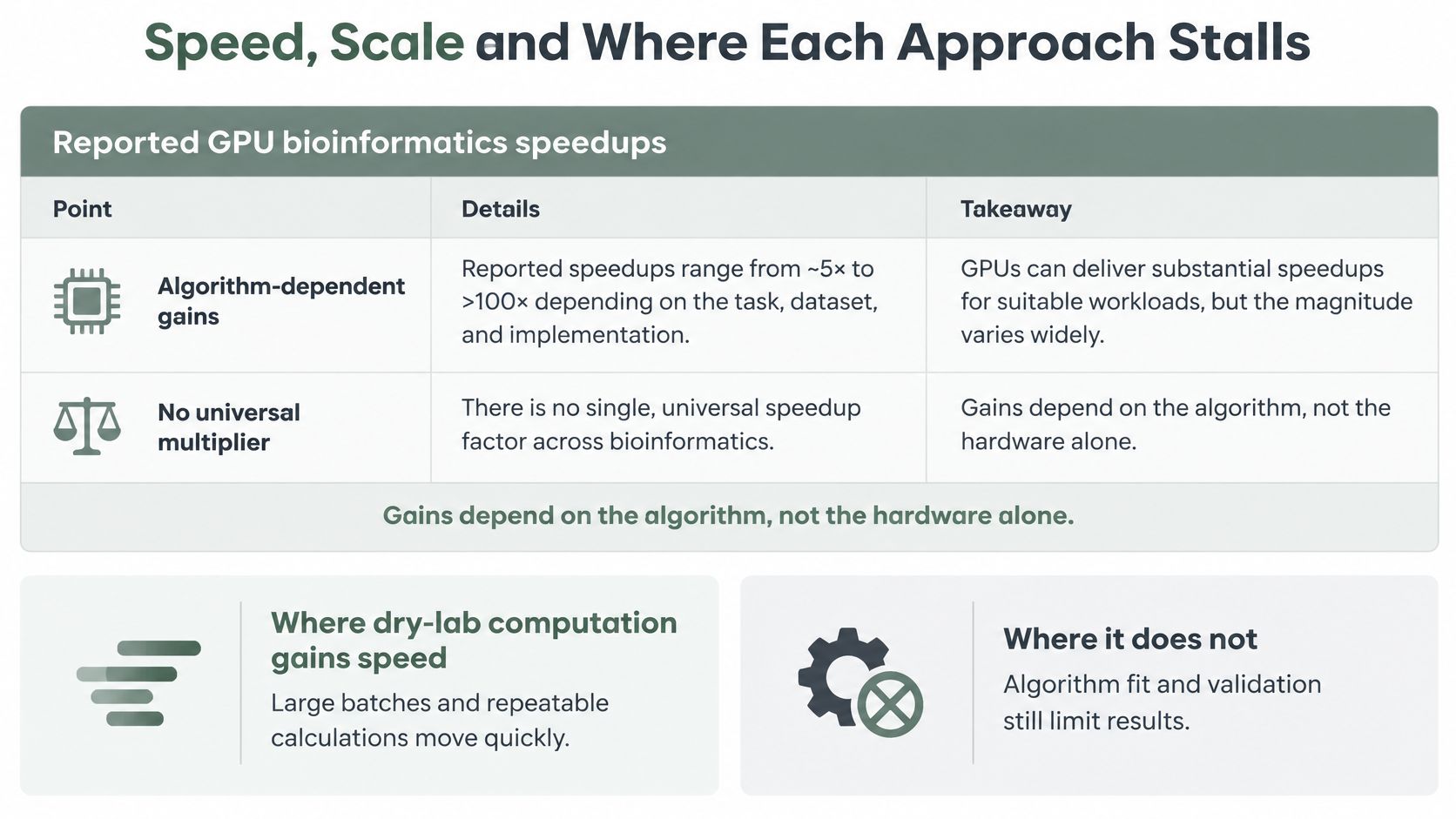
These reported computing speedups come from the GPU bioinformatics benchmark review, and measure computation rather than wet-lab throughput.
The distinction matters when planning a project. A faster calculation doesn't shorten an incubation, generate missing controls, or establish whether a prediction survives experimental testing.
The workload determines whether acceleration is useful.
Parallel calculations aren't the whole workflow
GPU hardware suits workloads that can perform many similar calculations concurrently. Branching logic, serial dependencies, transfers between memory locations, and small problems can reduce the benefit. Comparing a GPU implementation against serial CPU code also answers a different question from comparing it against an optimized multithreaded implementation.
Wet-lab throughput faces different limits. Scientists must accommodate preparation time, material consumption, instrument access, operator variation, and environmental conditions. Running more plates isn't useful if temperature handling or reagent preparation changes between batches without documentation.
The practical sequence is to use computation for parameter sweeps, plate-layout optimization, dose-response fitting, uncertainty analysis, and hypothesis prioritization. Then reserve physical experiments for conditions that distinguish competing explanations, rather than testing every possible combination.
Measure the complete decision cycle
A useful performance log includes more than execution speed:
- Wall time: Include preprocessing, failed jobs, and review, not just the final successful calculation.
- Cost per evaluated condition: Account for computational resources or consumed laboratory materials.
- Memory footprint: Check whether the intended workload fits available hardware.
- Convergence or accuracy: Establish whether the method reaches an acceptable result.
- Independent validation rate: Track whether predictions hold against measurements not used to tune the model.
A parameter sweep that finishes quickly but uses an inappropriate noise model can rank conditions confidently and incorrectly. The relevant outcome is a defensible experimental decision, not a large collection of computed answers.
Faster computation can scale systematic model error. Calibration against measured data and independent experimental checks remain part of the workload, even when they aren't included in a computing benchmark.
Where the Workflows Hand Off and What the Record Must Show
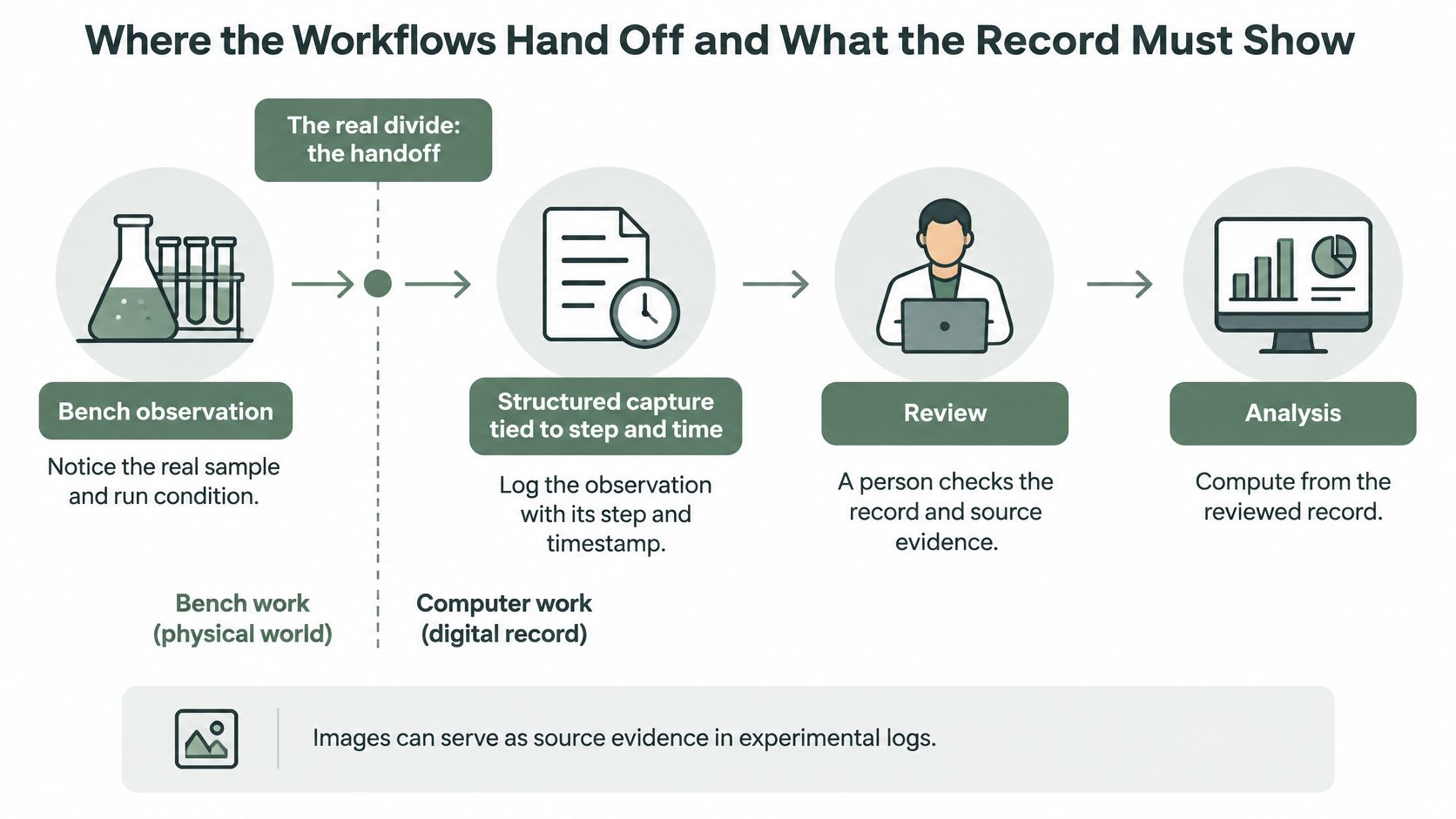
The fragile boundary isn't hands-on work versus computer work. It's the transfer from an observed event to a dataset that someone else can interpret.
A structural-biology and in-vitro biochemistry data-management study identifies detailed tracking, analysis, and auditability as tools for diagnosing irreproducibility, including outcomes affected by temperature variation and reagent-batch differences. A reproducible analysis script can't compensate for experimental context that never entered the record.
The handoff needs an explicit workflow.
Build an experimental context packet
The dataset should travel with a compact, structured record:
- Identity and provenance: Sample identifiers, origin, preparation history, and links to the relevant plate or run.
- Materials: Reagent identity, lot, concentrations, and substitutions.
- Execution conditions: Instrument settings, temperatures, actual timings, and the protocol version.
- Interpretation safeguards: Controls, exclusions, deviations, unexpected observations, and reasons for decisions.
The working sequence is bench observation, capture tied to step and time, human review, then analysis. Interpretation must also return to the bench, where the experimental owner can assess whether an apparent pattern fits what occurred.
Say a scientist prepares a serial dilution across a multiwell plate. An incorrect transfer volume early in the series changes the concentrations of downstream wells, yet the analysis receives only the intended concentrations.
A fitting routine may absorb that discrepancy into its estimated parameters without a useful warning. Similarly, replacing a reagent lot midway through a series can introduce a handling boundary that the analyst mistakes for a biological response. More computing power can't reconstruct an unrecorded transfer error or lot change.
Preserve the observation, not just the polished account
The Lab Manager explanation of ALCOA principles defines ALCOA as attributable, legible, contemporaneous, original, and accurate. ALCOA+ adds complete, consistent, enduring, and available; ALCOA++ adds traceable.
Contemporaneous means recorded when the activity occurs, rather than reconstructed afterward. That distinction matters for a transient color change, unusual pellet appearance, foam, an instrument alarm, elapsed incubation, or a decision to repeat a step. The final instrument file may contain none of them.
Attribution establishes who made the observation. Preserving the original capture allows a reviewer to distinguish what the scientist first recorded from a later correction or interpretation.
Record standard: An organized account should clarify the source observation, not silently replace it.
For applicable electronic records, FDA electronic-record guidance specifies that change history should identify the date and time, the individual, the old and new values, and the reason when applicable. Correcting a concentration should therefore leave a visible distinction between the original entry and the corrected value.
The FDA's data-integrity guidance also emphasizes documentation at the time of performance and second-person review of original laboratory records within its regulated context. A cleaned-up summary alone doesn't demonstrate what changed during execution.
Make replication possible
NIH guidance on rigor and reproducibility emphasizes transparent experimental details that allow others to assess, reproduce, and extend the work. Methods must describe execution sufficiently, not merely name a familiar assay.
A practical scientific data-management workflow should connect raw files, experimental notes, reviewed metadata, and analysis versions. Missing information should remain visibly missing rather than being filled with an assumption.
The protocol describes intended actions. The experimental record describes actual actions and observations. These standards support better documentation, but no checklist or capture tool independently guarantees compliance.
Choosing the Starting Point for Your Research Question
The starting approach should follow the uncertainty that needs resolving. A question about existing evidence calls for different work from a question about whether a predicted effect occurs physically.
Starting approach by research question
| Research question | Start with | Why | Add next |
|---|---|---|---|
| Which of many conditions should be tested first? | Dry-lab sweep or plate-layout optimization | Computational ranking can narrow wet runs | Wet verification of top candidates |
| Does a predicted effect hold in the physical system? | Wet-lab run | Measurement tests the prediction | Dry analysis of measured results |
| What does an existing large dataset show? | Dry-lab analysis | Reanalysis can examine patterns without generating new samples | Experimental check of key findings |
| Why does an assay drift between days? | Wet-lab run with contemporaneous records | Temperature and reagent-lot effects leave traces mainly at the bench | Comparison of records across runs |
| How should a standard curve be fitted and samples back-calculated? | Either, with validated inputs | Fit quality depends on measured standards | Check recovery and fit warnings before use |
| Which new experiment would distinguish competing models? | Dry-lab comparison of predictions | Identifies conditions where predictions disagree | Targeted wet-lab test |
Start assay troubleshooting with execution
Day-to-day drift tempts analysts to add a batch correction immediately. That can be premature if the actual cause is a preparation change, different elapsed incubation, or reagent substitution.
A better starting point is a deliberately documented wet run followed by comparison with previous run records. The analyst can then decide whether a known technical factor belongs in the model, whether affected results require exclusion, or whether another experiment is necessary.
The standard-curve question needs similar care. Fitting and back-calculation are computational tasks, but the standards are physical preparations. A visually smooth curve doesn't establish that the concentrations were prepared correctly or that unknown samples fall within a defensible reporting range.
Recovery and fit warnings should be reviewed before sample concentrations are reported. A successful software run isn't equivalent to a valid analytical result.
Set the decision before committing resources
A useful research decision-making process starts with explicit criteria:
- Decision-changing result: What result would change the experimental or project decision?
- Physical failure modes: What could go wrong during preparation, handling, incubation, or acquisition?
- Required inputs: Which measurements and contextual fields will the analysis need?
- Review ownership: Who checks the experimental record, and when?
When both approaches could help, start where an informative iteration is cheaper, then confirm with the other approach. That isn't automatically the dry lab: a simple bench check may resolve an uncertainty more directly than building an elaborate model.
A model can rank options, but only an experiment can confirm them.
The next planning document should carry forward the question, the required inputs, and the capture points. Those are the details that turn a broad research aim into executable work.
Which Side of the Bench Fits You and How to Build Both Skill Sets
A wet-lab day often revolves around incubation windows and instrument queues. Scientists prepare reagents, run plates, inspect unexpected changes, and document work between time-sensitive steps.
A dry-lab day involves cleaning and joining datasets, checking distributions, fitting models, investigating version mismatches, and asking how samples were handled. Waiting for an answer about a preparation step can block progress as effectively as waiting for an instrument.
Build skills around the work
| Starting background | Skills worth developing | Practical exercise |
|---|---|---|
| Bench scientist | Documentation discipline, scripting for plots and curve fits, statistical interpretation | Analyze a completed assay and connect every exclusion to its source observation |
| Computational researcher | Assay literacy, provenance review, experimental validation | Follow a run at the bench and map handling events to the resulting dataset |
Bench scientists don't need to become software engineers to make data analysis-ready. Consistent identifiers, explicit units, structured observations, and deviations recorded when they occur provide a strong foundation. Enough statistics to interpret a confidence interval or goodness-of-fit warning helps prevent overconfident reporting.
Computational researchers benefit from learning common assay failure modes before choosing a model. Standing beside the experimental owner during a run reveals decisions that an instrument export won't explain.
Make cross-training produce an artifact
Useful routes include:
- A co-supervised project: Assign a bench owner and an analysis owner, with shared responsibility for the handoff.
- A provenance reconstruction: Take an existing dataset and identify which conclusions its surviving records can support.
- A rotation: Work in the other environment long enough to complete and explain a bounded task.
Lab managers should set a common record standard and pair each analyst with the bench owner of the data. In JLL's 2026 life-sciences facilities-management report, 54% of global life-sciences facilities-management leaders considered scarcity of candidates with required technical skills or licenses a top talent challenge, while 85% ranked succession planning and knowledge transfer as their top workforce priority.
Those findings concern facilities-management leaders, not every scientific hiring market. For research teams, a concrete hiring question remains useful: Can the candidate walk through a deviation and show where it lives in the record?
Where AI Helps and Where a Person Must Verify
AI doesn't remove the need for either experimental observation or computational judgment. A 2024 researcher interview describes the value of combining intuitive experimental observation with precise analysis, while noting the difficulty of integrating large models into established research workflows.
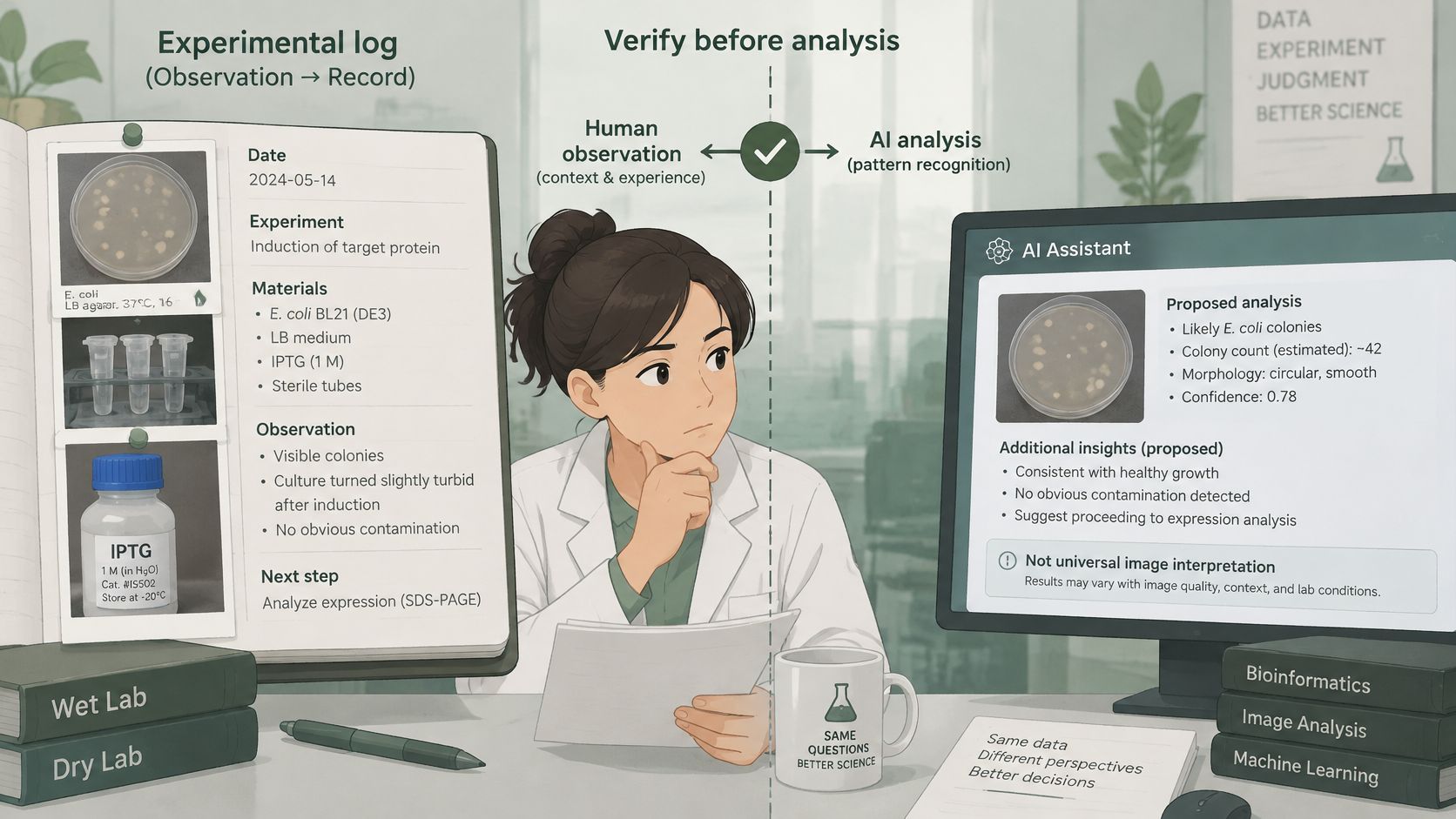
The verification boundary remains with the scientist.
Separate assistance from confirmation
| AI can support | A person must verify |
|---|---|
| Proposing experimental designs | Whether the design fits the assay and available controls |
| Detecting patterns | Whether handling artifacts offer a competing explanation |
| Summarizing prior experiments | Whether the summary preserves consequential deviations |
| Supporting calculations | Whether inputs, units, and assumptions match the experiment |
An AI summary can omit a deviation that wasn't present in its inputs. A calculation can be mathematically correct for the wrong stock concentration. Neither output establishes whether a sample was mislabeled, pipetting was interrupted, or a control failed during the run.
A defensible biology AI workflow therefore requires source checking before an output influences a scientific decision. Every consequential statement should trace to an observation or reviewed input, and the experimental owner should check its interpretation.
The distinction between assistance and experimental verification also applies when reviewing demonstrations of laboratory AI.
Keep the scientist in control
Verbex, made by Multimod Labs, keeps bench captures for human review rather than independently deciding their scientific meaning. The scientist selects Objective, Materials, Procedure, Observations, Conclusion, or a custom section before capturing information.
Voice and typed notes preserve source context and timestamps; timers support time-sensitive documentation, and images can serve as source evidence. Supported, sufficiently legible material-label images can be processed on-device into Materials entries, but that isn't universal scientific image interpretation.
Review & Complete creates a source-backed Organized draft. Supported devices may also produce an ELN-style draft when local Apple Intelligence processing succeeds; the scientist still reviews and edits the result before completion.
Verification boundary: Tools can't know whether input values are right for a particular experiment, so every number must be checked before anyone acts on it.
Experimental literacy, data literacy, and the ability to audit AI output are complementary skills. None provides permission to skip the others.
Confirm Your Record Before You Run the Next Experiment
Before the next run, the experimental owner and analyst should agree on a short pre-run record. The point isn't to document every movement, but to preserve the details needed to distinguish biological findings from execution problems.
- Name the question and approach. State whether the immediate need is measurement, analysis, prediction, or a combination.
- List analysis inputs. Specify required data fields, units, controls, and file formats before acquisition.
- Set capture points. Include actual timing, temperature, reagent lots, and deviations at relevant steps.
- Assign review. Identify who checks the record and when that review happens.
- Define corrections. Preserve original and changed values with attribution and the reason where applicable.
- Retain source observations. Keep the original note or image alongside the organized account.
These steps work with paper, spreadsheets, or a laboratory documentation tool. A short note recorded during execution is more useful than a detailed reconstruction that fills gaps.
Carry the record into the existing workflow
Verbex for iPhone and iPad, free to download, captures voice notes, typed notes, timers, and images, organizes them for human review, and exports completed records as PDF, DOCX, or Markdown. It's an ELN companion, not a replacement for an official ELN or validated system, and export doesn't imply automatic synchronization.
Processing occurs on the iPhone, with no account, cloud AI, cloud storage, advertising, analytics, or tracking. The app doesn't interpret scientific results, manage inventory or samples, provide regulatory sign-off, or guarantee reproducibility.
The practical rule is unchanged: choose the approach from the question, and keep the bench record complete enough for another scientist to reconstruct what happened.
For the next plate, dilution series, or assay run, set the capture points before preparing reagents. Verbal Experiment or Verbex offers a private, on-device way to preserve bench observations and prepare a source-backed record for review and export into an existing documentation workflow. Capture what changed, then leave with a record.