 Blog
What Is Electronic Batch Record and How It Works
An electronic batch record is the digital, time-stamped manufacturing history of one specific batch, from the approved recipe through to release. It belongs to that lot alone, it's built as the batch runs rather than reconstructed afterward, and in the United States no rule forces a manufacturer to keep it electronically at all.
So why does the term cause so much confusion? Because the visible part of a batch record is a document, and documents are easy to digitize. The part that makes an electronic batch record genuinely electronic sits underneath that surface: enforced step order, required fields, linked signatures, a reviewable audit trail, and a validated system standing behind all of it. The commercial pull is real. The global electronic batch records market was valued at USD 858.4 million in 2024, according to Growth Market Reports.
What follows is written for people who record experiments for a living and want to know where this particular record sits next to their own notebook, and where it doesn't.
Table of Contents
- What an Electronic Batch Record Is in Plain Terms
- How a Master Record Becomes a Batch Record
- The Key Components of an Electronic Batch Record
- A Batch From Start to Finish in an EBR
- Paper, Electronic and PDF Records Compared
- Where an Electronic Batch Record Ends and an ELN Begins
- Choose the Right Record Before Your Next Run
What an Electronic Batch Record Is in Plain Terms
Follow a single lot from the moment the approved recipe is issued to the moment quality signs the release, and everything that happened in between belongs in one record. When a colleague asks what is electronic batch record, the shortest useful answer is a record of one lot: what went in, what was done, what came out, and who checked the parts that mattered.
Think of the flight log kept for one trip. It doesn't describe aircraft in general. It describes that aircraft on that day, the route flown, the fuel loaded, the conditions met, the crew who performed and checked each stage, and any incident along the way. An electronic batch record works the same way for a manufacturing lot. Two batches of the same product each get their own record, because two batches are two events.
The record answers three questions, and a reviewer should never have to hunt for any of them:
- What was made. The product, the lot number, the batch size, the yield achieved.
- How it was made. The steps executed, the equipment used, the values recorded at each step.
- Who checked it. The named people who performed and verified each significant step, with the time they did it.
Most of the EBR conversation belongs to regulated manufacturing, particularly pharmaceuticals, where the record supports a release decision. Bench research usually runs on an electronic lab notebook instead, and that's the right tool for experiments that produce knowledge rather than lots. The two records touch during technology transfer.
Where an organization builds the wider system around such records, the surrounding questions of document control, change control and audit preparation matter as much as the record itself, and frameworks for audit-ready quality systems for digital health cover that ground.
A useful test: if you can't point to a lot number on the front of the document, you're probably looking at a template or a procedure, not a batch record.
By the end of this piece, a reader should be able to tell an electronic batch record apart from a PDF of a form, and know which of the two their own work needs.
How a Master Record Becomes a Batch Record
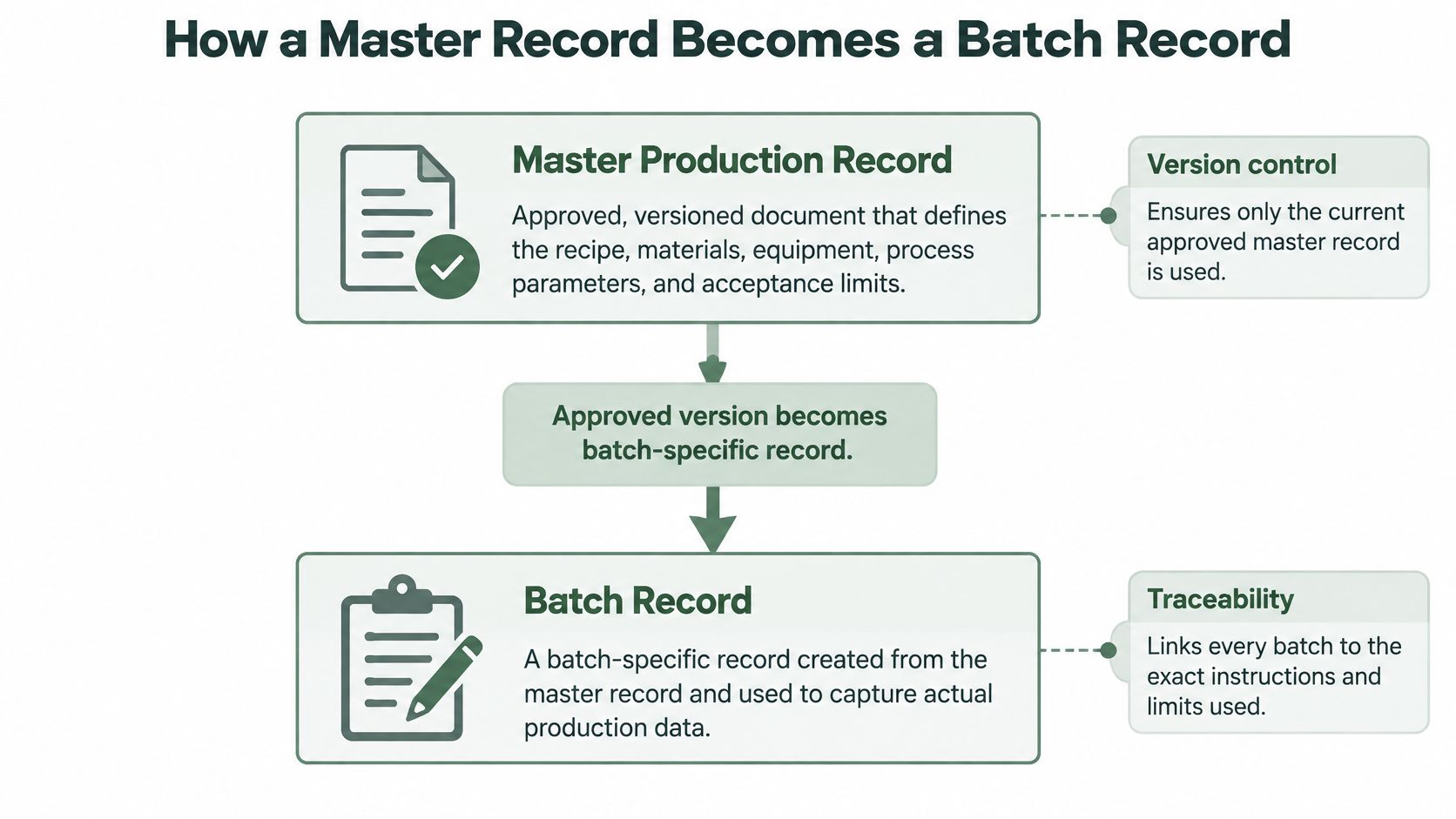
Every batch record comes from somewhere, and the somewhere is the master. The relationship is one to many: one approved master produces a record for every lot made under it, which is why the version matters so much.
The master production record sets the rules
The master production record is the approved, versioned document that states the recipe, the materials, the equipment, the process parameters and the acceptance limits for a product. It's authored once, reviewed, and re-approved whenever something changes. U.S. current good manufacturing practice rules make the two-person check explicit: the master production and control record must be dated and signed by one person, then independently checked, dated and signed by a second person, as 21 CFR 211.186 sets out.
The batch record captures one lot
The batch record is the executed instance. Under 21 CFR 211.188, a record must be prepared for every drug-product batch and contain complete production and control information. The regulation lists what that includes: the applicable master record, dates, equipment and production lines, the identity of each component lot, weights and measures, laboratory and in-process results, packaging inspections, actual yield and percentage of theoretical yield, labeling records, sampling, responsible personnel, and any investigations. In an electronic system, those items become required fields, workflow steps, signatures and an audit trail rather than handwriting on a form.
A worked example with one lot
Say a manufacturer runs a 500 kg lot of a granulated powder under master record version 3, which sets a mixing time of 20 minutes. The executed record shows 22 minutes. Nobody has to spot the discrepancy by eye, because the entry falls outside the approved instruction and is flagged as a deviation needing a documented reason and an approval before release. The same record carries actual yield and the percentage of theoretical yield, which is how a reviewer sees at a glance whether the lot landed where the master said it would.
The numbers there are illustrative. The mechanics aren't.
None of it works if the master is poorly written or edited, which is why standard operating procedures matter upstream of both layers. A version-controlled master that nobody follows produces a batch record full of deviations. A master that's followed but not controlled produces a record nobody can defend.
Before reading any batch, a reviewer should be able to name two things: the master record version the batch was run under, and the lot the record documents. If either is missing, there's nothing to compare the actuals against.
The Key Components of an Electronic Batch Record
The record has to hold the whole batch in one traceable place. The FDA data-integrity guidance is direct about what counts as evidence: timestamps, user identity, audit history, units, revisions and original values are part of the record, not optional interface details. It also notes that an electronic copy is acceptable as a true copy only when it preserves the original record's content and meaning, including its metadata.
| Component | What It Captures | Why It Matters |
|---|---|---|
| Master production record | Approved recipe, steps and acceptance limits | Sets the rules each batch is checked against |
| Material identities | Component and in-process lot numbers | Supports tracing each lot back to its materials |
| Equipment and process parameters | Equipment IDs, status and operating conditions | Shows the conditions each step ran under |
| Operator entries and signatures | Who performed and who checked each significant step | Ties each action to a named person |
| In-process and lab results | Test results with units and limits | Supports the batch release decision |
| Deviations and approvals | Out-of-limit events, reasons and approvals | Makes exceptions visible before release |
| Audit trail | Time-stamped entries, changes and deletions with reasons | Lets reviewers reconstruct what changed and when |
| Yield and release evidence | Actual versus theoretical yield, labeling and release sign-off | Closes the record for final review |
The component most people miss
An audit trail is a time-stamped log of every entry, change and deletion. For each change it should show the earlier value, the user, the time, and (where the change is GMP-relevant) the reason. The failure it prevents is subtle. Without it, a corrected number looks exactly like a number that was always there, and a reviewer can't tell an honest fix at 09:14 from a quiet edit three weeks later.
Why the system matters as much as the form
An electronic batch record is usually executed inside a validated computerized system that can block a step performed out of order, refuse to advance without a required field, and flag a value outside range at the moment it's typed. That's the difference between a form and a system. Corrections happen at the point of work, before the batch moves on, rather than in a review weeks later.
The material genealogy that falls out of this is a lineage problem in its own right, and Kagool on enterprise data lineage explains the general idea of tracing a value back through every system that touched it. Teams writing these components into their own document set usually start with GMP documentation requirements before they start shopping for software.
A reviewer opening any electronic batch record should be able to answer four things without leaving the record:
- Who did each step, by name, with the timestamp attached
- Which material lots went in, including in-process materials
- What changed since the entry was first made, and who changed it
- Why it changed, with the documented reason and the approval
A Batch From Start to Finish in an EBR
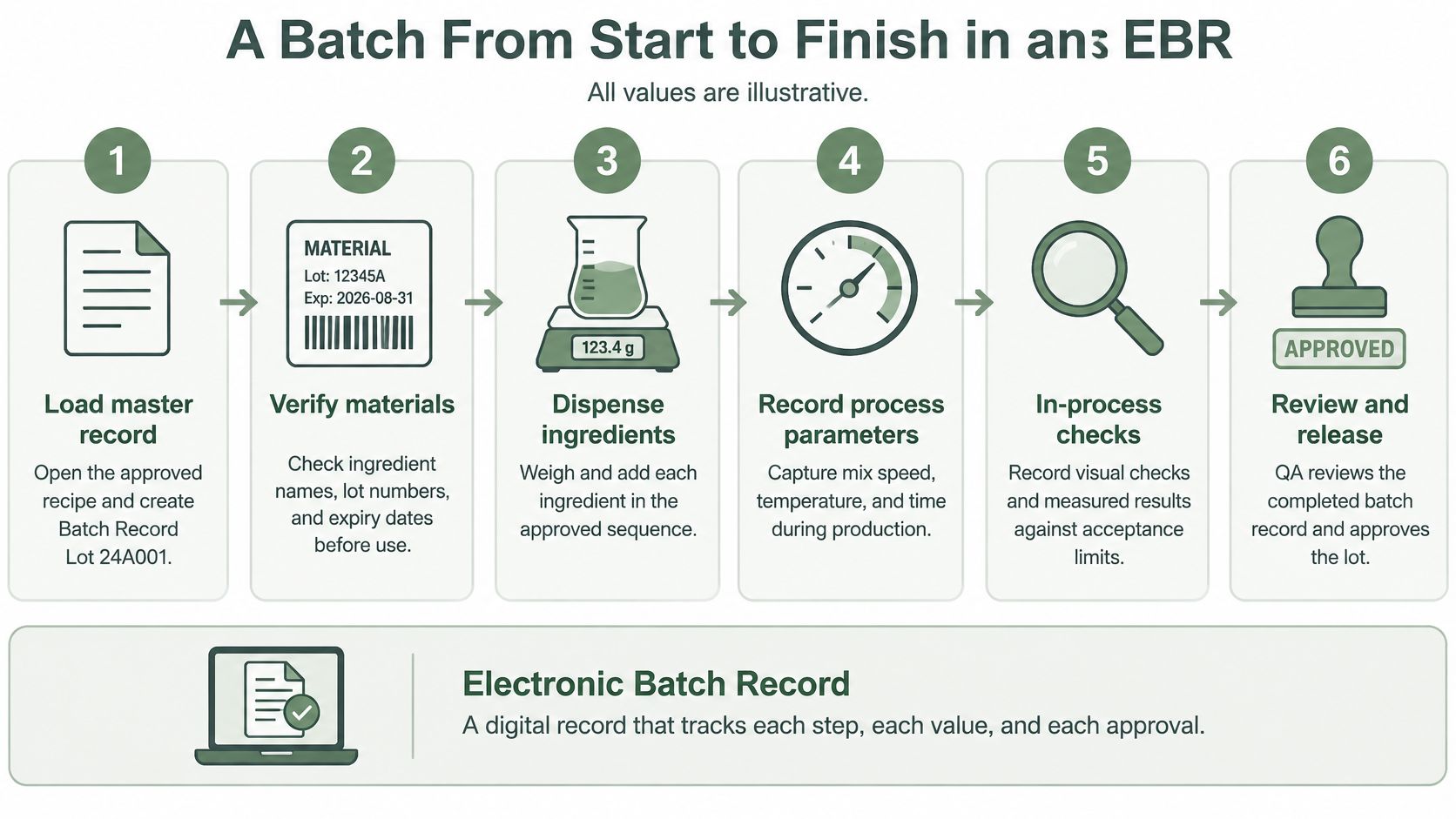
Watch one liquid formulation batch move through an electronic batch record and the shape of the thing becomes obvious. The steps below follow an illustrative batch, and every value in them is invented for the example.
Seven steps, one lot
- Load the master and create the record. The approved master record is instantiated as a batch record with its own lot number, tying the batch to the exact version in force that day.
- Confirm each material lot. Every raw material is checked against the record by name and lot number before use, so a wrong lot can't be entered.
- Execute the steps. Each step takes its entries, timestamps and signatures while the system checks required fields and ranges as the operator works.
- Record the in-process result. Say the specification for pH is 7.0 to 7.4 and the measured value comes back at 7.8. The system raises a deviation, which needs a documented reason and an approval before the batch advances.
- Review by exception. The reviewer works through flagged events, late entries, overridden steps and changed critical data instead of re-reading every routine entry.
- Complete the final checks. Yield and labeling are confirmed against the record.
- Release. An authorized person makes the release decision on the completed record.
Seeing the sequence run inside a real system makes the handoffs clearer than any description of them.
The limit on review by exception
Review by exception is the step that most needs scrutiny, because it's defensible only when the validated system captures the events that need human eyes: out-of-limit results, skipped or overridden steps, late entries, manual interventions, deviations, and changes to critical data. If detection has gaps, a shorter review hides problems rather than improving quality.
The regulatory picture is still moving. The European Commission opened consultation in 2025 on a draft revision of GMP Annex 11 that proposed stronger expectations for lifecycle management, supplier oversight, security, data integrity and searchable electronic copies that include audit trails, and the proposal was not final at the time of that coverage, as this review of the EBR regulatory landscape sets out. Digitization can raise compliance risk when it automates a weak process.
Four questions are worth asking of any system before trusting a shortened review:
- Which exceptions are detected, and are they listed explicitly?
- Can that detection be proven during validation, not just asserted in a brochure?
- Are audit-trail changes reviewed before release, or only the process data?
- How are disconnected instruments, transcription workarounds and temporary manual entries handled when an integration fails?
Data also leaves the record constantly, in reports, summaries and exported tables. Template-driven report automation workflows are worth understanding for exactly this reason: the moment a number is regenerated outside the controlled system, it becomes a copy that has to be traceable back to its source.
The question to carry into the next batch is simple. Which events in your own process would trigger a flag, and who reviews them?
Paper, Electronic and PDF Records Compared
Paper still works, legally. U.S. rules require a complete production and control record for each batch and don't mandate an electronic system, so for plenty of manufacturers an electronic batch record is a choice rather than an obligation. What changes with that choice is the set of controls behind the screen.
| Feature | Paper Batch Record | Electronic Batch Record |
|---|---|---|
| Data entry | Handwritten at the bench, often copied later | Entered or confirmed at the point of work |
| Step sequencing | Relies on the operator reading the instructions | Can enforce order and required fields |
| Signatures | Handwritten signatures and initials | Electronic signatures linked to the record when validated |
| Changes | Corrections made by line-through and initials | Audit trail keeps prior value, user, time and reason |
| Review | Manual page-by-page review | Can route review and flag exceptions, depending on configuration |
| Retrieval | Physical storage and manual search | Retrievable by computer when controls allow |
| Validation | Procedural controls | Computerized system must be validated under applicable rules |
The line Part 11 draws
Under 21 CFR Part 11, an electronic record used for a regulated activity can be treated as trustworthy, reliable and generally equivalent to paper when it meets the rule's requirements. Part 11 covers records created, modified, maintained, archived, retrieved or transmitted under FDA recordkeeping requirements, including records kept electronically instead of on paper. For closed systems, the controls have to protect the record and prevent a signer from readily repudiating a signature as not genuine. Converting a paper form into a digital document isn't sufficient on its own.
Three things that aren't an electronic batch record
A scanned paper form sent by email. The rule distinguishes electronic records from paper records merely transmitted electronically. Scanning and emailing doesn't turn the underlying paper record into a Part 11 record.
A spreadsheet of results. It's a data file with no enforced sequence, no attribution logic and no governed change history. It can hold values. It can't tell a reviewer what happened to them.
A PDF exported from a validated system. It's a copy. Without the underlying audit trail, nobody can see how the record changed. The boundary between an electronic document, an electronic logbook, an electronic batch record and a manufacturing execution system is worth drawing deliberately, and this analysis of how Annex 11 reshapes manufacturing IT explains why the distinctions matter to buyers.
What Annex 11 expects of an audit trail
European expectations are stated plainly in EU GMP Annex 11. It describes an audit trail as a secure, computer-generated, time-stamped electronic record that allows reconstruction of actions affecting data. The functionality should be enabled and locked at all times, risk-based controls should capture GMP-relevant changes and deletions, and the reason for a change should be documented. Audit trails must be available, convertible to a generally intelligible form, and regularly reviewed. Electronic signatures are permitted, but they're expected to have the same impact as a handwritten signature, stay permanently linked to the record, and include the time and date applied.
The test that settles most arguments: if an inspector asks who changed a value, when, and why, can the record answer without anyone reconstructing it from memory?
Automation doesn't fix a weak process, it scales one. Digitizing a batch record that nobody reviewed properly gives you a faster, cleaner-looking version of the same gap.
Where an Electronic Batch Record Ends and an ELN Begins
The two records look similar on a screen, which is why they get conflated. They answer different questions, and three contrasts settle most of the confusion.
The owner
An electronic lab notebook belongs to the research team. The batch record belongs to quality and manufacturing, because it supports a release decision that carries regulatory weight. Ownership decides who can change the structure of the record and who signs it off.
The unit of record
The notebook records an experiment or a project, with the reasoning and dead ends that make the work interpretable later. The batch record records exactly one lot, and it stops at release.
The control expectation
A notebook can stay flexible, because research changes direction. A batch record enforces steps and approvals, because a process that varies from lot to lot is a process nobody can release against.
A workable rule: if the record answers what did we do in this experiment, it's notebook territory. If it answers what did we do to this lot and who approved it, it's batch record territory.
The boundary blurs during pilot work and technology transfer, when a bench experiment becomes the basis for a manufacturing recipe. The bench notes then become source material for the master record, and they're only worth something if they were captured as the work happened. For a fuller working definition of the notebook side, see what an ELN is.
Bench scientists hold the first-hand evidence: the timer that ran long, the label that was hard to read, the reagent that came out of the fridge warmer than expected. Captured at the time, that evidence supports better contemporaneous documentation for the notebook and any later audit preparation. Captured from memory a week later, it's a story.
Neither record replaces the other. A batch record with no development history behind it documents a process nobody can explain.
Choose the Right Record Before Your Next Run
Route by setting first, because the answer changes completely depending on where you work.
In GMP manufacturing or any role that supports a regulated release decision, the electronic batch record belongs in a validated system with change control, access control and an audit trail, owned by quality and IT rather than by whoever happens to hold the tablet. A general note-taking app isn't that system, however well it captures text.
At the bench in research, the requirement is different and easier to satisfy: write what happened while it's happening, keep the protocol separate from the steps taken, and store records that someone else can read later without you in the room.
Three things worth doing this week:
- Confirm what your setting requires. Ask quality, your PI or the person who owns the validated systems before assuming the answer, because the obligation follows the release decision, not the job title.
- Compare your current template against the components table. Master reference, material lots, equipment, who did what, results, deviations, audit history, yield. The gaps tell you what your record can't answer.
- Log one deviation on the day it happens. Then read it back in two weeks and see whether it explains itself. If it needs you standing there to interpret it, the record isn't finished.
These steps are a starting point, not scientific, safety or regulatory advice, and every procedure needs local review before anyone relies on it.
For the bench end of that work, Verbex for iPhone and iPad, free to download, is an ELN companion that records notes by voice, typing, timers and images, keeps them timestamped on the device, and organizes them into a record the scientist reviews, edits and completes. It isn't an electronic batch record, isn't a validated system, and doesn't replace your official notebook. It sits between the protocol and the notebook, capturing what happened while it's still fresh.
Verbex exists for the gap that opens the moment a protocol meets a real bench: the timer that ran long, the lot number that wouldn't scan, the observation nobody wrote down because their gloves were wet. Voice notes, typed notes, timers and photos stay timestamped and on the device, and they come together into a source-backed draft you review before it goes anywhere. If that's the part of your documentation that keeps slipping, visit Verbal Experiment or Verbex and capture your next run as it happens.