 Blog
Clinical Research Best Practices: 8 That Matter
It's 4:40 p.m., an assay's running, a timer's sounding, both hands are occupied, and the most important observation of the day happens mid task. The color changes early. A sample waits longer than planned. A reagent looks off. By the time gloves come off, the exact minute, sequence, and reason for the decision are already getting fuzzy.
That's where good records fail. Not in a policy meeting. At the bench.
These Clinical Research Best Practices treat documentation as a set of bench habits, ordered around the life of an experiment. The list moves from recording in the moment, through deviation logging, traceability, audit trails, and templates, to materials, bias control, and privacy. Each practice pairs the regulatory expectation with the friction of doing it while work's moving, and with a fallback for when the ideal isn't feasible in that second.
Registration and reporting sit around all of it. The World Health Organization's International Clinical Trials Registry Platform data records 208,615 registrations in the United States through June 2026, 197,835 in China, and 118,722 in India. The same source notes that researchers should register a study before or at the start of participant enrollment and define primary and secondary outcomes in advance. In the United States, applicable clinical trials generally must be registered within 21 days after the first human participant is enrolled under 42 CFR Part 11.
By Multimod Labs
Table of Contents
- 1. Contemporaneous Documentation Under ALCOA+ Principles
- 2. Protocol Adherence and Structured Deviation Logging
- 3. Source-to-Record Traceability
- 4. Audit Trails and Version Control
- 5. Structured Templates Aligned With Reporting Standards
- 6. Reagent and Materials Traceability
- 7. Blinding, Randomization, and Allocation Records
- 8. Privacy, Data Minimization, and Confidentiality
- The 8 Clinical Research Best Practices at a Glance
- Turning the Checklist Into Daily Habit
1. Contemporaneous Documentation Under ALCOA+ Principles
Contemporaneous documentation means the note gets made when the event happens, not reconstructed from memory later. The trade-off is obvious. Stopping to write can interrupt a time sensitive step, but waiting trades a small interruption now for a wrong time, missing lot, or invented sequence later.
The FDA Good Documentation Practices guidance defines raw data expectations through ALCOA, meaning attributable, legible, contemporaneous, original, and accurate. The guidance directs users to sign and date records with the date or time data are collected or entered, and to make entries as the task is performed or observed. ALCOA+ adds complete, consistent, enduring, and available. A late entry isn't forbidden, but the guidance says it should be justified and supported by other documentation.
A practical capture doesn't need polished prose. Consider a reagent addition where the scientist dictates the exact time, lot number, and a faster than expected color change before moving to the next step. A timer linked note can preserve incubation start and stop times while hands stay on the work.
What to Capture Before Moving On
- The unexpected detail: Record the color change at minute 12, the pipette left at room temperature, or the brief equipment alarm.
- The source: Keep the first capture in the data capture form or electronic system where possible, and reference original raw data if it's transcribed later.
- The correction: Amend errors with a dated, attributed entry. Don't erase the original.
- The context: Small laboratories adapting formal systems can review GMP documentation for small research laboratories for proportionate controls.
A scientist dictating an observation during bench work shows the point: capture belongs at the bench, not after it.

2. Protocol Adherence and Structured Deviation Logging
The protocol calls for a 3,000 rpm spin, but the available rotor supports only 4,000 rpm. Record the actual setting, why the planned step changed, which samples were affected, and whether downstream steps changed. If a sample waits an extra 20 minutes before freezing, document the interval, sample ID, and decision to proceed or repeat.
The ICH Good Clinical Practice guideline_Step4_FinalConsolidatedGuideline_2026_0616_.pdf) requires investigators to document all protocol deviations and review them. For important deviations, they should explain what happened and, where applicable, take steps to prevent recurrence. Intentional deviations are limited to situations necessary to eliminate an immediate hazard to trial participants. In those cases, the investigator must report the hazard, the change made, and any proposed amendment to the ethics committee and, where applicable, regulatory authorities.
A Short Format That Works Under Pressure
- What changed: State the planned step and what happened.
- When and why: Record the time, cause, and person who made the decision.
- Impact and decision: Flag effects on an endpoint, sample handling, or dosing for principal investigator review.
A protocol deviation log template can make entries easier to find. Keep each entry beside the procedure and captures it explains. When there is no time to complete the log mid-experiment, record the facts promptly and finish the entry as soon as practical.
Bench rule: A documented deviation can be assessed. An undocumented one leaves reviewers guessing whether a result reflects biology or a change in handling.
3. Source-to-Record Traceability
A final value that can't be traced to its source asks reviewers to trust it. Source-to-record traceability means every reported value, image, and interpretation links back to a raw instrument file, source note, photograph, or timestamped observation. The work isn't glamorous. It is what lets someone else check the record rather than admire its formatting.
Risk based oversight makes that checking more focused. A four year analysis across seven contract research organizations covered 4,958 clinical trials and found adoption of risk based quality management elements was approximately 50% among new studies initiated in 2022. Among new studies using centralized monitoring, 65% also reduced source data review and source data verification. The lesson isn't to check less blindly. Critical data and processes should receive proportionately greater review, with predefined risk indicators, escalation thresholds, and documented corrective actions.
For a plate reader run, the summary table should name the raw export file and run date for each absorbance value. A gel photo belongs beside the observation, with lane layout and exposure time noted. Those links let a reviewer distinguish a direct observation from a calculation or transcription, which matters when numbers don't agree.
Build the Chain While Working
- One identifier scheme: Use consistent experiment, sample, and file IDs across notes, instruments, and exports.
- Source beside summary: Store raw files with the notes describing them, not in separate personal folders.
- Entry type: Label direct observations, calculated values, and transcriptions clearly.
- Review discipline: Apply the principles in documentation traceability guidance, and use similar checks to turn analysis certificates into compliance records.
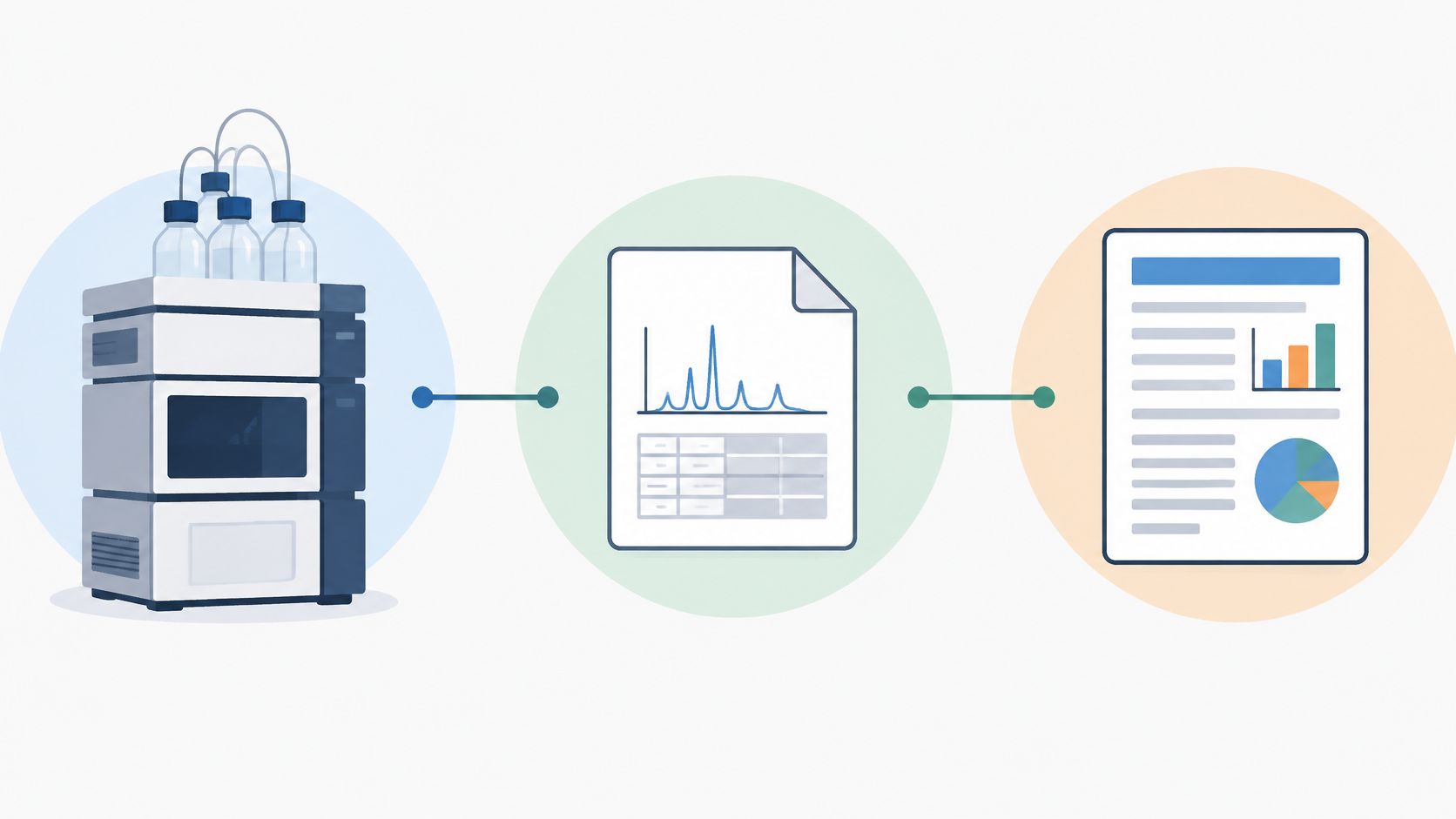
The workflow from sample handling through processing and reporting only holds together when each handoff leaves a trace.
4. Audit Trails and Version Control
A clean final record can still be a weak record. If nobody can tell who changed an observation, when it changed, or what the original entry said, the history has been lost. Audit trails preserve that history, while version control identifies the protocol, template, or method version used on a particular day.
The FDA guidance on electronic audit trails states that audit trails must support reconstruction of significant details about clinical investigation conduct and source data collection. A compliant trail electronically records creation, modification, and deletion with a timestamp, identifies the person making each change, and includes the reason for the change. It also should be protected from modification and from being disabled.
The FDA computerized systems guidance for clinical trials ties electronic record changes to 21 CFR 11.10(e) and says secure, computer generated, time stamped audit trails must independently record the date and time of operator actions that create, modify, or delete electronic records. Audit trails must be retained for at least as long as the related electronic records and remain available for agency review and copying.
Say a protocol moves from version 2.1 to 2.2 after a reagent change. Each experiment record should cite the version in effect when the run started. An edited observation should show the original wording, corrected wording, time, author, and reason.
Controls Worth Checking Before Reliance
- Protocol version: Put it at the top of every experimental record.
- No silent overwrite: Preserve originals and amend with attribution.
- System claim: Confirm that an ELN or LIMS provides a true audit trail before relying on it for regulated work, using audit trail requirements guidance.
- Template history: Keep a short change log so the current shared version is unambiguous.
Reviewing record history during a study timeline is easier when changes were preserved rather than cleaned away.

5. Structured Templates Aligned With Reporting Standards
A blank notebook page gives freedom. It also guarantees that each scientist will forget a different field. A structured template defines the minimum sections before work begins, so objectives, materials, procedure, observations, and conclusions don't depend on whoever happened to write the record that day.
The gap between following guidance and executing it consistently is real. A national survey of clinical studies found 67% reported following national or international monitoring guidelines, but 46.4% did not use data management software. Training was provided to only 43.9% of data entry staff and 37.5% of data monitoring staff. A written data quality plan should therefore define source documentation, edit checks, query handling, deviation classification, audit trails, and role specific training before enrollment or bench work begins.
A cell culture template might require passage number, seeding density, medium lot, and incubator ID for every run. A chemistry template can separate reaction setup, workup, and yield calculation. Both need a free text observations field, because unexpected findings rarely fit fixed boxes and shouldn't be squeezed out by excessive structure.
Keep Templates Useful, Not Decorative
- Five to seven core sections: Add fields only when a real review need appears.
- Reporting references: Use SPIRIT for protocol completeness and CONSORT for trial reporting as references, even when a bench study isn't a formal trial.
- Revision discipline: Review templates after each protocol revision rather than letting obsolete fields accumulate.
- Training evidence: Measure completion separately for data entry and monitoring roles, with periodic competency checks.
A template earns its space only when it prevents a missing detail or speeds review. Fields nobody uses become noise scientists learn to skip.
6. Reagent and Materials Traceability
Weak signal appears on Friday. The result could reflect the sample, the assay, or the antibody lot that arrived on Monday. Without materials traceability, the team repeats the work and argues from memory. With lot, expiry, storage, and equipment details recorded at use, investigation becomes a check rather than a debate.
Lot-to-lot variation deserves particular attention with antibodies, cell culture media, enzymes, and reference standards. Catalog numbers alone aren't enough when the same product differs by lot. Record the lot when a container is opened, not when it is empty, and keep the materials entry inside the experimental record so it gets reviewed with the result.
Consider a western blot with weak signal after a new primary antibody lot entered use that week. The lot entry gives the team a concrete variable to test. A buffer record should include measured pH, preparer, preparation date, and expiry, so a later discrepancy can be traced to the batch rather than assigned vaguely to technique.
Capture Labels Without Creating Transcription Errors
- Photograph the label: Use the image as source evidence when transcription is awkward, then confirm transcribed values against it.
- Record excursions: Note broken cold chain, extra bench time, or a container left uncapped, even when the event seems minor.
- Use complete identifiers: Include supplier, catalog number, lot number, expiry, and concentration or grade where relevant.
- Handle special materials deliberately: Even common sterile supplies such as bacteriostatic water need identity and handling records when they enter a procedure.
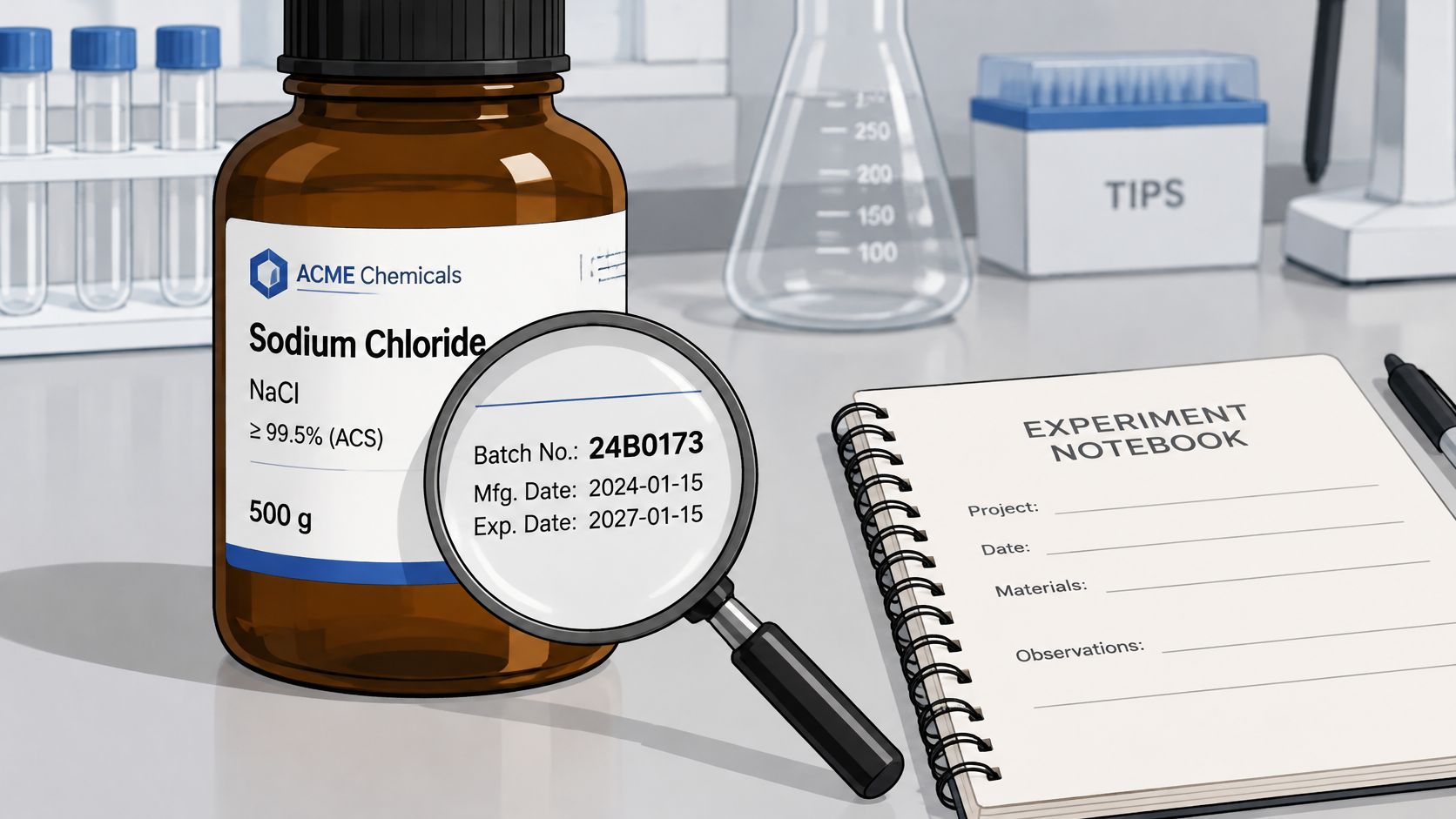
The magnified label beside a notebook captures the friction well. Reading small print while gloved is inconvenient, but guessing a lot number later is worse.
7. Blinding, Randomization, and Allocation Records
A scorer who knows which slide came from the treated group may interpret a borderline image differently. A researcher choosing the healthiest-looking wells for one condition can also undermine comparability. Randomization limits investigator influence on assignment. Blinding limits knowledge that could shape measurement, analysis, or interpretation.
Diversity belongs in the design because bias also affects who enrolls and whose outcomes are reported. An FDA reporting document indicates that White participants made up more than 50% of enrollment in a majority of drug programs. A 2025 analysis of phase III solid tumor trials examined 181 trials and found that race was reported in 86.7% and ethnicity in 60.2%. Reporting alone does not create representativeness, but without it, readers cannot assess whether findings may apply across groups.
Decentralized trials bring a different set of trade-offs. A 2025 evidence summary on decentralized clinical trials reported a summary odds ratio of 1.01 (95% CI, 0.93 to 1.09) compared with traditional trials, with attrition of 9% versus 14%. Remote methods can reduce participant burden. Unreliable internet, limited digital confidence, device access gaps, privacy risks, and unclear responsibilities between investigators and vendors can still exclude participants or increase missing data.
Record the Bias Controls by Step
- Generation: Record the randomization method before the experiment or enrollment begins. If the planned method cannot be used, document what changed and why.
- Concealment: Keep allocation keys separate from observation records. If separation is impractical, restrict access and record who can view the key.
- Blinding status: Specify who was blinded during conduct, scoring, and analysis. If a role could not be blinded, state that plainly.
- Unblinding: Record accidental disclosure, the records it may have affected, and the decision taken.
- Recruitment versus retention: Track enrollment targets and missingness by relevant demographic and access variables. Plan for translation, devices, transport, community partnerships, and technical support where feasible.
A short, specific allocation record is more useful than a general statement that a study was blinded. The following video reviews how design choices shape interpretation before data collection hardens into evidence.
8. Privacy, Data Minimization, and Confidentiality
Research notes collect more than results. A voice note can include a participant name spoken in passing. A photo can show a hospital wristband, computer screen, shipment label, or unpublished compound structure. Data minimization starts at capture: record what's scientifically needed, use coded identifiers, and don't let convenience turn a bench note into an unnecessary copy of personal data.
The FDA page on Good Clinical Practice and human subject protection regulations identifies informed consent requirements in 21 CFR Part 50 and institutional review board requirements in 21 CFR Part 56. FDA rules require consent documentation to be signed and dated when consent is obtained. Investigators must maintain adequate and accurate case histories, including signed consent forms, medical records, progress notes, hospital charts, nurses' notes, and case report forms.
That framework becomes practical in small choices. A coordinator uses a study ID rather than a participant name in visit notes, photos, file names, and dictation. A discovery lab stores unpublished structures locally and exports only the summary needed by the official ELN. The record remains useful without spreading identifiers into tools that never needed them.
Checks Before a Tool Touches Sensitive Notes
- Coded identifiers everywhere: Apply them to typed notes, voice captures, images, and filenames.
- Processing location: Confirm where data are processed and stored, and check vendor claims against documentation.
- Institutional approval: Confirm permitted processing with the ethics board or data protection officer.
- Human data boundaries: For applicable United States trials, consent materials must explain that a trial description will be available on ClinicalTrials.gov, personally identifying information won't be included, and a results summary may be posted.
Verbex processes captures on the iPhone and requires no account, which can matter when local processing is a requirement. Institutional policy still decides whether a given tool may be used.
The 8 Clinical Research Best Practices at a Glance
| Practice | Core Habit | Primary Benefit | Main Challenge | Key Reference |
|---|---|---|---|---|
| Contemporaneous Documentation Under ALCOA+ Principles | Record observations as they happen, with attributable and transparent entries | Reduces recall errors and clarifies event sequences | Can interrupt work and requires consistent discipline | ALCOA principles; ICH E6(R3) |
| Protocol Adherence and Structured Deviation Logging | Document what differed from the protocol, why, and its impact | Makes results easier to interpret and supports scientific integrity | Deviations may be overlooked or logging may feel burdensome | ICH E6(R3); OECD GLP guidance |
| Source-to-Record Traceability | Link reported values to original notes, files, or instrument outputs | Enables reliable verification and supports reproducibility | Maintaining consistent links and storage takes effort | FDA electronic records guidance (2024); ICH E6 |
| Audit Trails and Version Control | Preserve time-stamped change history and identify the protocol version used | Shows how records changed and connects results to the correct protocol | Tools may lack reliable audit trails, and review can require training | 21 CFR Part 11; EU GMP Annex 11 |
| Structured Templates Aligned With Reporting Standards | Use consistent sections and required fields for each record | Reduces omissions and makes records easier to compare | Rigid or outdated templates can hinder useful documentation | SPIRIT 2013; CONSORT Statement |
| Reagent and Materials Traceability | Record material lots, expiry dates, preparation details, and relevant equipment | Helps investigate material-related results and supports reproducibility | Manual transcription is slow and prone to errors | IWGAV antibody validation guidelines (2016); GMP guidance |
| Blinding, Randomization, and Allocation Records | Document assignment methods, concealment, blinding, and unblinding | Reduces bias and makes study design transparent | Blinding may be impractical, and records can inadvertently reveal allocation | CONSORT Statement; ARRIVE guidelines (2010) |
| Privacy, Data Minimization, and Confidentiality | Limit sensitive data and control where it is stored and who can access it | Reduces disclosure risk and supports legal and ethical compliance | Secure storage can complicate collaboration and tool selection | Declaration of Helsinki (revised 2024); ICH E6(R3); GDPR and HIPAA |
Turning the Checklist Into Daily Habit
None of these practices works as an end of month cleanup. They work when the record is built while the experiment is still visible, audible, and traceable. The point isn't paperwork for its own sake. It's capturing bench reality well enough that another scientist, auditor, or future colleague can tell what was planned, what changed, and why the conclusion deserves confidence.
Before the Experiment
- Confirm the plan: Record the objective, protocol version, endpoints, template version, and relevant approvals.
- Prepare bias controls: Set the randomization method, allocation concealment, blinding responsibilities, and enrollment or sampling targets where applicable.
- Stage materials: Check catalog and lot numbers, expiry dates, storage conditions, equipment IDs, and coded labels.
- Define review needs: Identify critical data, likely risks, escalation thresholds, and who reviews deviations.
During the Experiment
- Capture at the event: Record observations, times, quantities, unexpected events, and decisions before moving on.
- Log deviations immediately: Use what, when, why, impact, and decision. Keep the entry beside the affected procedure and samples.
- Attach source evidence: Link raw instrument files, label photos, gel images, timer records, and calculations to the relevant entries.
- Protect sensitive information: Use coded IDs in dictation, filenames, photographs, and shared notes.
At End of Day Review
- Check the chain: Confirm every reported value points to a source and every correction preserves the original with a reason.
- Review open risks: Close or escalate deviations, accidental unblinding, storage excursions, missing data, and unexplained changes.
- Verify completeness: Check materials, protocol version, allocation records, and conclusions against the template.
- Export deliberately: Move the reviewed record into the official ELN or archive without overwriting source captures.
One useful next step is the free Lab Documentation Pack, which offers 16 editable Word, Excel, and PDF templates under CC BY 4.0, with no account needed. The pack extends to 42 files with worked examples and working formulas, but the templates are editable scaffolds, not scientific, safety, legal, or regulatory advice, and local review remains essential.
Readers who struggle to record while hands are busy can consider Verbex for iPhone and iPad, free to download, for voice notes, typed notes, timers, and images organized for human review. It supports contemporaneous capture that can fit into existing ELN and audit preparation workflows. No app replaces human review, institutional validation, or the validated official system. Tools support the habit. Scientists remain responsible for the record.
Capture what changed and leave with a record using Verbal Experiment or Verbex. Verbex is a private, on device lab documentation app for iPhone and iPad that organizes timestamped voice notes, typed notes, timers, and images into a source backed draft for review and export as PDF, DOCX, or Markdown. Visit the site to see how it can support contemporaneous bench documentation while the official ELN remains the system of record.