 Blog
Protocol Deviation Log Template: Fields and Examples
Does a deviation log explain what happened to the experiment, or merely prove that someone noticed a problem? A useful protocol deviation log template records the departure, its impact, the escalation decision, and the action needed to close it. It stays short enough for bench capture while preserving the evidence a reviewer needs.
By Multimod Labs.
Table of Contents
- Protocol Deviation Log Template Fields at a Glance
- Classify Each Deviation and Set Its Escalation Path
- How to Complete One Deviation Entry Step by Step
- Common Bench Deviations and How to Log Each One
- Corrective and Preventive Actions That Hold Up
- Log a Deviation You Find Late
- Keep Your Deviation Log Audit Ready
- Adopt the Template for Your Next Experiment
Protocol Deviation Log Template Fields at a Glance
A protocol deviation log is a dated, traceable record with an entry for each departure from the approved protocol, using fields that make the event reviewable.
| Field | What to record | Why it matters |
|---|---|---|
| Experiment or study ID | Experiment, study, or project identifier | Ties the deviation to the correct work |
| Protocol title and version | Protocol or SOP name and revision applicable at the time | Shows which requirements applied |
| Notebook entry or sample ID | Notebook page, run number, or sample identifier | Links the event to affected data or material |
| Date deviation occurred | Date and time of the departure | Establishes the event timeline |
| Date deviation identified | Date and time someone noticed it | Shows how long it went unnoticed |
| Step affected | Protocol step number and name | Makes the departure specific and checkable |
| Description of departure | What was done compared with what was planned | Allows reconstruction without the author |
| Reagent, instrument or lot involved | Lot numbers, instrument IDs, or equipment states | Identifies potentially affected materials and runs |
| Immediate containment | What was stopped, quarantined, or repeated | Shows what limited further impact |
| Impact on data, samples or safety | Brief assessment of results, material, and people | Provides the basis for classification |
| Classification level | Minor, important, or safety hazard under agreed criteria | Sets the review and escalation path |
| Root cause category | Training, equipment, material, procedure, or unknown; mark provisional findings | Directs action toward the cause |
| CAPA owner and due date | Named person and deadline for corrective or preventive action | Makes follow-up accountable |
| Notification recipient and date | Who was told and when, with a reporting reference | Documents escalation |
| Protocol amendment needed | Yes or no, with an amendment reference when raised | Records whether the protocol needs changing |
| Reviewer initials and date | Reviewer's initials and review date | Shows that a person assessed the entry |
Also record whether an adverse event occurred and whether the experiment or participant continued. Put the answers in the impact field and reflect their significance in the classification field. Continued work isn't evidence that the departure was harmless.
The NIMH study-wide protocol deviation log template provides the basis for this adapted field set, including contemporaneous recording, prompt principal investigator review, and final signed review at closeout. A wet-lab version maps notebook references, sample IDs, reagent lots, and instrument details onto that structure.
Keep document controls outside individual entries
Template revision, effective date, and controlled-copy status belong in the document header. Repeating them in every row adds work without improving the event description.
Keep occurrence and identification dates separate. Their difference explains whether the team recognized the problem immediately or discovered it during later review, a distinction that can change the impact assessment.
The table can be copied into a spreadsheet or document as a starting layout. Like the Lab Documentation Pack templates, it's an editable documentation scaffold, not scientific, safety, legal, or regulatory advice; worked examples and formulas require local review and validation.
Classify Each Deviation and Set Its Escalation Path
A minor-looking event doesn't automatically have a minor reporting obligation. Impact classification and notification requirements are separate decisions, and the log needs to preserve both.
The FDA protocol deviation guidance document describes deviations as changes, divergences, or departures from protocol procedures and anchors importance to potential significant effects on data completeness, accuracy, or reliability, or a participant's rights, safety, or well-being. A laboratory can adapt that impact-based approach without pretending that every bench experiment is a clinical trial.
| Level | Criteria | Typical response |
|---|---|---|
| Minor | No meaningful effect on data completeness, accuracy, reliability, people, or samples | Document, trend across entries, and review at the routine check |
| Important | Could significantly affect data completeness, accuracy, or reliability, or a participant's rights, safety, or well-being | Investigate cause, assess data impact, decide on repeat or qualification, and determine notification requirements |
| Safety hazard | A departure was needed to prevent immediate harm to people or the lab | Act first, inform the principal investigator and safety contact promptly, record the change, and propose an amendment where appropriate |
These are proposed local working categories, not a universal regulatory classification system. A safety flag may coexist with an important-deviation classification rather than replace it.
Use impact questions before choosing a label
The reviewer should ask:
- Result reliability: Could the departure change the result or its interpretation?
- People and safety: Could it affect a participant or laboratory safety?
- Recurrence: Could the same failure affect other experiments?
Possible dispositions include invalidating a run, quarantining samples, repeating a justified step, or qualifying affected data. Repeating a step isn't automatically a correction: an extra wash or extended incubation can introduce another departure.
Under ICH Good Clinical Practice_Step4_FinalGuideline_2025_0106.pdf), protocol changes generally require prior documented IRB/IEC approval, except changes needed to eliminate an immediate participant hazard or certain logistical or administrative changes. For an immediate-hazard exception, the investigator informs the sponsor promptly and reports the hazard, implemented change, and proposed amendment to the ethics committee and applicable authorities.
Record the rule that started the reporting clock
Consider an illustrative out-of-window visit with limited assessed impact. Under a hypothetical institutional procedure without a fixed deviation-reporting clock, the reviewer documents the determination and follows the applicable sponsor and ethics requirements.
Under a different procedure requiring IRB reporting within 10 business days of discovery, limited impact wouldn't cancel the deadline. That institution-specific example, alongside risk-proportionate handling reinforced by ICH E6(R3) Annex 1 becoming effective in the EU on 23 July 2025, illustrates why reporting rules need local confirmation rather than a universal deadline, as contextualized in the FDA guidance resource on protocol deviations.
Each entry should identify the governing SOP or reporting rule and track discovery date, deadline, recipient, submission date, acknowledgment, and amendment status. A submitted notification and an acknowledged notification aren't the same workflow state.
How to Complete One Deviation Entry Step by Step
Logs become difficult to review when authors start with an explanation and reconstruct the facts afterward. Capture the observation first, then add assessment and decisions as the evidence develops.
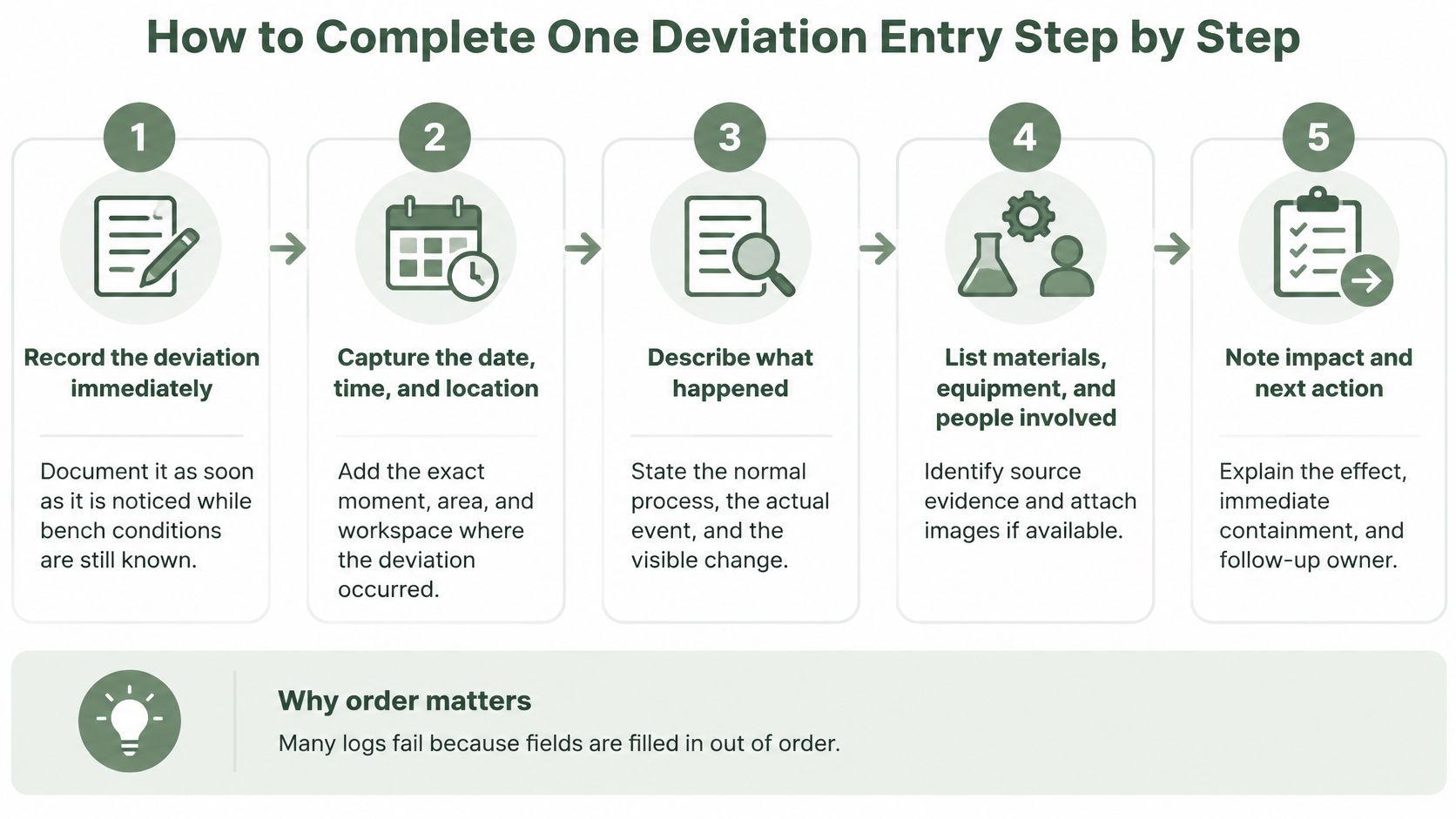
Work from observation to disposition
The following illustrative scenario follows an overnight incubation discovered at 8 a.m., 6 hours beyond its protocol window. A freezer alarm had been silenced during the overnight work; that fact belongs in the timeline, but it doesn't establish why the incubation overran.
Open the entry when the departure is noticed.
The entry reads: “At 8 a.m., the operator checked the samples and identified an incubation beyond the permitted window.” The record identifies the operator, workspace, experiment, and actual entry timestamp.Record the requirement and observed condition without assigning blame.
“The protocol window ended at 2 a.m.; samples remained incubating until 8 a.m.” The entry names the affected step and separates the observed timing from any suspected explanation.Attach the source evidence.
The record references the incubation start note, timer history, instrument identifier, and freezer alarm acknowledgment record. A label photograph identifies the affected material; the alarm record supports only the alarm timeline, not a causal conclusion.State what happened to the samples next.
“Further processing paused; affected samples were segregated pending review.” The continuation status states that the run was paused, rather than implying that the samples were discarded or successfully recovered.Assess impact with explicit uncertainty.
“Extended incubation may affect endpoint comparability; suitability remains unresolved pending protocol-owner review.” The safety assessment is recorded separately, with its basis, rather than inferred from sample appearance.Assign a provisional classification against local criteria.
“Provisionally important because the timing departure could affect result reliability.” The reviewer records the criterion used and whether the classification needs confirmation.Investigate the cause before finalizing its category.
“Root cause unknown; review timer setup, alarm handling, and overnight task ownership.” The silenced freezer alarm remains a contextual event unless evidence connects it to the missed incubation endpoint.Assign follow-up and document the reporting decision.
The entry names the CAPA owner, due date, reviewer, notification recipients, and amendment determination. “Pending assessment” is acceptable while work continues, provided the record identifies who will resolve it.
Review test: Could a reviewer who wasn't at the bench reconstruct the requirement, departure, evidence, containment, and unresolved decisions from this entry alone?
A short running-log row can reference a linked event record when the evidence won't fit cleanly in a cell. That's preferable to squeezing an investigation into an unreadable spreadsheet paragraph.
Common Bench Deviations and How to Log Each One
A 2023 audit published in Perspectives in Clinical Research found that 23 of 54 postgraduate research protocols reviewed, or 42.6%, contained protocol deviations or protocol violations. That finding concerns the audited protocols, not a prevalence estimate for all wet labs, but it gives practical context for maintaining an explicit log.
| Deviation | Illustrative bench example | What to log and check |
|---|---|---|
| Missed or out-of-window timepoint | Illustrative: sample pulled two hours late | Planned and actual time, timing source, affected samples, and endpoint sensitivity |
| Expired or unlabeled reagent | Illustrative: buffer used three days past expiry | Reagent ID, lot, expiry, storage evidence, and runs that used it |
| Wrong concentration or volume | Illustrative: stock made at 10 mM instead of 1 mM | Calculation, intended and used values, preparation record, and affected batches |
| Skipped or altered step | Illustrative: wash step omitted | Step number, reason if known, whether repeated, and consequences of repetition |
| Equipment out of calibration | Illustrative: pipette or incubator check overdue | Instrument ID, last check date, verification results, and potentially affected runs |
| Missing control on plate | Illustrative: negative control absent | Plate ID, required control, and effect on plate interpretation |
| Mislabeled sample | Illustrative: tube carries another sample's ID | Original and corrected IDs, supporting identity evidence, and handling notes |
Check interpretation, not just visible damage
A missing negative control may leave an apparently clean plate, but the reviewer still needs to decide whether background or contamination can be assessed. The absence of an obvious problem doesn't replace the missing control.
Likewise, an overdue calibration check doesn't establish that an instrument performed incorrectly. The entry should distinguish an overdue verification from demonstrated out-of-tolerance performance, then define the affected interval using available evidence.
For mislabeled tubes, a corrected label needs an evidence trail. If identity can't be established independently, the record should preserve that uncertainty rather than convert an assumption into a confirmed identity.
A plausible result doesn't erase a departure, and an unusual result doesn't prove that a departure caused it.
Keep observations and explanations separate
The guidance on documenting unexpected results is useful when an experimental observation and a procedural departure appear together. The observation record should state what changed; the deviation entry should state which requirement wasn't followed.
Before closing an entry, the reviewer should check:
- Scope: Which samples, plates, preparations, or downstream analyses share the exposure?
- Interpretability: Which conclusions remain supportable, and which need qualification?
- Disposition: Will material be retained, repeated, excluded, or held for a decision?
- Classification: Which agreed impact criterion applies?
The same deviation type can lead to different classifications. A late exploratory observation and a late time-critical endpoint shouldn't receive identical labels merely because both involve timing.
Corrective and Preventive Actions That Hold Up
A deviation entry is useful only when it connects the event to a decision and a follow-up. Containment limits further exposure; correction addresses affected work; corrective and preventive actions address causes and reduce recurrence.
ICH E6(R3) calls for documenting and reviewing deviations, explaining important deviations, and implementing measures to prevent recurrence where applicable. The ICH E6(R3) guideline supports a response proportionate to the deviation's impact and cause.
Follow the action chain
| Action | Question answered | Illustrative reagent example |
|---|---|---|
| Immediate containment | What prevents further exposure? | Segregate suspect buffer and pause its use |
| Correction | What happens to affected work? | Prepare replacement buffer and assess affected runs |
| Corrective action | What removes the identified cause? | Replace an ambiguous expiry-labeling practice |
| Preventive action | Where else could that cause operate? | Extend a weekly expiry check to shared stocks |
| Effectiveness check | What evidence shows the fix worked? | Inspect shared stocks and review subsequent deviation entries |
For an equipment deviation, a calibration reminder should identify the instrument ID and a named backup owner. A reminder sent to an unattended inbox does not provide a functioning control.
Use root-cause analysis documentation to distinguish an immediate mistake from process conditions that made it likely. Retraining fits when the evidence supports a knowledge gap. If instructions are unclear or a handoff is missing, fix that condition rather than treating retraining as the whole action.
Distinguish isolated events from recurring causes
A low-impact, isolated event may need only a correction and a documented rationale. Repeated entries with the same cause point to a broader failure that needs an owner and a process change.
Add a recurrence field that counts matching root-cause categories over the period defined in the SOP. Keep the underlying entry references so a reviewer can check whether the events share a cause.
Compact categories such as equipment, materials, procedure, training, and handoff make entries easier to compare than unrestricted narratives. A short evidence field records why the cause and action were selected.
Close the entry with evidence. Record an owner and due date for implementation and the effectiveness check. Define the check method, review date, result, and response if the action fails.
Log a Deviation You Find Late
A late-discovered departure needs an honest reconstruction, not a cleaner-looking timestamp. The record should distinguish when the event occurred, when it was identified, and when the entry was written.
Never backdate the entry or rewrite the original note to make it appear contemporaneous. The author records the actual entry date and labels reconstructed details explicitly.
Build the timeline from checkable sources
Useful sources include:
- Instrument records: Run histories, temperature traces, and freezer alarm logs.
- Bench captures: Dated notebook entries, timer records, and timestamped voice or typed notes.
- Material evidence: Label photographs, preparation records, and documented storage conditions.
- Recollection: Clearly attributed memory, identified as such rather than presented as a dated source.
Each reconstructed field should identify its supporting source. If the occurrence time can't be established, “unknown” or a supported time interval is more accurate than an invented timestamp.
Separate an earlier event from an inferred cause
Consider an illustrative culture contamination finding on Monday, followed by discovery of a freezer power interruption on Friday night. The freezer log establishes when the interruption occurred; it doesn't, by itself, establish when contamination began or whether the interruption caused it.
If the deviation is the documented power interruption affecting stored material, Friday is the occurrence date and Monday is the identification date. The contamination observation belongs in the impact assessment, with the causal connection marked unconfirmed unless additional evidence supports it.
A reviewer should then check which materials were exposed, whether they entered the culture workflow, and what alternative explanations remain. A neat chronology isn't enough if the affected material can't be connected to the experiment.
Evidence boundary: A late entry should make dated evidence, inference, and memory distinguishable at a glance.
The final review tests the impact assessment against the reconstructed timeline. Any unsupported assumption should remain visible as an unresolved question, with an owner if further investigation is warranted.
Keep Your Deviation Log Audit Ready
An audit-ready log allows another person to follow the record without relying on its author's memory. The FDA data-integrity guidance describes ALCOA expectations: records should be attributable, legible, contemporaneously recorded, original or a true copy, and accurate.
Those expectations translate into practical recording habits, not a special export format.
Connect each expectation to a bench habit
- Attributable: Identify the person making the entry and the person performing the review. Reviewer initials need an unambiguous identity reference.
- Legible: Use readable entries and consistent terminology. Instrument identifiers should match the laboratory's established identifiers.
- Contemporaneous: Capture observations near the event rather than reconstructing a polished account at the end of the experiment.
- Original or true copy: Retain the source capture or a traceable true copy alongside the organized record.
- Accurate: Check transcribed IDs, timestamps, units, and protocol references against their sources.
Corrections should preserve the original information. A dated addendum should identify the correction, author, reason, and affected entry; silent overwriting removes the distinction between the initial observation and later knowledge.
For paper records, the correction method should leave the original readable. For electronic records, the laboratory should use a method that retains an appropriate correction history rather than assuming ordinary file editing provides one.
Control the form and the handoff
The header's template revision, effective date, and controlled-copy status should match the version authorized for use. Retire obsolete blank copies from shared folders and bench stations while retaining completed historical records under their original revision.
The laboratory's good documentation practices should define where the completed log, supporting evidence, and review record belong. A spreadsheet attachment shouldn't become the only surviving source merely because it's convenient to email.
PDF, DOCX, and Markdown can support archiving or transfer, but a file format doesn't establish compliance. The quality or compliance owner decides whether a system and its procedures are validated or otherwise appropriate for their intended use.
Before archiving, check:
- Final review: Retain the signed closeout review and resolve or explicitly transfer outstanding actions.
- Source record: Preserve evidence supporting the event and any subsequent corrections.
- Template provenance: Store the revision used to create the completed record.
- Traceable handoff: Keep references connecting the deviation, impact decision, notifications, and action evidence.
Adopt the Template for Your Next Experiment
Before adopting a deviation log, pilot it on a real experiment. The recorder should be able to capture what changed and its immediate impact at the bench; the reviewer should be able to identify the escalation decision and follow-up without searching through a long narrative.
Make capture and review separate jobs
The operator records the departure and links the relevant source evidence. The designated reviewer confirms the impact, escalation path, and actions. After the pilot, revise fields that caused hesitation while keeping the information needed to trace the decision and closeout.
For a ready-made starting point, Verbex offers a free Lab Documentation Pack with 16 editable templates across 42 Word, Excel, and PDF files, including worked examples and working formulas. No account is needed to download it. The templates are licensed under CC BY 4.0, so they can be used, shared, and adapted for any purpose with credit to Verbex.
For bench-side note capture, Verbex for iPhone and iPad lets scientists speak notes while their hands are busy. Notes are timestamped and organized into a lab record for review and sealing, then export to PDF, Word, or the user's ELN. Its AI features run on device.
Choose a pilot experiment, name the recorder and reviewer, and check whether the log carries the event from capture through impact review and action closeout.
Verbex helps scientists capture what changed at the bench and prepare a reviewed record for an existing documentation workflow. Visit Verbal Experiment or Verbex to explore the documentation templates and capture app, then choose a pilot experiment with a named recorder and reviewer.