 Blog
Blog
Good Documentation Practices for Wet Labs
A timer is sounding, a sample needs to go on ice, and both gloves are covered with powder or buffer. The notebook is open, but the next action takes priority. A quick note lands on a glove, a protocol margin, or a paper towel, with the intention of transferring it later. Later, the detail is incomplete, the timing is uncertain, and the scientist has to reconstruct what happened from memory.
Good documentation practices make that reconstruction unnecessary. They preserve the conditions, actions, observations, deviations, and decisions that connect an experiment's raw evidence to its conclusion. The aim isn't to create more paperwork. It's to create a record that another scientist can understand, review, repeat, and, when necessary, challenge.
Table of Contents
- The Reality of Bench Work and Record Keeping
- Core Regulatory Frameworks and ALCOA Principles
- Building a Technically Defensible Lab Record
- Choosing the Right Capture Tools for Wet Labs
- Common Documentation Mistakes and How to Fix Them
- Implementing Better Documentation Habits Today
The Reality of Bench Work and Record Keeping
A wet-lab experiment rarely follows the clean sequence printed in a protocol. A centrifuge takes longer than expected. A reagent looks different from the previous preparation. A tube label starts to peel. A timer rings while a colleague asks about a control. The scientist adapts, often correctly, but the adaptation may never reach the official record.
That gap matters because memory preserves the story, not the evidence. It tends to smooth over short delays, omit failed attempts, and convert uncertainty into confidence. A note written at the end of a shift can capture the intended procedure, yet miss which sample was handled first, when a temperature changed, or whether a visual observation occurred before or after a deviation.
Practical rule: If an observation can affect how a result is interpreted, it belongs in the record when it occurs, not when the experiment looks successful.
The OECD Principles of Good Laboratory Practice established documentation as part of the process by which studies are planned, performed, monitored, recorded, reported, and archived. The framework, first published in 1981 and revised in 1997, applies to non-clinical health and environmental studies, including work used to assess chemical safety, and requires records such as study plans, raw data, final reports, quality-assurance records, training records, samples, and computerized-system documentation (OECD Principles of Good Laboratory Practice).
What contemporaneous capture protects
A contemporaneous entry creates a defensible connection between a physical action and the resulting interpretation. It can show who handled the sample, what material or instrument was involved, when the action occurred, what was observed, and whether the procedure departed from the plan.
That protection works in both directions. It helps a reviewer trust a sound result, and it gives a scientist an honest explanation for a weak or failed result. A failed experiment with complete source notes can guide the next attempt. A polished report with missing timing, undocumented changes, or discarded raw observations can't.
A useful record therefore includes more than the final measurement:
- Deviations, including what changed and why.
- Unexpected observations, such as precipitation, color change, contamination concerns, or instrument behavior.
- Timing, especially where incubation, exposure, or processing order matters.
- Uncertainty, rather than a confident interpretation added after the fact.
- Decisions, including the reason a sample was repeated, excluded, or handled differently.
Good documentation practices accept that the bench is messy. They design a capture habit that survives that mess.
Core Regulatory Frameworks and ALCOA Principles
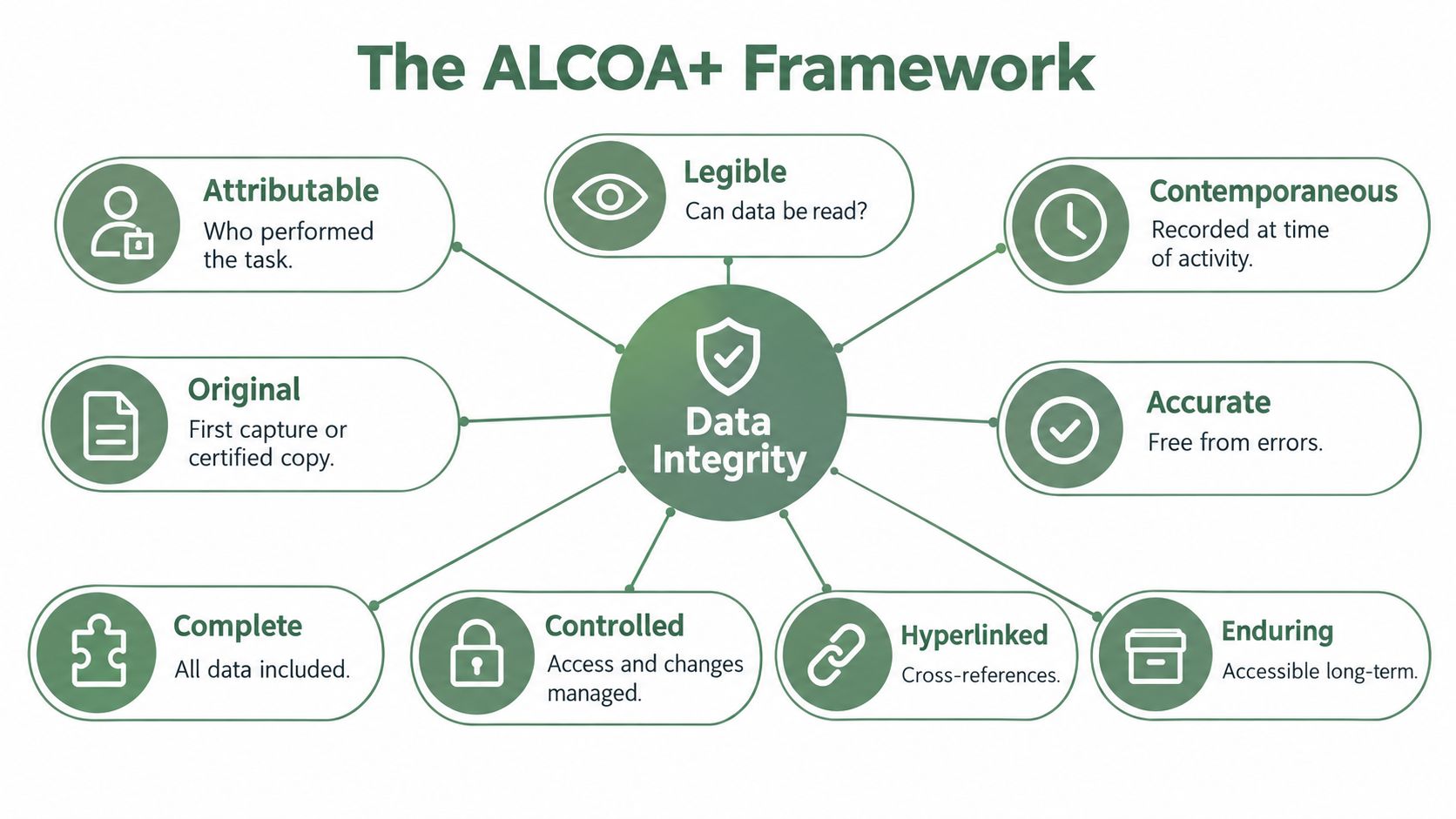
The FDA's ALCOA model gives laboratory teams a practical test for whether a record can be trusted. Data should be Attributable, Legible, Contemporaneously recorded, Original or a true copy, and Accurate. The FDA also defines data integrity through completeness, consistency, and accuracy, so retaining only a final result isn't enough (FDA data integrity guidance).
Attributable means a reviewer can identify the person who performed or recorded the activity. Legible means the entry remains readable and understandable. Contemporaneous means it was recorded as the activity happened or was observed. Original means the first record, or a verified true copy, remains available. Accurate means the record reflects the observation without guessing, smoothing, or making corrections without disclosure.
Translating ALCOA into bench behavior
Consider a mislabeled tube. A reliable correction doesn't erase the original entry or overwrite the history. It preserves the prior information, identifies the correction, records who made it, and makes the reason reviewable. The same logic applies to an electronic record, where authenticated identity, timestamps, access controls, and a reviewable change history protect the original source.
The FDA expects complete information, including data from all tests performed, not only the experiments that produced a preferred outcome. For regulated pharmaceutical testing, 21 CFR 211.194 requires complete data from tests needed to demonstrate compliance, including graphs, charts, spectra, identifiers linking results to materials and lots, and evidence that a second person reviewed the original records (21 CFR 211.194).
The OECD framework adds an important organizational dimension. Facility management, study directors, study personnel, and quality-assurance staff each carry defined responsibilities. Documentation isn't a private habit that ends with the person at the bench. It supports oversight, review, reporting, retention, and archiving.
Why ALCOA matters outside regulated laboratories
Academic and early-stage biotech laboratories may not operate under the same direct regulatory obligations as pharmaceutical manufacturing, but they still face failed reproductions, manuscript review, technology transfer, and internal scrutiny. An unaltered source record helps distinguish an original observation from a later interpretation.
For a plain-language expansion of the framework and its practical implications, the ALCOA guide provides a useful reference. Teams that need a reusable starting point may also use the Lab Documentation Pack (16 lab record templates), which contains editable protocol, notebook, deviation, inventory, calibration, and monitoring templates delivered in Word, Excel, and PDF files.
Building a Technically Defensible Lab Record
A technically defensible record lets a reviewer repeat the work or recalculate the result without relying on the original scientist's memory. WHO laboratory guidance frames sufficient documentation around that downstream use. Records should contain enough information to repeat the work and recalculate the result, including identifiers, reagent and control details, calibration information, calculations, derived data, anomalies, and resolutions (WHO good practices for pharmaceutical quality control laboratories).
A practical entry can follow a stable sequence. Start with an experiment or study identifier, objective, date, operator, and relevant sample identifiers. Then record materials, method or protocol version, instrument identity and settings, time-sensitive actions, raw observations, deviations, calculations, review status, and conclusion.
A section-by-section record blueprint
Stable identifiers do much of the organizational work. The same experiment ID or sample ID should appear on the notebook entry, aliquot, instrument output, image, and exported report. Names alone are fragile because people abbreviate them differently, while a consistent identifier gives every related artifact a common reference.
| Record Element | Purpose | Example |
|---|---|---|
| Experiment identifier | Connects related records | EXP-2026-014 |
| Objective | States the question being addressed | Compare treatment response under the approved method |
| Materials and identifiers | Establishes what entered the experiment | Reagent name, lot, expiry, sample ID, control ID |
| Procedure and version | Shows which method guided the work | SOP or protocol title and version |
| Instrument settings | Preserves operating context | Instrument ID, program, temperature, speed, acquisition settings |
| Raw observations | Retains the first evidence | Appearance, readings, images, spectra, instrument output |
| Deviations | Explains departures from the plan | Delay, substitution, repeat, handling issue, reason |
| Calculations | Allows independent checking | Formula, inputs, units, derived value |
| Review status | Shows whether another person checked the entry | Reviewer identity, date, comments |
| Conclusion | Separates interpretation from observation | Result, limitation, next action |
The table is a structure, not permission to fill every field retrospectively. If an instrument setting isn't recorded at the time, the later value may be a remembered default rather than the actual setting.
Capture provenance, not just content
A sample image without a sample ID is difficult to defend. A spectrum without the instrument run, method, or file reference is incomplete. A calculation without its inputs can't be checked.
Governance guidance such as MedQAIR governance insights is useful when a team is deciding how identifiers, access, review, and retention should work across related records. The bench-level implementation can remain simple: assign the identifier before work begins, use it consistently, attach or reference raw files, and record deviations as events rather than hiding them in a final narrative.
A clear notebook workflow also benefits from a stable entry pattern. The guide on how to keep a lab notebook offers a practical complement to formal requirements. For method-heavy teams, the Lab Protocol System provides master protocol, experiment plan, SOP, change record, and deviation log templates with worked examples in Word and PDF, as part of the complete Lab Documentation Pack.
Choosing the Right Capture Tools for Wet Labs
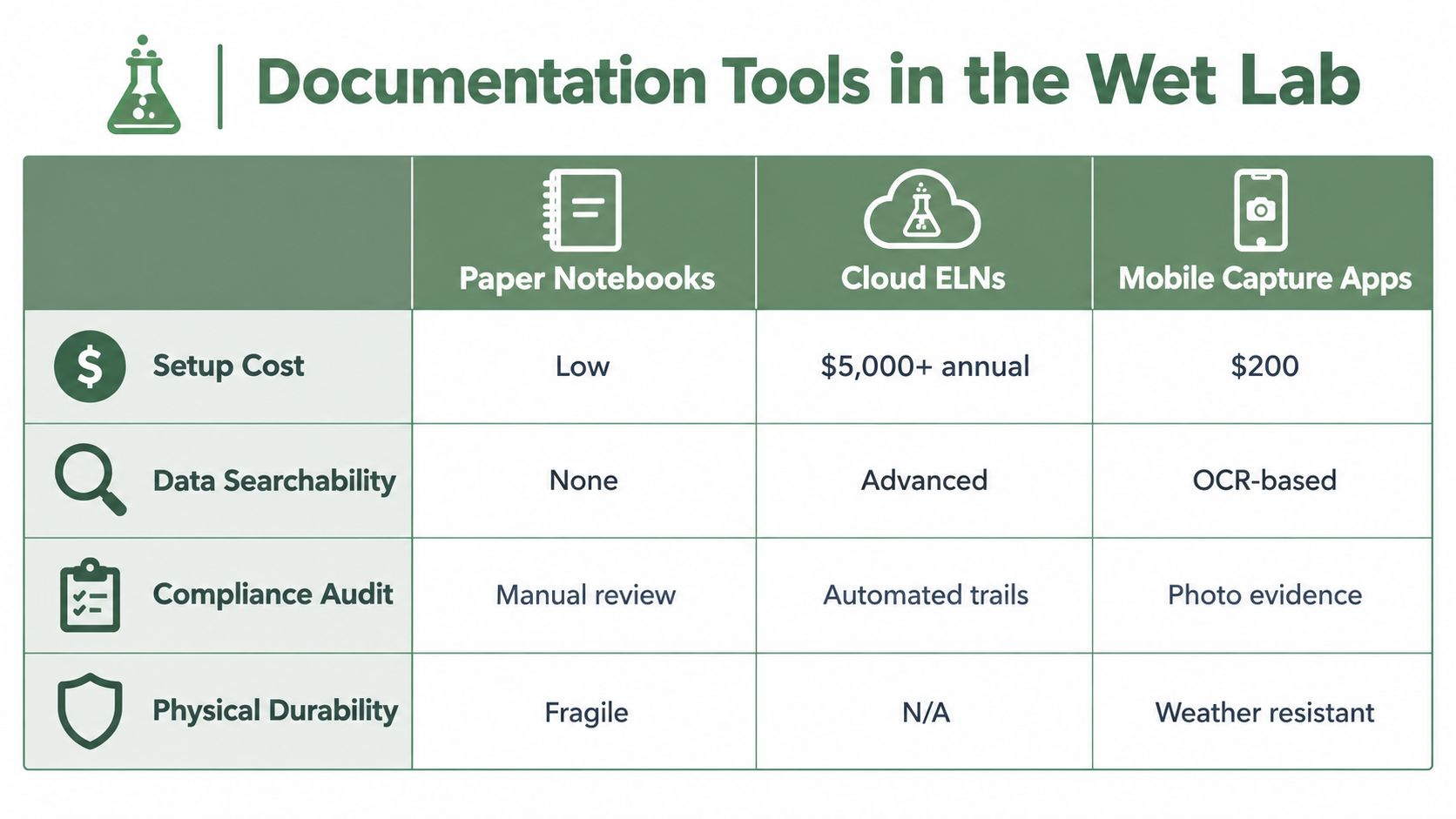
The best documentation tool is the one a scientist can use during the action without creating a safety or contamination problem. Paper notebooks are familiar and independent of software, but paper can be difficult to search, connect to instrument files, or use when gloves and liquid handling make writing impractical. Cloud ELNs support collaboration and centralized access, yet they introduce account, connectivity, governance, and data-residency decisions that a laboratory must evaluate.
Mobile capture tools occupy a different position. They can make it easier to record a short observation, start a timer, type a detail, or attach an image close to the bench. They shouldn't be confused with the laboratory's official system. Their value depends on whether the source capture remains reviewable and whether the resulting record can move into the team's established workflow.
Compare the trade-offs before choosing
| Tool type | Strength | Weakness | Best fit |
|---|---|---|---|
| Paper notebook | Immediate, familiar, independent of network access | Harder to search, link, and share; physical damage remains a risk | Individual records where paper control is established |
| Cloud ELN | Centralized collaboration, search, and structured workflows | Requires governance for access, connectivity, privacy, validation, and retention | Teams with an approved organizational ELN |
| On-device capture app | Fast multimodal source capture near the bench | Doesn't replace official records, validation, review, or sign-off | Scientists who need to capture bench events before formal entry |
Privacy is part of the tool decision, not an afterthought. A laboratory handling unpublished results, proprietary chemistry, patient-related material, or restricted project information should understand where notes, images, and processing leave the device. On-device processing can reduce exposure to cloud services, but it doesn't remove the need for local access controls, retention rules, backups, and institutional policy.
A practical companion workflow
Verbex is a private, on-device lab documentation app for iPhone and iPad. It sits between the protocol and the official ELN, allowing a scientist to select Objective, Materials, Procedure, Observations, Conclusion, or a custom section before capturing a voice note, typed note, timer, or image. Source captures preserve context and timestamps, and supported material-label images can be processed on-device into structured Materials entries when the text is sufficiently legible.
Review & Complete creates a source-backed Organized draft for human review and editing. Supported devices may also offer an additional ELN-style draft when local Apple Intelligence processing succeeds. Verbex requires no account and uses no cloud AI, cloud storage, advertising, analytics, or tracking. Completed records can be exported as PDF, DOCX, or Markdown, but the app doesn't automatically synchronize with an ELN or replace a validated system.
Teams comparing formal systems can use this electronic lab notebook comparison to clarify where a capture tool ends and an official ELN begins.
Common Documentation Mistakes and How to Fix Them
Most documentation failures aren't caused by ignorance. They happen when the scientist is trying to protect a sample, keep a run moving, or avoid breaking concentration. The problem is that a shortcut taken under pressure can remove the evidence needed to interpret the result later.
Writing on a glove is a classic example. It feels immediate, but the note may smear, disappear with the glove, or lose its connection to the sample and activity. A paper towel or protocol margin has the same weakness if it isn't preserved as the original record and linked to the experiment.
Three failures that deserve an immediate fix
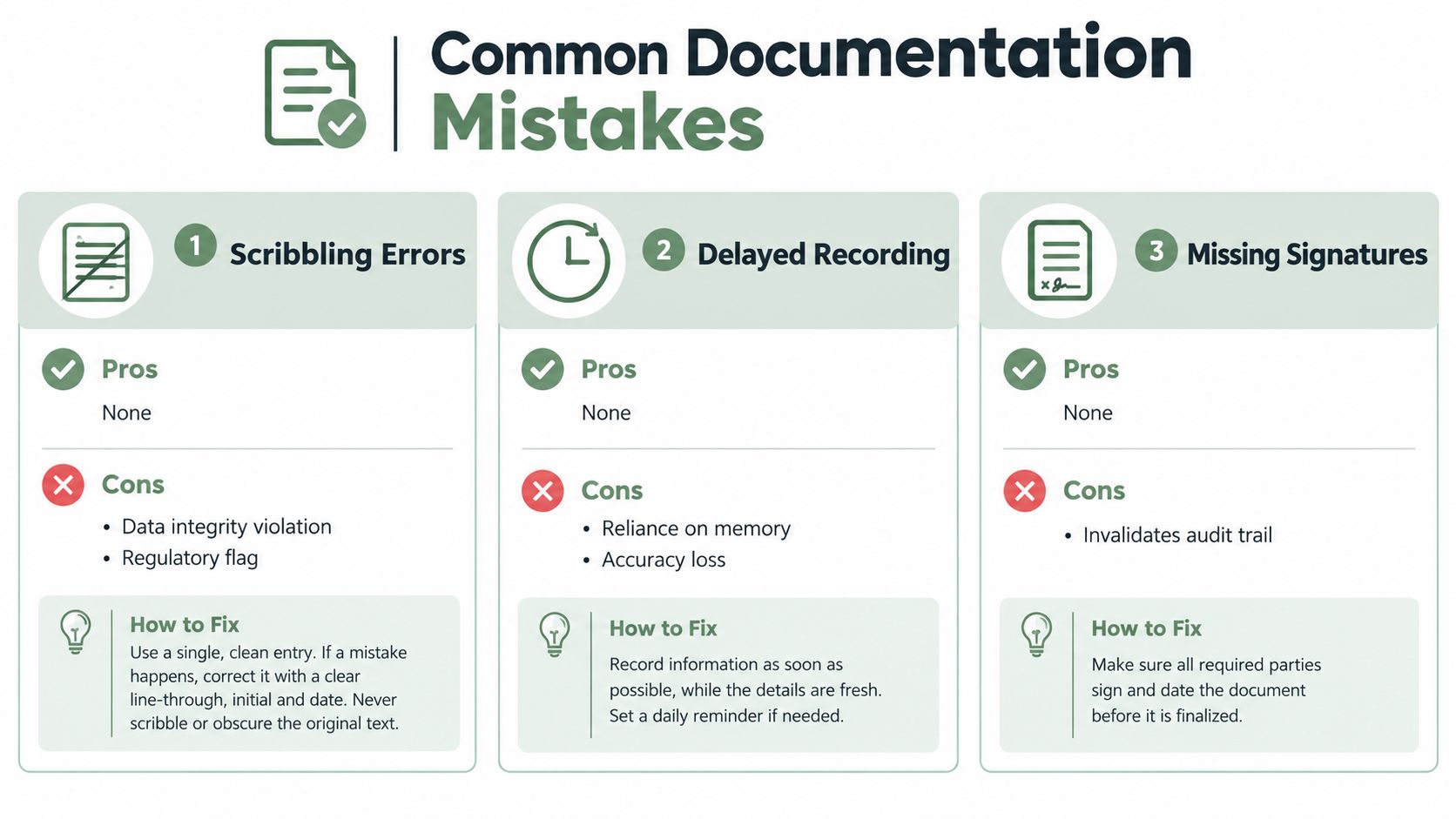
Scribbling and silent overwrites. A correction should preserve the prior entry and make the new entry attributable and reviewable. In paper records, that normally means a clear correction that doesn't obscure the original, with the required identity, date, and reason under the laboratory's procedure. In electronic systems, the correction should use the approved audit-trail function rather than deleting and re-entering information.
Delayed recording. Reconstructing a week of work from memory creates uncertainty around sequence, timing, and omissions. If a late entry is unavoidable, it should be identified as late and explain what is known, what source supports it, and why it wasn't recorded contemporaneously. It must not pretend to be an entry made earlier.
Missing review evidence. A record can contain excellent observations and still lack a clear review trail. The FDA expects review evidence in the regulated pharmaceutical testing context, and teams should define who reviews what, when review occurs, and how comments or corrections are resolved.
Bench habit: When the process can't pause, capture the minimum source detail first, then complete the structured record before the context disappears.
Protocol deviations need a reason, not an apology
A deviation log should state the planned condition, the actual condition, the time or stage affected, the material or sample involved, the immediate action, and the likely limitation. “Had to repeat” isn't enough. “Sample S-014 was incubated outside the planned sequence because the centrifuge cycle was still running, then processed using the approved method” gives a reviewer something they can evaluate.
The same discipline helps with literature and manuscript work. Scientists preparing reports can also consult these referencing tips for students when separating original observations, borrowed methods, and cited interpretation. Clear attribution protects the experimental record as well as the written publication.
A contemporaneous review can be brief. Before leaving the bench, the scientist checks that each sample has an identifier, each important action has a time or sequence, each deviation has a disposition, raw files are linked, and unclear entries are marked rather than completed.
Implementing Better Documentation Habits Today
Reliable records come from a repeatable day, not an annual audit exercise. The system should make the next correct action easy before work starts, while the sample is being handled, and before the scientist leaves the laboratory.
A daily capture checklist
Before the experiment
- Identify the work: Assign the experiment, study, sample, and material identifiers.
- Confirm the method: Record the protocol or SOP title and version.
- Prepare the record: Open the correct entry structure and confirm the required sections.
- Check the tools: Make sure the notebook, capture device, timer, and image workflow are available and permitted by local policy.
During the experiment
- Capture actions in real time: Record timing, changes, observations, and decisions as they occur.
- Preserve source evidence: Keep raw instrument files, images, calculations, and relevant outputs connected to the identifier.
- Log deviations plainly: State what was planned, what happened, and what action followed.
- Separate fact from interpretation: Record the observation first, then label the conclusion or hypothesis.
Before leaving the bench
- Review for gaps: Check people, dates, samples, reagents, equipment, settings, observations, deviations, and calculations.
- Make corrections transparently: Preserve the original and document the change according to the approved process.
- Complete review and export: Confirm the record's status and move it into the authorized archive or ELN workflow.
- Protect access: Use the laboratory's approved backup, retention, and access controls.
A short checklist won't solve a broken system, but it exposes where the system fails. If scientists regularly need to reconstruct timing, locate raw files, or guess which protocol version applied, the remedy may be a better template, a clearer handoff, or a tool that fits the physical workflow.
The video below provides another practical perspective on documenting standard laboratory work.
Teams standardizing procedures can also review guidance on how to improve operations with Doczen SOPs. The important point is to keep the SOP, source capture, review, and final record connected without pretending that any single app can guarantee compliance or reproducibility.
Verbex helps wet-lab scientists capture bench reality with voice notes, typed notes, timers, and images, then organize those source captures into a record for human review and export. To explore an on-device ELN companion for iPhone and iPad, visit Verbal Experiment.