 Blog
Blog
Lab Asset Management: A Practical Guide for Wet Labs
A centrifuge is sitting on the wrong bench, a calibration label is partly unreadable, and the maintenance spreadsheet hasn't been updated since the last researcher left. The experiment still has to run, so someone checks a drawer, asks a colleague, and reconstructs the instrument's status from memory. That small delay can become a much larger problem when a result changes and nobody can show which equipment condition, reagent lot, or storage state existed at the time of use.
Lab asset management provides the record behind the experiment. It connects instruments, materials, samples, and supporting infrastructure to identities, locations, owners, status, maintenance history, and experimental evidence. The most useful approach for a small wet lab isn't an enterprise rollout on day one. It's a staged system that starts with searchable records and evidence capture, then adds maintenance, utilization, and procurement controls as the team can support them.
Table of Contents
- What Lab Asset Management Actually Protects
- Asset Categories That Matter in a Wet Lab
- The Full Lifecycle from Purchase to Disposal
- SOPs and Compliance Requirements Explained
- Choosing the Right Asset System for Your Lab Size
- Implementation Roadmap for Small Wet Labs
- Real Lab Cases and Best Practices
What Lab Asset Management Actually Protects
A failed calibration label doesn't automatically invalidate an experiment, but it creates an unanswered question. Was the instrument within its required status when the measurement was made? Was the issue discovered before or after the run? Which certificate, service record, or exception note supports the answer?
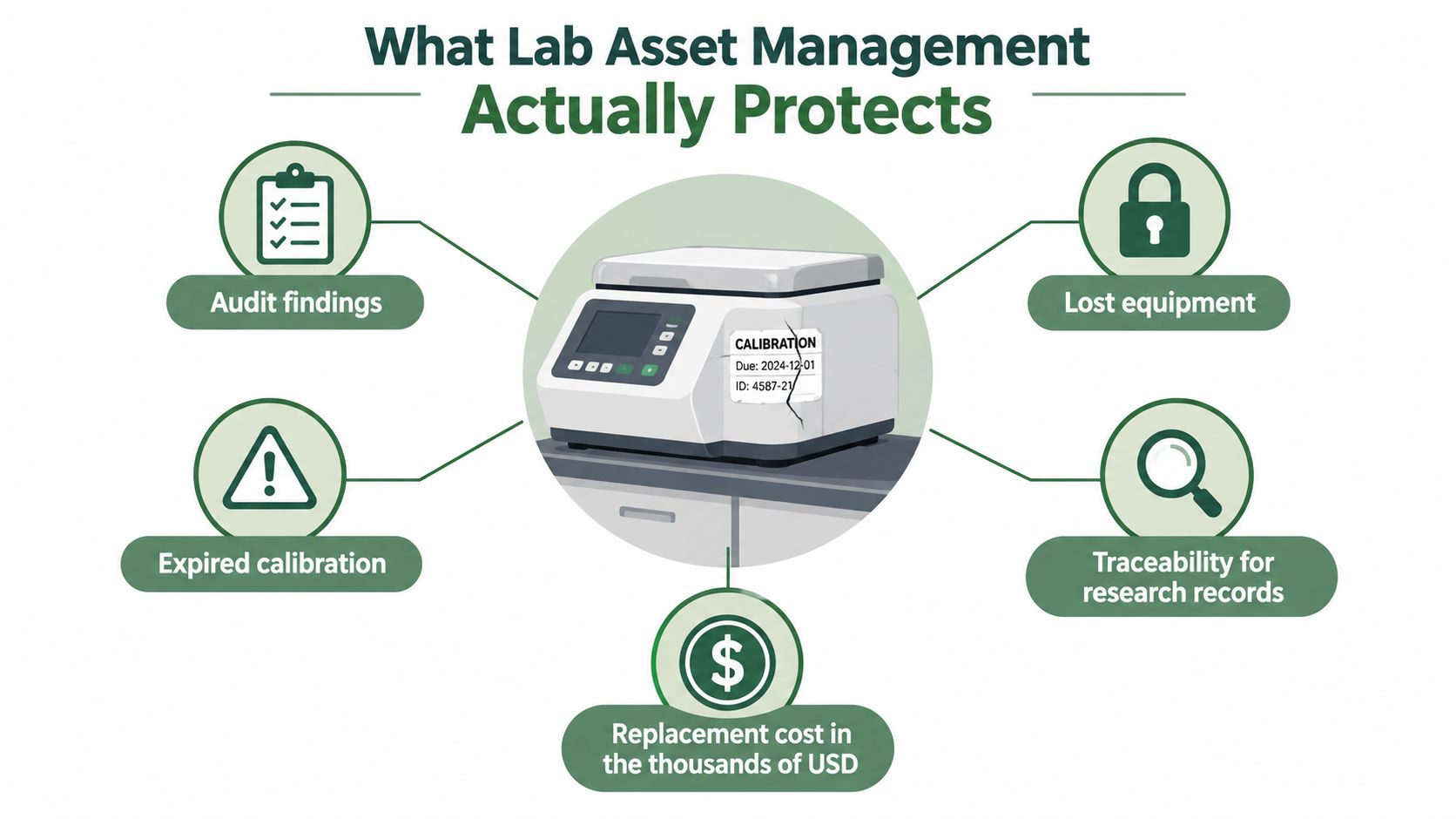
Lab asset management is the organized control of physical and consumable resources that can affect laboratory work. That includes balances, centrifuges, incubators, pipettes, freezers, analytical instruments, reagents, samples, reference materials, and critical infrastructure. It isn't just a count of what the lab owns. A useful record links each item to its identity, location, owner, status, calibration or service history, and relevant experiment.
ISO/IEC 17025 established a globally recognizable connection between equipment control and result validity. Its lineage began with ISO Guide 25 in 1978. ISO/IEC 17025 was published in 1999, revised in 2005, and updated in 2017. The standard expects laboratories to identify equipment that can affect results, verify or calibrate it before use, maintain equipment and software records, and document calibration status and protocols. These expectations are summarized in the ISO/IEC 17025 background and equipment-control reference.
From inventory to defensibility
The practical test is simple. If a reviewer asks why a result changed, can the lab identify the exact instrument configuration, calibration status, maintenance history, material lot, and experimental context at the time of use?
Practical rule: An asset record earns its place when it helps explain a scientific decision, not merely when it fills a row in a spreadsheet.
Small teams can adapt general best practices from myhalo to laboratory conditions, but they should keep the implementation proportionate. A searchable register with a clear asset ID may be more reliable than a complex platform that nobody updates. The first objective is traceability close to the bench, not administrative sophistication.
Asset Categories That Matter in a Wet Lab
A wet lab becomes easier to manage when assets are grouped by the evidence they require. Instruments, reagents, consumables, and biological materials don't fail in the same way, so they shouldn't share one undifferentiated record.
Instruments and core equipment
Balances, centrifuges, incubators, pipettes, freezers, refrigerators, temperature-controlled rooms, and analytical instruments can directly affect measurements or sample conditions. Their minimum record should include:
- Identity: Asset ID, manufacturer, model, serial number, and software version where relevant.
- Location: Room, bench, cabinet, or storage area.
- Readiness: Available, in use, quarantined, under maintenance, or retired.
- Calibration: Last calibration, next due date or recalibration criteria, certificate, and acceptance information.
- Service history: Preventive maintenance, repairs, malfunctions, modifications, and resolution.
- Use context: The experiment, protocol, project, or researcher associated with a significant run.
WHO guidance calls for an equipment inventory log that is updated when equipment is added or retired. It also recommends equipment-specific records for preventive maintenance, function checks, calibration, manufacturer service, problems, troubleshooting, and resolution. The WHO laboratory equipment inventory guidance provides the underlying record structure.
Reagents and chemicals
Reagent records need lot numbers, expiry dates, preparation details, storage conditions, and supplier information. A bottle may be physically present and still unsuitable for a particular experiment because it has expired, was stored incorrectly, or belongs to a lot involved in a known deviation.
Consumables and supplies
Pipette tips, tubes, filters, plates, columns, gloves, media components, and other supplies often receive less attention because they aren't calibrated. That doesn't make them irrelevant. A contaminated consumable, incompatible filter, or substituted plate can affect an outcome without appearing in the instrument register.
Samples and reference materials
Biological samples, standards, controls, and reference materials need identity, custody, storage location, condition, and retention information. Their records should connect to the experimental entry rather than sit in a separate list that a researcher may forget to consult.
The boundary matters because an instrument record proves equipment readiness, while a material record explains what entered the experiment. Combining both into a single generic inventory field usually hides the evidence that a reviewer needs.
The Full Lifecycle from Purchase to Disposal
A laboratory instrument shouldn't appear in the database only after it breaks. Its record should follow the asset from acquisition through retirement. A 2022 IEEE-described university asset-management system organized six functions across that life: acquisition, acceptance, use, maintenance, performance evaluation, and disposal. The reported implementation standardized daily work, supported analysis of asset data, reduced repetitive workload, and improved equipment-use efficiency over more than two years. The IEEE laboratory asset-management system description gives useful context for this lifecycle model.
Six stages worth recording
Acquisition: Record the justification, purchase order, supplier, expected specifications, warranty, and intended owner. The record should identify what problem the instrument is meant to solve.
Acceptance: Capture delivery condition, serial number, included accessories, installation details, initial checks, and baseline calibration or qualification evidence. Acceptance is the point where the lab confirms that the delivered item matches the requirement.
Use: Link meaningful use to a protocol, project, researcher, or experiment. The record doesn't need to log every casual interaction, but it should preserve enough context to identify the equipment state during consequential work.
Maintenance: Schedule preventive maintenance, calibration, function checks, and service tasks. An equipment maintenance log template can help a small team define the fields before adopting software.
Performance evaluation: Record drift, failed checks, repairs, modifications, out-of-tolerance findings, and decisions about affected work. This stage connects equipment condition to the question of whether prior data needs review.
Disposal: Document decommissioning, data removal where applicable, hazardous-material handling, transfer, recycling, and record retention. Guidance on managing and recycling lab equipment can help teams think through the final stage instead of treating retirement as a deletion event.
A strong lifecycle record keeps certificates, service evidence, and relevant experimental context close enough to retrieve together. It doesn't require every document to live in the same application, but it does require stable identifiers and links between systems.
A laboratory can also begin with a simple rule: no asset becomes available for routine use until its identity, location, acceptance status, and required calibration or maintenance state are recorded.
SOPs and Compliance Requirements Explained
Compliance becomes practical when translated into actions at the bench. The question isn't whether a laboratory owns an asset platform. The question is whether its records show what the equipment was, when it was checked, who changed the record, and whether it was authorized for use.
ISO/IEC 17025 treats equipment control as part of laboratory competence. A calibration label should show the last calibration date and the date or criteria for recalibration, so staff and auditors can determine whether the instrument is authorized for use. The associated record should preserve the instrument identity, configuration, calibration protocol, status, maintenance, and software details that support the measurement.
FDA 21 CFR Part 11 adds a specific requirement for electronic records within scope. Electronic-record systems must use secure, computer-generated, time-stamped audit trails that independently record operator actions creating, modifying, or deleting records. The FDA says audit trails should be retained for at least as long as the associated electronic records and remain available for agency review and copying. The FDA guidance on computerized systems used in clinical trials explains the audit-trail expectation.
What the record should prove
The FDA's Part 11 scope guidance applies to electronic records created, modified, maintained, archived, retrieved, or transmitted under FDA recordkeeping requirements. Even where enforcement discretion applies to particular technical provisions, underlying documentation duties remain. Dates, times, event sequencing, and visible corrections matter because a contemporaneous record is different from an informal note reconstructed later.
WHO good-practice guidance for pharmaceutical quality-control laboratories specifies that equipment requiring calibration should have a unique identifier, calibration status, and next recalibration date. It also calls for identity, manufacturer, model, serial number or other identifier, qualification or calibration requirements, location, calibration results, acceptance criteria, maintenance history, damage, malfunction, modification, repair history, duration of use, and observations. The WHO pharmaceutical quality-control laboratory guidance provides these details.
| Framework | Core Asset Expectation | Key Evidence Required |
|---|---|---|
| ISO/IEC 17025 | Equipment affecting results is identified, verified or calibrated, maintained, and controlled | Calibration status, equipment records, software details, maintenance evidence, authorized-use status |
| FDA 21 CFR Part 11 | In-scope electronic records preserve secure, chronological audit history | Time-stamped audit trail, operator actions, retained source history, visible changes |
| WHO equipment guidance | Inventory and item-level equipment histories remain current | Identity, location, service, calibration, problems, troubleshooting, resolution |
| WHO pharmaceutical quality-control guidance | Calibrated equipment carries clear status and recalibration information | Calibration results, acceptance criteria, due date, repairs, modifications, observations |
SOPs work when they define the smallest action that protects the record. A researcher should know where to record a failed function check, how to quarantine an instrument, and how to link the event to affected experiments. Detailed IQ, OQ, and PQ documentation should support the relevant qualification process, not become a detached filing exercise.
Choosing the Right Asset System for Your Lab Size
A small lab usually has two bad options. It can rely on scattered spreadsheets and memory, or it can buy an enterprise system that demands more administration than the team can sustain. The right choice depends on setup effort, maintenance burden, audit readiness, documentation fit, and total cost of ownership, not on how many features appear in a product demonstration.
| Tier | Best For | Setup Effort | Audit Readiness | Integration Path |
|---|---|---|---|---|
| Spreadsheet register | A very small lab establishing its first structured record | Low, if fields and ownership are clear | Basic, dependent on version control and disciplined updates | Link rows to certificates, ELN entries, and shared evidence folders |
| Dedicated LIMS | Labs needing centralized schedules, calibration tracking, material alerts, and broader control | Moderate to high, depending on configuration | Stronger when validated and consistently maintained | Connect asset IDs to laboratory workflows and formal records |
| On-device companion app | Teams capturing equipment condition, materials, timing, and observations at the bench | Low for capture, with human review required | Supports traceable source evidence but doesn't replace a validated system | Export records as PDF, DOCX, or Markdown into an ELN or archive |
A spreadsheet works when the asset population is manageable, one person owns the register, and the team agrees on required fields. It fails when multiple copies circulate, status changes go unrecorded, or calibration evidence is stored under inconsistent names.
A dedicated LIMS can handle broader operational control, but the lab must budget for configuration, training, permissions, maintenance, and governance. It shouldn't be selected merely because it can represent every possible asset category. A platform with unused workflows is an expensive filing cabinet.
An on-device companion tool can solve a different problem: capturing evidence while the experiment is happening. Verbex, made by Multimod Labs, is a private, on-device lab documentation app for iPhone and iPad. It supports voice notes, typed notes, timers, and images, organizes captures into a source-backed record for review, and exports completed records as PDF, DOCX, or Markdown. It isn't a LIMS, inventory system, QMS, ELN, or validated replacement. The lab inventory system comparison can help teams separate inventory control from bench documentation.
Decision test: If researchers won't update the system during real experiments, adding more fields won't improve the record.
Implementation Roadmap for Small Wet Labs
Small academic and biotech labs can begin without interrupting active research. The safest path is to control the highest-risk assets first, make evidence capture easy, and postpone utilization and procurement features until the basic record is trusted.
Stage one establishes searchable identity
Start with instruments and materials that could materially affect results. Assign a stable asset ID, record the location and owner, photograph labels where useful, and capture current status. For critical reagents, include lot, expiry, supplier, preparation date, and storage condition.
The record should be searchable by the name a scientist uses at the bench, not only by a procurement code. A balance might be found by serial number, room, asset ID, or local name. Choose one canonical identity, then add practical search terms.
Stage two connects maintenance to use
Add calibration dates, service tasks, certificates, function checks, and exception status. When an instrument is used, connect its ID to the experiment or protocol record. If a problem appears during a run, record the condition immediately, mark the equipment appropriately, and identify the affected work rather than relying on a later memory-based reconstruction.
A staged evidence workflow can remain lightweight:
- At the bench: Capture a typed or voice note, timer event, or image of the instrument display, label, or condition.
- During review: Confirm the asset ID, material lot, timestamp, and experimental context.
- After completion: Export or transfer the organized record into the lab's ELN, archive, or approved documentation workflow.
Verbex supports this kind of source capture on the iPhone and iPad. Processing occurs on the device, with no account, cloud AI, cloud storage, advertising, analytics, or tracking. Users choose a section such as Objective, Materials, Procedure, Observations, or Conclusion before capturing information, then review and edit the organized draft. That can support contemporaneous documentation, but it doesn't independently determine scientific meaning or replace the official record system.
Stage three reviews and expands
Only after the first two stages are used consistently should the lab add utilization monitoring, procurement controls, check-in and check-out workflows, or automated reporting. Review missing locations, overdue maintenance, repeated deviations, and assets that researchers cannot find.
A small lab doesn't need to measure everything. It needs to know whether its records answer practical questions: What is this asset? Where is it? Can it be used? What evidence supports that status? Which work depends on it?
Real Lab Cases and Best Practices
A university research group can begin with a simple instrument register. Each balance, centrifuge, incubator, and pipette receives an asset ID, location, owner, and calibration field. When an internal review finds inconsistent calibration documentation, the group doesn't immediately purchase an enterprise platform. It adds a maintenance calendar, stores certificates under the asset ID, and requires researchers to record exceptions when an instrument is unavailable or overdue.
The trade-off is manual discipline. The group gains a clearer record without taking on a complex implementation, but someone must own the calendar and inspect the register. The system works because the added fields answer a real audit question.
A small biotech team may face a different gap. Its ELN contains the final experiment record, but observations, timing changes, material-label details, and instrument conditions are captured on paper or reconstructed later. The team adds bench-side source capture, then reviews and transfers the organized record into the existing ELN workflow. The improvement isn't an invented time saving or a compliance guarantee. It is a stronger connection between what happened at the bench and what appears in the formal experiment record.
A practical checklist
- Assign stable identities: Use one asset ID for each instrument and link labels, certificates, service events, and experimental records to it.
- Record readiness: Distinguish available equipment from equipment that is overdue, damaged, quarantined, or under service.
- Keep evidence near the event: Capture observations, images, timers, material labels, and deviations while the work is happening.
- Track critical materials: Preserve lot, expiry, preparation, storage, and supplier information for reagents and reference materials.
- Make calibration visible: Show the last calibration and next recalibration date or criteria on the record and, where appropriate, the equipment label.
- Expand in stages: Add maintenance first, then utilization and procurement controls once the team consistently maintains identity records.
- Keep humans responsible: Researchers review, correct, complete, and approve the scientific record. No capture tool should decide what an observation means.
The most durable lab asset management system is usually the one a small team can maintain during a busy experiment. Searchability comes before dashboards. Evidence capture comes before automation. A clear record of what was used, when, and under which condition protects research better than a complex system filled with stale data.
For teams building a practical documentation workflow, Verbal Experiment or Verbex offers private, on-device capture for voice notes, typed notes, timers, and images, with reviewed records exportable as PDF, DOCX, or Markdown for an existing ELN process. Researchers can use it alongside an asset register to record equipment condition, material labels, timing, and deviations while the work is still happening.