 Blog
Lab Notebook with Duplicate Pages: Which Option Holds Up
A reviewer needs the assay notes, but the notebook has to stay at the bench. A lab notebook with duplicate pages solves that problem by making a removable copy while the original stays bound. The useful distinction isn't carbonless paper versus an app. It's whether a reviewer can follow the experiment through its entries, attachments, corrections, and signatures without guessing which version is complete.
By Multimod Labs.
Table of Contents
- Duplicate Page Notebook Options at a Glance
- How Duplicate Pages Create Two Records
- Checklist and Requirements for a Defensible Duplicate Page
- Keeping Attachments and Corrections on Both Pages
- Where Digital Capture Fits Beside a Paper Original
- Choosing the Right Setup for Your Bench
- Confirm Your Notebook Workflow Before Your Next Experiment
Duplicate Page Notebook Options at a Glance
Notebook options compared on the criteria that matter
| Option | How the copy is made | Original stays bound | Built-in audit trail | Copy durability | Works best for |
|---|---|---|---|---|---|
| Carbonless duplicate notebook | Pressure transfers writing to the duplicate page | Yes | No | Requires legible transfer and protected storage | Bench records that need a copy for review |
| Carbon paper notebook | Carbon sheet placed between pages | Yes | No | Requires complete transfer and protected storage | Teams already working with carbon-copy forms |
| Plain bound notebook with scans or photos | Copy made after entry by scanning or photographing | Yes | No | Requires readable files, backups, and stable identifiers | Labs without duplicate stock that accept a later copy |
| Electronic lab notebook (ELN) | Entries stored digitally | Not applicable | Yes, with logged edits in an appropriately configured system | Requires managed retention and usable exports | Shared, searchable records with edit history |
| Verbex beside a bound notebook or ELN | Timestamped voice and typed notes, timers, and images exported as PDF, DOCX, or Markdown | Yes, paper original stays bound | Timestamped source captures, not an ELN audit log | Requires retained source context and reviewed exports | Capturing bench events while hands are busy |
A duplicate page supplies a second paper copy made during writing. An ELN can supply a logged history of entries and edits, but a photograph or exported document doesn't acquire that history just because it's digital. Verbex is made by Multimod Labs, the publisher of this article. It's an ELN companion for iPhone and iPad, not an ELN, LIMS, or replacement for a bound notebook.
For physical organization, Grainmark Leather's comparison of ring binders versus traveler's notebooks offers useful context about refillable formats, but refillability isn't the same as permanent laboratory page control. The selection rule is straightforward: when a workflow needs a bound original and a removable review copy, duplicate pages meet that need. When colleagues also need search, shared access, and edit history, a controlled digital layer belongs alongside the paper. Neither format compensates for missing observations or an unexplained change.
How Duplicate Pages Create Two Records
Writing on the original sheet presses the entry onto the carbonless duplicate beneath it. In a carbon-paper notebook, a separate carbon sheet performs the transfer instead. The duplicate is typically numbered and perforated so it can leave the book without taking the original with it.
The National Institutes of Health's Responsible Science guidance describes permanently sewn databooks and numbered duplicate pages intended for carbon copies. Its operating convention is specific: researchers enter data on the original bound-in page; the duplicate receives the carbon copy or auxiliary material such as photographs and otherwise remains blank.
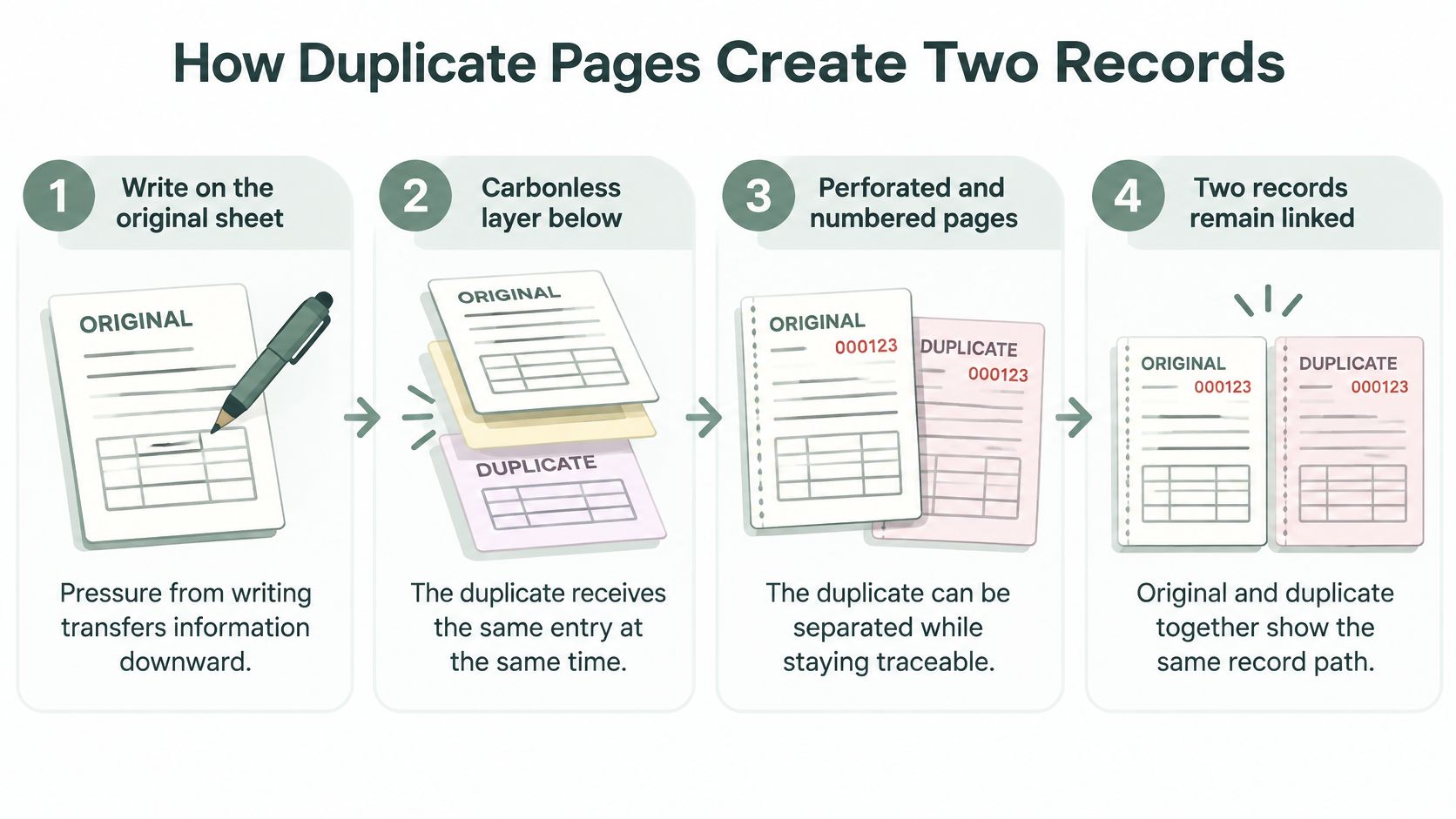
The working sequence
- Record the event on the original. Observations, preparation details, and calculations belong there as the work happens. A later clean rewrite loses the relationship between the observation and its first recording.
- Inspect the duplicate before turning the page. Check small characters, decimal points, units, and table headings. A readable original doesn't prove that the pressure transfer worked.
- Separate only the intended copy. Tear along the perforation when a reviewer or collaborator needs it, and record its destination when the laboratory's procedure calls for that.
- Retain the original permanently. The book should still contain the experimental sequence after copies leave for review.
The common failure is removing both sheets. A removable duplicate is useful precisely because the source page doesn't have to travel with it. The Macmillan Learning laboratory-notebook specifications describe this retained-record workflow and caution against removing both pages.
Illustrative example
During a dilution series, a scientist records the stock identity, diluent, transfer volumes, calculations, and an interrupted mixing step directly on the original. The duplicate goes to the principal investigator for review while the source record remains in the notebook.
That arrangement works only if the interruption and calculations transferred legibly. A duplicate containing the planned dilution table but missing the deviation isn't an adequate account of the experiment.
Practical rule: The copy should leave the bench only after someone has checked what actually transferred.
The immediate inspection is physical: numbered pairs, clean perforations, an intact original, and a written rule identifying the archival sheet.
Checklist and Requirements for a Defensible Duplicate Page
A duplicate page is only as reliable as the record it carries. Page numbers, clear attribution, and a usable transfer matter, but they cannot repair an entry that omits what happened or why a correction was made.
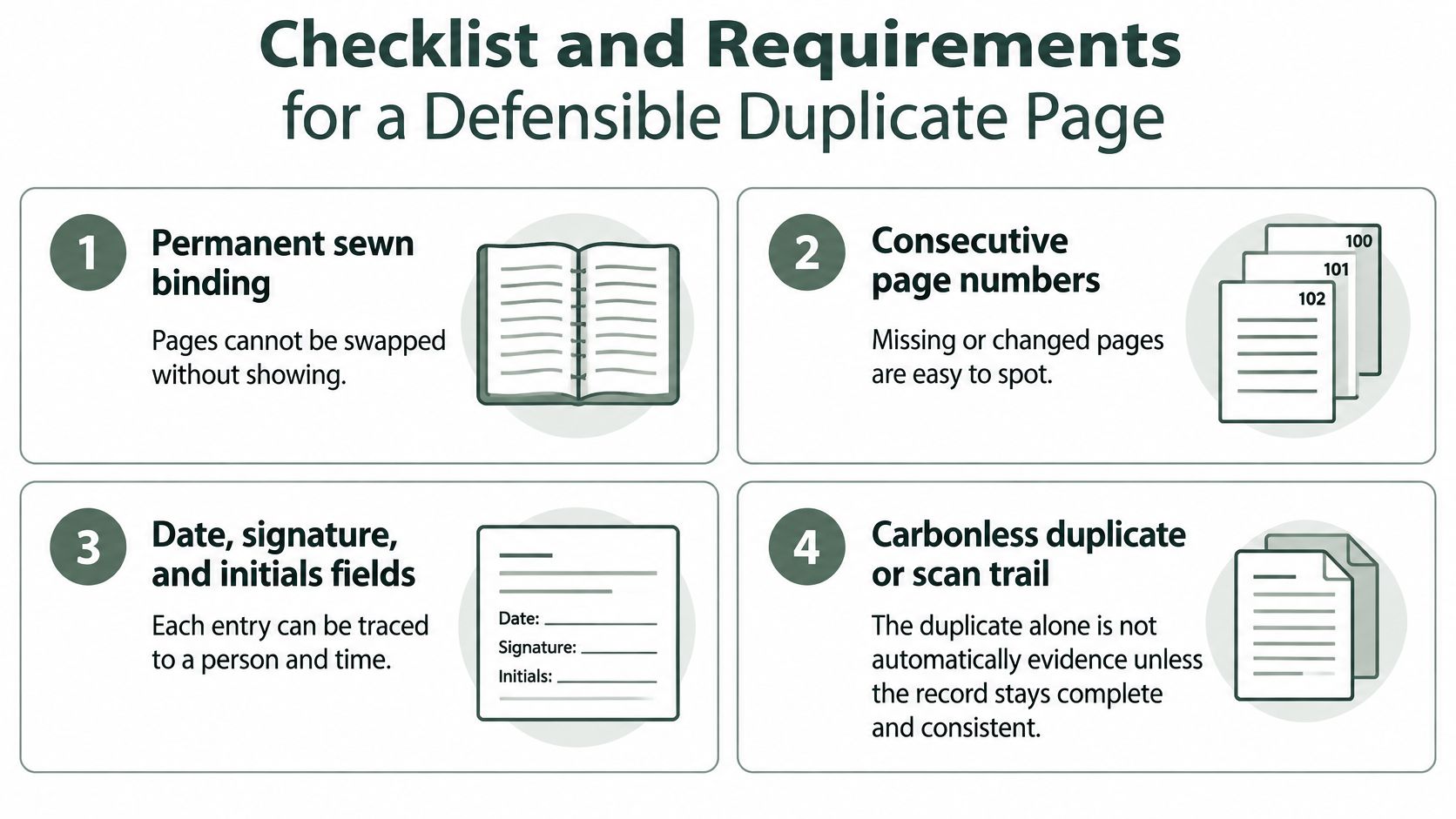
- Permanent binding. Choose a notebook construction that makes removal or replacement of original pages apparent.
- Consecutive page numbers. Give each duplicate the same page reference as its original.
- Clean perforations. A review copy should separate without damaging the retained page.
- Legible transfer. Check that the ballpoint used at the bench transfers clearly.
- Enough page sets. Leave room for calculations, failed attempts, and deviations, not only the planned procedure.
- One-sided recording. Follow the notebook's transfer arrangement rather than treating each sheet as ordinary paper.
- Space for attachments. Allow room to identify supporting material associated with the entry.
- Attribution and review fields. Include space for dated signatures and witness initials when institutional policy calls for them.
Copy quality and record quality are separate checks. A duplicate can reproduce an undated observation or unexplained correction just as faithfully as a complete entry.
Test the notebook as a recording system
Write a sentence, calculation, table, correction, and initials using normal bench pressure. Inspect the duplicate, then photograph it. If a reviewer can't distinguish a decimal point from a transfer mark, the page set hasn't passed.
Use the backing sheet supplied or recommended for the notebook. Without it, writing pressure may mark later sets. Test the actual page arrangement, not a loose sample sheet on a clean desk.
The NIH research-record guidance gives a useful framework for checking legibility, completeness, organization, attribution, dating, and identifiable corrections. These qualities don't come from having a second sheet. An orderly-looking entry can still omit a material identity or the reason a measurement was repeated.
Match the requirement to the work
For nonclinical studies governed by U.S. Good Laboratory Practice rules, 21 CFR 58.130 requires direct, prompt, legible recording in ink, except for automated collection, with dated and signed or initialed entries. Changes must preserve the original, explain the reason, and identify when and by whom they were made. These rules don't apply to every academic experiment; the principal investigator or quality team should establish the requirements before recording begins.
Patent-oriented documentation has a different focus: preserving evidence of work and its development. Indiana University's academic patent-record guidance discusses numbered, permanently bound records, signatures, and witnessing. It refers to a two-week witnessing window. Retention periods depend on the applicable institutional guidance and patent relevance.
Record requirements and what they mean on a duplicate page
| Requirement | Source guidance | What it means on a duplicate page |
|---|---|---|
| Consecutively numbered pages | Academic notebook guidance cited for patent-oriented work | Both sheets carry the same page reference so the pair can be traced |
| Entries made as events occur | Nonclinical GLP recording rule | Dated entries record bench work promptly, rather than replacing it with a later summary |
| Changes state the reason, date, and signer | Nonclinical GLP correction rule | A visible correction retains the original and includes attribution, date, and explanation |
| Witness signature and date | Academic patent-oriented notebook guidance | A witness reviews the page within the institution's established window |
| No page removal or insertion | Academic notebook guidance | Original pages remain intact; authorized removal of duplicates is accounted for |
| Retention for patent-relevant work | Institutional retention guidance | Relevant notebooks enter the organization's long-term retention process |
The distinction between originals and removable copies resolves an apparent conflict. Keeping original pages intact does not prevent a lab from distributing the duplicate designed to leave the book. The lab still needs a record of who received it and whether it contained the complete reviewed entry.
Witnessing is a process, not a printed line
Illustrative patent-track example: A researcher records an experimental preparation and arranges independent review within the institution's specified window. Before review, the researcher spots an incorrect material identifier, draws a single line through it, and adds the correct identifier, reason, initials, and date without obscuring the original.
The witness reviews the corrected record, not a replacement page. A signature field alone can't show that sequence. The guide to signing a laboratory notebook entry can help distinguish authorship from subsequent review.
When records pass between people or systems, document the handoff by identifying the record and recipient. The general guidance on chain of custody records for data offers transfer-documentation context, though laboratory procedures must define how that applies to notebook records.
Before adopting a notebook, settle three questions: Are the pages numbered? Do corrections preserve the earlier text and explain the change? Does witnessing happen on an agreed schedule? A notebook purchase answers none of them.
Keeping Attachments and Corrections on Both Pages
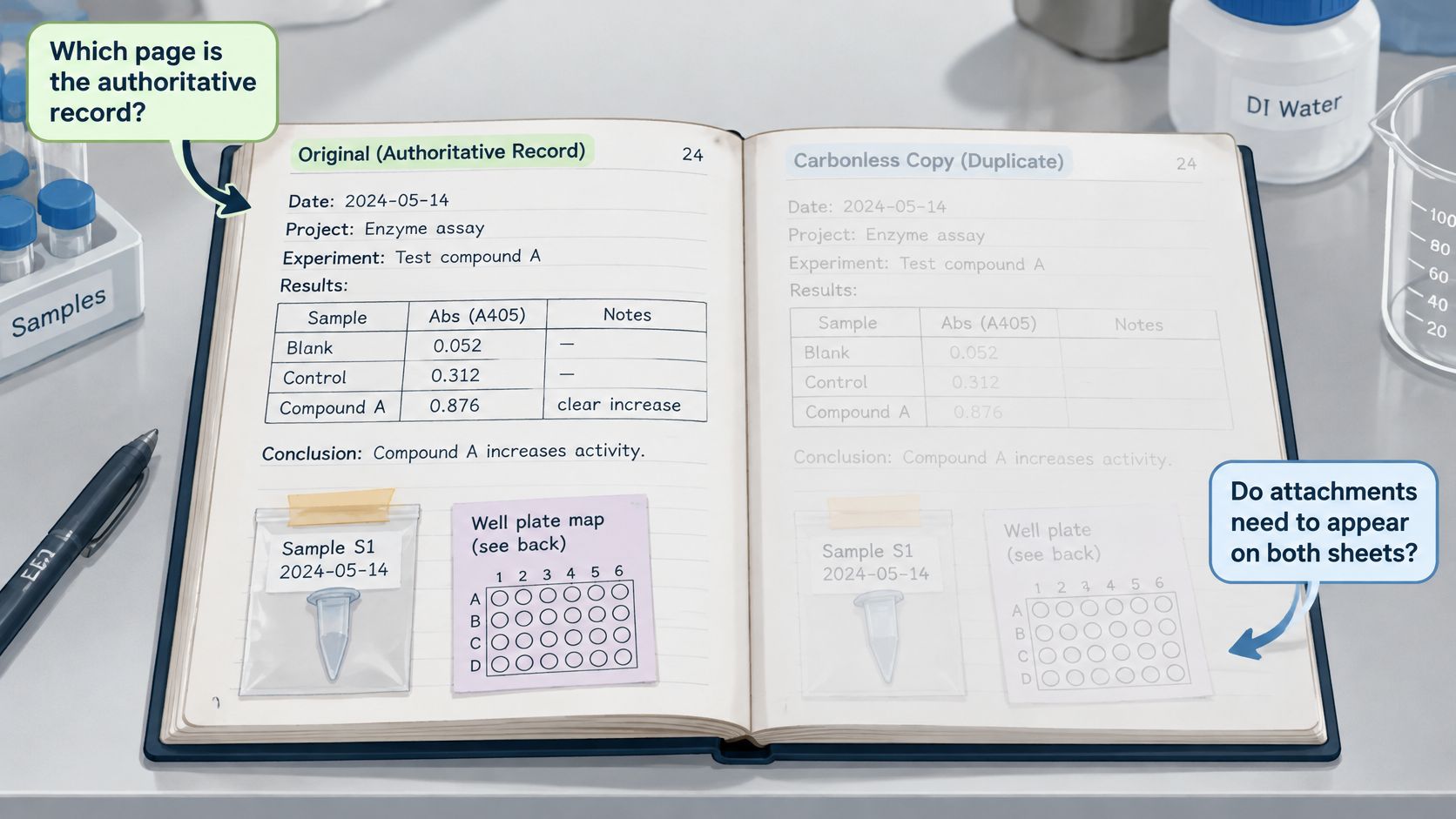
Which sheet is authoritative? Must a spectrum appear on both? What happens when the duplicate is faint? These questions should have answers before the first attachment is pasted down.
The MIT laboratory-notebook guidance calls for firm ballpoint pressure, one-sided writing, sequential recording, legible corrections, and identifiers connecting supplementary material to notebook pages. That last requirement matters when an instrument file or photograph can't fit neatly into the page pair.
Rules for keeping the pair consistent
- Designate the bound original as authoritative. The duplicate serves the role assigned by laboratory policy, such as review or working reference.
- Attach equivalent supporting material to both sheets. Printed graphs, spectra, and spreadsheet analyses shouldn't disappear from the review copy merely because the handwriting transferred.
- Assign attachment identifiers. Record each identifier beside the relevant entry and on the attachment. Large electronic files need a stable reference and controlled storage location.
- Connect label photographs to written material details. A reagent-label image can supplement the entry; the lot identifier should also be readable in the material record.
- Carry corrections through deliberately. When sheets are intended to match, apply the visible correction, explanation, initials, and date to both. A detached duplicate requires a documented amendment route.
- Document failed transfer rather than disguising it. Note the faint or incomplete duplicate on the original and identify the legible source. Don't rewrite the duplicate as though the replacement text transferred during the experiment.
A separately identified scan or replacement copy may be useful when an impression fails. Its status should remain explicit: it's a later reproduction of the source, not the contemporaneous pressure copy.
Two sheets aren't meaningful redundancy when each contains a different fraction of the experiment.
Attachments need a destination
Say an assay page refers to a spreadsheet analysis, but only the original receives the printout. The reviewer now has the observation without the calculation supporting its interpretation. Conversely, a spreadsheet attached only to the duplicate may leave the archive incomplete when that copy departs.
The same problem applies to signatures obtained after separation. The laboratory's good documentation practices should define how later review and amendments remain linked across versions.
The essential decision is therefore not whether the notebook has duplicates. It's which version is archival, which is working, and how subsequent additions reach the appropriate record.
Where Digital Capture Fits Beside a Paper Original
Paper versus electronic is a false choice when the two formats perform different jobs. A laboratory can retain its bound source record while using digital tools to retrieve observations, prepare calculations, and assemble review material.
NIH's electronic laboratory notebook best-practices guidance distinguishes visible paper corrections from electronic correction histories. A PDF or transcription shouldn't be presented as equivalent to the original merely because the text looks the same. Provenance, attachments, timing, amendment history, and review status matter too.
A traceable dual-record workflow
- Keep stable references. Use notebook, page, experiment, and attachment identifiers that survive export and filing.
- Separate observation from amendment. A later typed explanation should retain its actual entry time rather than appearing to have been written at the bench.
- Preserve source captures. Retain the notes, images, and instrument outputs needed to understand the organized record.
- Export readable history. Where the recording system provides an audit trail, retain it alongside the human-readable record under local policy.
The distinction between source and summary isn't limited to handwriting. FDA Good Documentation Practices guidance includes photographs, dictated observations, computer printouts, and instrument-generated information within its discussion of raw data. A spoken observation can therefore deserve deliberate retention, rather than being treated as disposable drafting material.
The capture companion's role
Verbex is a private, on-device experimental capture tool for iPhone and iPad. Scientists choose Objective, Materials, Procedure, Observations, Conclusion, or a custom section before capturing voice notes, typed notes, timer events, or images. The scientist chooses the context; the app doesn't independently decide scientific meaning.
Voice and typed notes preserve timestamps and source context. Supported material-label images can become structured Materials entries through on-device processing when the text is sufficiently legible, not through universal scientific image interpretation.
Review & Complete prepares a source-backed Organized draft for the scientist to check, edit, and complete. Supported devices may also offer an additional ELN-style draft when local Apple Intelligence processing succeeds. Completed records export as PDF, DOCX, or Markdown for deliberate transfer into the laboratory's documentation workflow.
Processing occurs on the iPhone, with no account, cloud AI, cloud storage, advertising, analytics, or tracking. That privacy model doesn't make the app a validated system or an official ELN, and export doesn't mean automatic synchronization.
Before adding a capture layer, the laboratory should confirm which files its electronic lab notebook accepts and how staff will log subsequent amendments. Searchable text is useful only when its relationship to the source remains clear.
Choosing the Right Setup for Your Bench
Setup by bench situation
| Bench situation | Suggested setup | Why it fits |
|---|---|---|
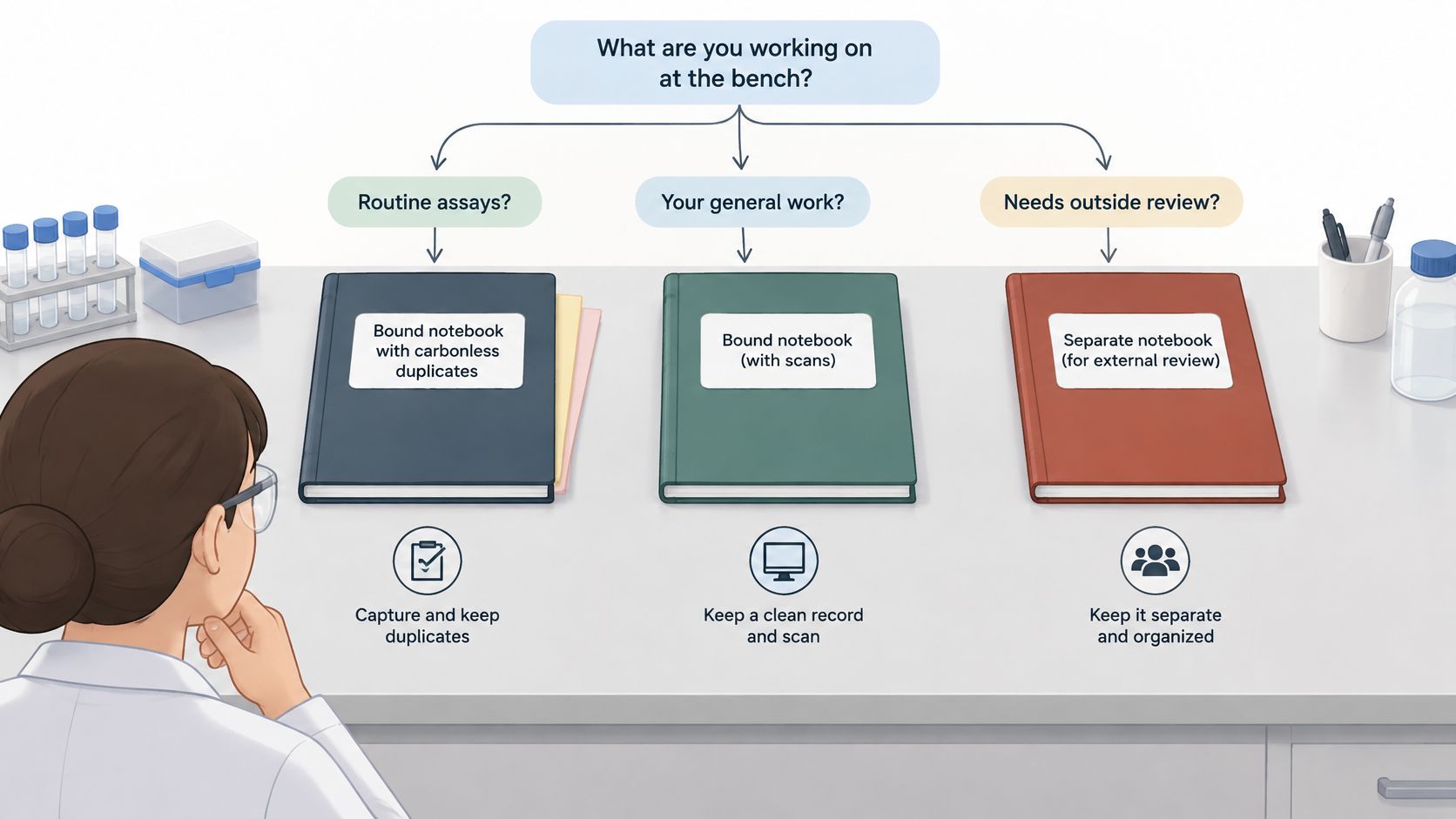
| Routine assays with no outside review | Bound notebook with carbonless duplicates, or plain bound notebook with scans | The original stays bound; scans are made when needed, while carbonless copies form during writing |
| Work that may reach patents or audits | Bound duplicate notebook with witnessed pages, plus an ELN for search | Retains a controlled paper record with review appropriate to institutional policy |
| Multi-person projects needing shared access | ELN as master record where policy permits, duplicates kept at paper-only sites | Supports shared retrieval and logged edits without leaving paper sources unaccounted for |
| Hands-busy steps with timers and images | Capture companion such as Verbex beside a bound notebook or ELN | Preserves bench captures for human review before transfer |
| Nonclinical GLP study | Bound notebook following the applicable entry and correction rules | Uses a quality-assurance-approved recording and retention workflow |
A routine assay doesn't necessarily need a removable copy every day. If nobody uses that copy, a plain bound notebook with controlled scans may be simpler. Carbonless duplicates make more sense when review or submission is a regular part of the work.
For collaborative projects, the laboratory should define the master record rather than letting every scientist choose independently. Otherwise, one colleague may amend the ELN while another continues using an outdated paper copy.
Illustrative PCR workflow
Consider a team preparing a PCR run with bound duplicates as its signed paper record. Before setup, the scientist records the experiment identifier and links the notebook page to the digital capture record.
During preparation, reagent-label photographs preserve material evidence, and timer events document time-sensitive steps. If an interruption delays the next step, the scientist captures the delay and its context instead of reconstructing it after the run.
At review, the scientist checks the organized draft against the source captures and the handwritten entries. The reviewed export enters the ELN through the team's approved transfer process, while the paper pair receives the attachments and review treatment required by policy.
Selection test: The right setup makes an unexpected event easy to record and straightforward to trace later.
The failure mode isn't choosing paper instead of software. It's creating several partial accounts with no agreed reconciliation process. For regulated work, quality assurance should approve that process rather than relying on the notebook's marketing description.
Before the first entry, each team should match its work to a bench situation, identify the authoritative record, and assign responsibility for review.
Confirm Your Notebook Workflow Before Your Next Experiment
- Name the archival original. Record the rule in the notebook's opening pages, including the purpose of removable duplicates and digital exports.
- Check the physical notebook. Inspect binding, numbering, perforations, writing space, transfer quality, and attribution fields against the laboratory's needs.
- Write an attachment and correction rule. Specify identifiers, storage locations, equivalent attachments, and the process for amending an already distributed copy.
- Run a realistic test entry. Include a calculation, a material identifier, a correction, and an attachment reference. Photograph the pair and confirm that the duplicate is readable without consulting the original.
- Agree on review arrangements. The principal investigator or quality team should establish which copy reaches witnesses, the review deadline, and how review is documented.
Turn the rules into a usable scaffold
A workflow is ready when another scientist can follow the test entry without an oral explanation. If the reviewer has to ask where the spectrum lives or which number was corrected, the documentation procedure still needs work.
Verbex's Lab Documentation Pack offers 16 editable templates as 42 Word, Excel, and PDF files, including worked examples and working formulas. Users enter their email on the pack page, and the download starts immediately. The templates are documentation scaffolds, not scientific, safety, legal, or regulatory advice; examples and formulas require local review and validation.
For hands-busy capture, the app remains an optional companion beside the bound original. Its output still needs human review and doesn't replace a bound notebook, official ELN, or validated system.
Scientists can visit Verbal Experiment or Verbex for the Lab Documentation Pack and adapt a documentation scaffold to their laboratory's duplicate-page rules. Verbex for iPhone and iPad, free to download, offers optional voice, typed-note, timer, and image capture for bench events that belong in the reviewed experimental record.