 Blog
Batch Record Documentation: What Must Be Recorded
Batch record documentation is the checked, dated, signed record of one specific batch, reproducing the approved master record and showing what was done, with which materials and equipment, by whom, and what the controls and yield showed.
A timer has sounded, the reagent looks cloudy, and the operator has already started the next transfer. The approved form has space for a result, but nowhere obvious to explain the interruption. That's where useful documentation begins to separate from a form that merely looks complete.
By Multimod Labs.
Table of Contents
- What Batch Record Documentation Must Contain
- Why Weak Records Delay Batch Release
- How to Record the Batch While It Runs
- Sorting Notes Corrections and Investigations
- Reviewing Hybrid and Electronic Records
- Common Batch Record Errors and Remedies
- Carry Source Notes into the Official Record
What Batch Record Documentation Must Contain
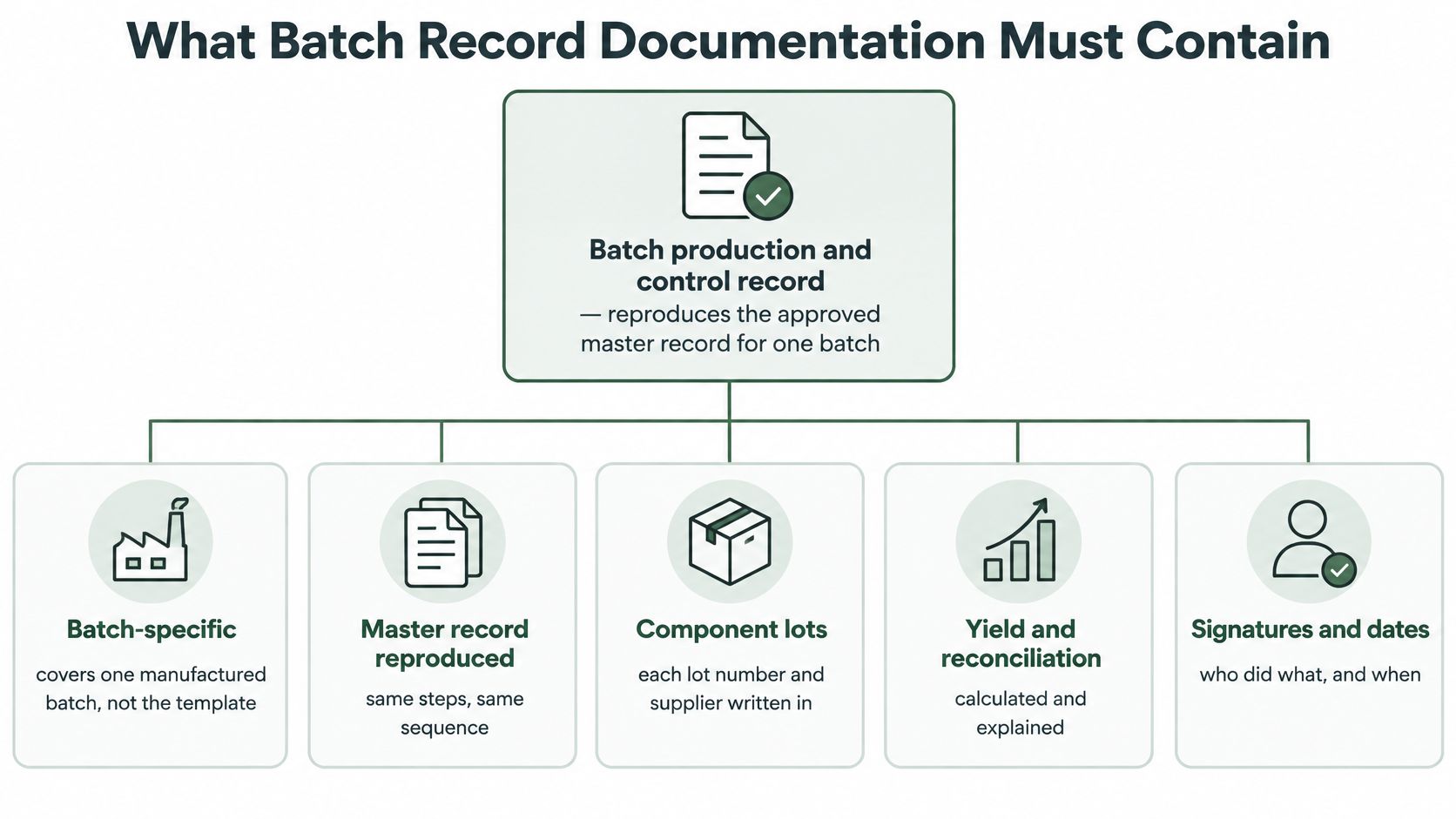
A batch production and control record is the executed history of a manufactured drug-product batch. Under 21 CFR 211.188, it must reproduce the approved master production or control record, be checked for accuracy, dated, and signed, and contain complete information about significant manufacturing, processing, packing, and holding steps.
Three documents serve different purposes:
- Master production or control record: The approved instructions describing what should happen.
- Executed batch record: The batch-specific account of what happened.
- Laboratory source records: Instrument data, notebook entries, observations, and other evidence supporting the executed account.
A source note doesn't become an approved instruction because it contains a sensible adjustment. Likewise, copying a result into the batch record doesn't make its underlying instrument file disposable. The laboratory needs a defined relationship between the instructions, the execution record, and the supporting evidence.
Required contents of a drug product batch record
The following lookup follows the practical sequence of preparation, execution, testing, and review. The capture details translate the regulatory elements into information an operator and reviewer can use.
| Element | What to capture | Why the reviewer needs it |
|---|---|---|
| Accuracy check, date, and signature | Checked copy of the approved master record, dated and signed | Establishes the approved instructions used for this batch |
| Dates of operations | Start and completion of each significant step | Places events in order and supports contemporaneous recording |
| Major equipment and lines | Identity of equipment and processing lines used | Links the batch to cleaning, calibration, and equipment history |
| Component and in-process identity | Specific batch or lot identity of each component and in-process material | Traces materials if a lot is later questioned |
| Weights and measures | Actual quantities used, not only planned amounts | Shows what was charged, not what the recipe assumed |
| In-process and laboratory results | Control results, including failing or suspect results | Supports disposition and prevents selective reporting |
| Inspections of packaging and labeling | Inspection of packaging and labeling facilities before use | Helps identify mix-up risks before packaging |
| Yield | Actual yield and percentage of theoretical yield | Flags loss, mix-up, or an unrecorded step |
| Labeling control | Complete labeling control record and a specimen or copy of labeling | Establishes which labeling was used |
| Containers and closures | Description of drug product containers and closures | Ties packaging materials to the batch |
| Sampling | Sampling performed during the batch | Shows what was sampled and when |
| People | Identity of each person performing, directly supervising, or checking significant steps | Makes execution attributable |
| Investigations | Results of investigations or examinations made | Keeps discrepancies and their assessment within the batch history |
The required elements belong together, rather than in disconnected files that only the original operator can access.
Apply the reconstruction test
A reviewer should be able to reconstruct the batch from the controlled record and its accessible, identified supporting records. A reference such as instrument output attached is inadequate if several unnumbered printouts could fit that description.
Reconstruction test: A filled field isn't necessarily evidence. The entry must identify what happened clearly enough for someone other than the operator to verify it.
The broader GMP documentation requirements help place that batch-specific evidence within the laboratory's documentation practices. If materials, equipment, people, results, yield, or unresolved investigations can't be reconstructed, the record remains incomplete even when every box contains text.
Why Weak Records Delay Batch Release
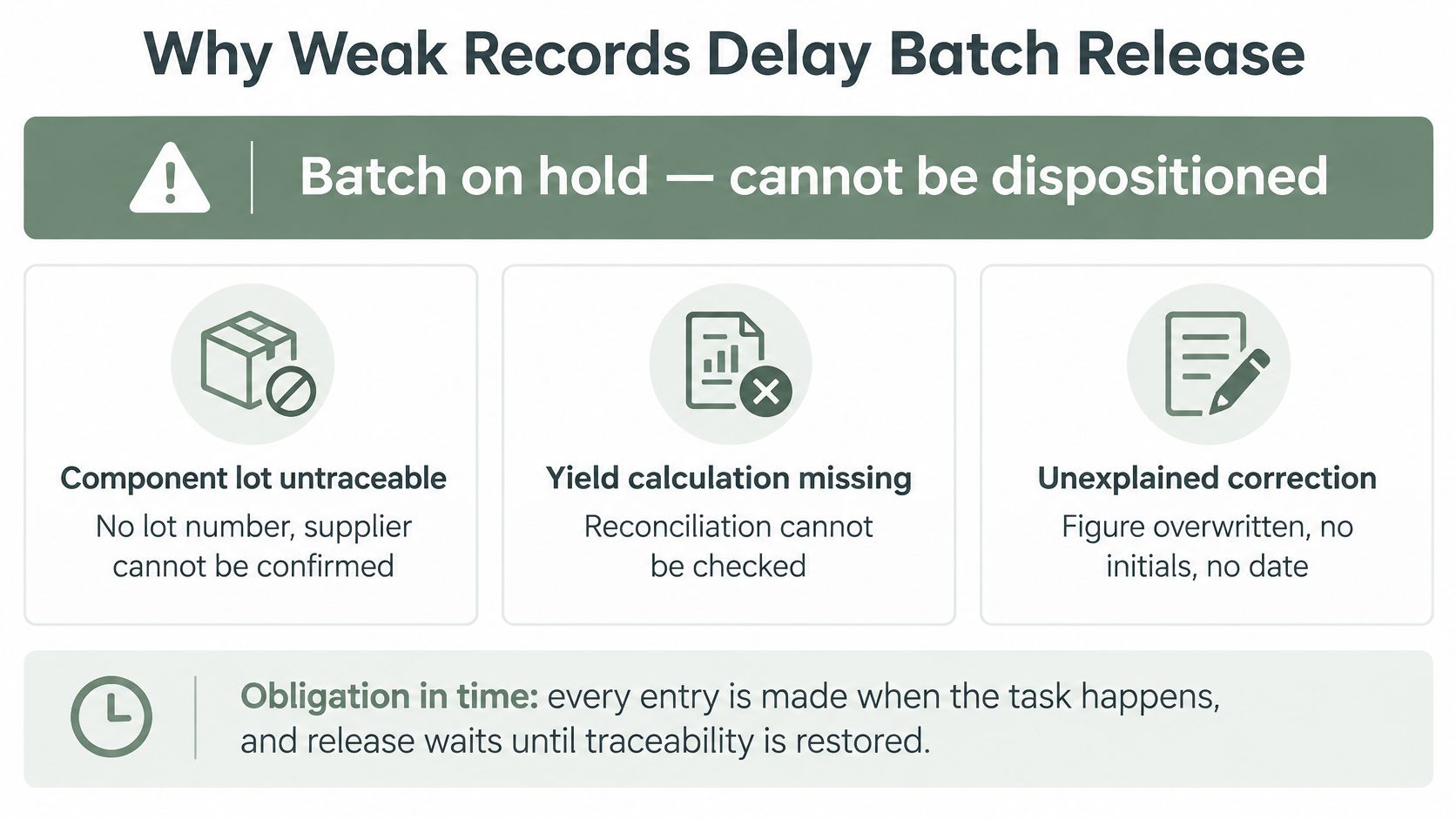
A reviewer reaches the final yield calculation and finds a missing waste quantity. Elsewhere, a component has a catalog number but no lot identity, and a corrected weight has no explanation. Manufacturing may be finished, but the quality unit still lacks the evidence needed to assess the batch confidently.
The obligation isn't new. The published regulatory history of the batch-record rule identifies September 29, 1978, in 43 FR 45077, as its original publication, establishing a production and control record for every manufactured drug-product batch.
What enforcement figures actually show
A 2025 warning-letter analysis published by WFMZ reported 303 FDA warning letters to drug and biologics firms during 2025, with at least 94% of letters reviewed in each analyzed year citing a documentation, recordkeeping, or data-integrity problem in some form. The analysis classified documentation as the primary reason for 15% in 2021, 53% in 2024, and 37% in 2025.
Those are broad documentation findings, not a measured rate of batch-record failures. They don't mean every notebook slip becomes a warning letter, nor do they establish how long an individual batch will remain on hold.
They do show why reviewers treat missing entries, unexplained alterations, and unreliable raw data as quality concerns rather than cosmetic defects.
A batch can meet a specification while its documentation remains insufficient to support a defensible disposition decision.
The practical consequences can include inspection observations, investigations, delayed disposition, and reduced confidence in the batch history. Common gaps are easy to recognize:
Different settings, different obligations
In commercial drug manufacturing, the batch record is a regulated production history. In development, a full manufacturing batch record may not be the applicable legal requirement, but poor source capture still undermines interpretation and technology transfer.
A missing lot number can prevent a development scientist from explaining why a method changed between runs. An unexplained correction can leave a receiving team unable to distinguish a transcription error from a process change.
For a broader manufacturing perspective, American Additive Manufacturing's QA guide provides an adjacent quality-assurance resource, not a substitute for pharmaceutical requirements. At the bench, the useful intervention is narrower: capture the event while its details are still knowable.
How to Record the Batch While It Runs
The timer ends during a transfer. A reagent looks cloudy, but the scientist hasn't established whether that appearance matters. Stopping an unsafe operation takes priority, but postponing all documentation until the bench is clear creates a different problem: the eventual narrative may omit the uncertainty that existed at the time.
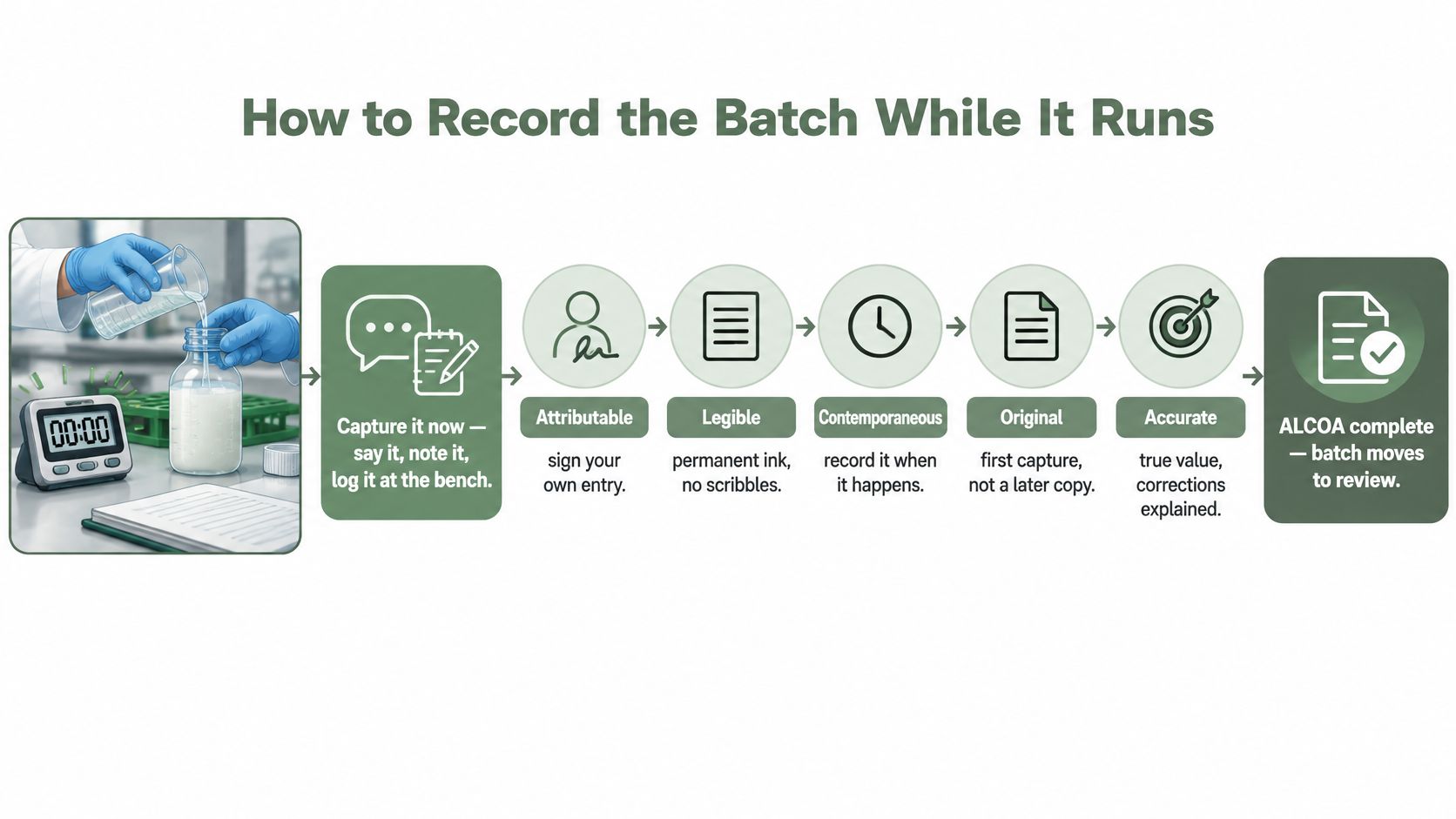
The FDA data-integrity guidance describes ALCOA as attributable, legible, contemporaneously recorded, original or a true copy, and accurate, alongside expectations for complete and consistent data. In working language, the record must show who captured the information, remain readable, reflect the activity when it occurred, preserve its source, and state the facts correctly.
These principles describe the quality of evidence, not just the appearance of a form.
A practical capture sequence
Confirm the starting identity. Establish the approved master or protocol version, batch or experiment identifier, and executing personnel before work begins. A detailed note attached to the wrong experiment is still misleading.
At each significant step, record the actual time, equipment identity, and material lot. Don't replace these with an end-of-day statement that the procedure was followed.
Capture actual weights and volumes. If a spill leads to another weighing or transfer, retain the sequence and distinguish material weighed from material successfully charged. Repeating an action doesn't erase the first attempt.
Enter readings when observed, including values that appear wrong. A surprising result needs context and assessment, not silent exclusion.
Use an approved capture route when hands are occupied. A timestamped voice note, typed fragment, timer record, or photograph can preserve the event, provided its author and batch association are clear. A recording timestamp alone doesn't establish when an earlier action happened.
Keep the original source and identify any transcription. A polished summary should clarify the record without replacing the evidence from which it was prepared.
Check unresolved blanks before leaving. Confirm lot, quantity, person, time, result, and unexpected events while labels, equipment, and witnesses remain available.
For an illustrative charge, the protocol specifies 100 g, while the scientist weighs 99.6 g. The useful entry records both values, the lot, the balance identity, and the time, without assuming that the difference is acceptable or that all weighed material reached the vessel.
Source captures need a defined destination
FDA also explains that inspectors may review records not created specifically for CGMP purposes when those records contain CGMP information. A timing note or image therefore can matter as evidence; calling it informal doesn't remove its relevance.
A private, on-device capture app can hold voice notes, typed notes, timers, and images pending review, but it doesn't replace the official batch record or ELN. In regulated areas, device use and the capture method must fit approved site procedures.
Outside pharmaceuticals, Lianyuhong Technology PCB assembly stages offer a useful comparison for mapping documentation to execution stages. That comparison concerns workflow design, not pharmaceutical acceptance criteria.
Sorting Notes Corrections and Investigations
A pipetting step fails, and the scientist doesn't yet know whether the batch is affected. The first entry should describe the failed action and immediate response, not prematurely declare no impact.
Capture and classification are separate decisions. Capturing the facts shouldn't wait for a final quality assessment, and an observation label must never become a way to avoid required escalation.
How to classify an event in the batch record
| If this is true | Call it | Keep visible |
|---|---|---|
| Something was seen or done and its impact isn't yet known | Observation | Original note, time, person, and sample or batch identity |
| The entry was wrong but the action itself followed the instruction | Correction | Original entry, new entry, person, time, and reason |
| The action departed from the approved instruction or an unexpected event may matter | Deviation | What differed, when it was found, immediate action, and later assessment |
| A result or discrepancy is unexplained, out of specification, or requires formal examination | Investigation | All related results, scientific justification, and conclusion in the batch record |
These labels aren't mutually exclusive stages. An observation may identify a deviation, and that deviation may require an investigation under the laboratory's procedures.
The FDA guidance on data integrity makes the important constraint clear: retained records include errors and passing, failing, or suspect results, and invalidating data requires a scientifically justified investigation. An inconvenient result isn't an entry error merely because a repeat passes.
The same event in different settings
Consider a missed incubation endpoint. In an exploratory development experiment, the scientist may document the timing difference as an observation, explain its implications, and limit how the result is interpreted.
In manufacturing, departure from an approved incubation instruction is a deviation for quality assessment. The operator shouldn't convert it into a correction by entering the intended endpoint instead of the actual one.
A protocol deviation log template can help separate the departure, immediate action, and subsequent assessment. Polymerize's discussion of audit trail requirements for labs is also useful when designing how changes remain attributable and reviewable.
What a supplementary note must preserve
- Event time and note time: Distinguish when the activity occurred from when the explanation was entered.
- Person and identity: Name the author and the affected batch, experiment, or sample.
- Facts and immediate decisions: State what happened, what remained uncertain, and what action was taken.
- Official-record reference: Identify where the note belongs and how reviewers can retrieve its source.
Classification rule: Correct the entry when the entry is wrong. Assess the event when the work departed from the instruction.
More blank fields won't fix a habit of reconstructing the day after the evidence has disappeared.
Reviewing Hybrid and Electronic Records
An electronic batch record can display a complete result while omitting the context needed to interpret it. Software can flag missing fields and configured limit breaches, but a correctly entered value can still belong to a scientifically questionable sequence.
Review by exception reduces workload, not review responsibility. The WHO guideline on data integrity emphasizes access to original electronic data and metadata, review of relevant audit trails and atypical results, and records that remain enduring and readable throughout retention.
A correct transcription can still be incomplete
Consider an illustrative chromatography run. The reported concentration was transcribed accurately into the batch record, but the injection time and an observation about a leaking vial remained on an unlinked paper scrap.
The transcription check passes. The contextual review fails because the reviewer can't assess whether the vial condition affected the reported result or its interpretation.
An electronic batch record is therefore worth evaluating by how evidence is captured and reviewed, not merely by whether the completed screen resembles the paper form.
Reconcile the evidence across systems
A hybrid review needs explicit checks:
- Operator identity: Reconcile the person performing the work with instrument, ELN, LIMS, and batch-record attribution.
- Timestamps: Compare execution, acquisition, entry, and amendment times, including documented clock differences.
- Material and result identity: Match lot numbers, sample identifiers, reported values, units, and result status.
- Authoritative source: Establish which record owns each data element and how copied values remain traceable.
- Review scope: Include relevant audit trails, deviations, out-of-trend and out-of-specification results, and unexplained discrepancies.
- Retention and readability: Confirm that attachments, metadata, and necessary electronic functionality remain available.
An exception engine also needs evidence that its rules cover the intended review scope and operate correctly under validated conditions. A blank exception list proves little if the system wasn't configured to recognize the relevant event.
A practical design is often structured fields for release-critical information plus retained, timestamped observational notes for context. That arrangement needs defined source authority, retention, review, and quality approval; digitization alone doesn't supply them.
Common Batch Record Errors and Remedies
Recurring documentation errors become easier to address when the remedy restores evidence rather than merely improving presentation. A reviewer needs to distinguish a recoverable omission from an event that requires assessment.
The closeout check should examine the evidence behind the completed fields.
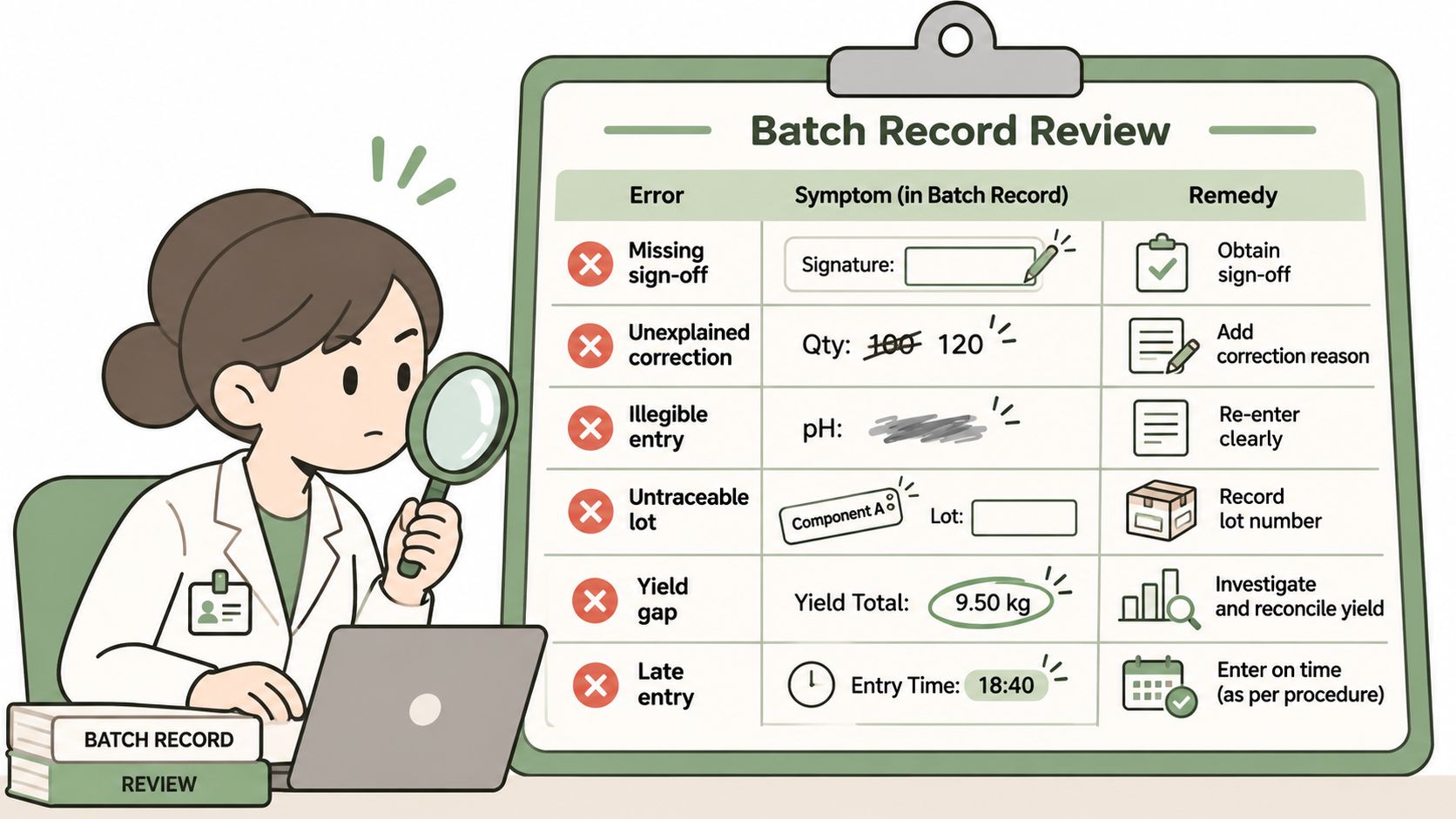
Batch record errors, symptoms, and remedies
| Error | Visible symptom | Remedy |
|---|---|---|
| Blank critical field copied as not applicable | Lot, balance, or operator missing | Add the supported value with a dated explanation, never a later guess |
| Same-day rewrite | Afternoon narrative replaces glove notes | Keep the original source and attach a reviewed transcription |
| Silent correction | Number overwritten and first entry unreadable | Recover the original from reliable evidence if possible; document the change, person, time, reason, and any unrecoverable gap |
| Orphan result | Out-of-specification value exists only in an instrument file | Link it to the batch history and initiate the required examination |
| Yield cannot be recalculated | Units differ or waste is omitted | Show arithmetic, units, and documented waste or losses |
| Unlinked attachment | Photo or chromatogram cannot be found | Identify the batch, step, attachment, and retention location |
A critical field marked not applicable can conceal missing execution evidence. It needs a justified explanation, not a convenient abbreviation, and the correction must not be backdated.
A same-day rewrite removes the original sequence and uncertainty if the source is discarded. Retaining that source matters even when the transcription is easier to read.
Silent correction prevents the reviewer from understanding the change. Correction fluid, overwriting, and reconstructed originals aren't remedies; when the first entry can't be recovered, that limitation itself needs documentation and assessment.
Fix the evidence, not the appearance
An orphan result makes the batch history look cleaner than the available data. It must be connected to the affected work, not invalidated because it complicates disposition.
Unreconciled yield prevents the reviewer from checking where material went. Unsupported waste estimates should never be inserted to make the arithmetic balance.
An unlinked attachment leaves the reviewer unable to establish whether the image or chromatogram belongs to the batch at all. Renaming a file helps retrieval only when its identity and retained source are also established.
The embedded video provides an additional viewing resource alongside the written checks.
A five-minute closeout checklist
Before handoff, the operator checks:
- Identity: Product, batch or experiment, and approved instruction version agree.
- Lots and quantities: Materials are traceable, with actual amounts and units.
- Times and people: Significant actions have attributable execution entries.
- Results: Passing, failing, suspect, and repeated results remain connected.
- Yield arithmetic: Inputs, outputs, units, and documented losses can be followed.
- Open events: Deviations and investigations have references and a clear status.
- Attachments: Supporting records are identified, readable, and retrievable.
If an error changes the account of what happened, its classification must be resolved before deciding how to amend the record. Development laboratories can use the same closeout habits without treating the checklist as proof that manufacturing requirements apply to every experiment.
Carry Source Notes into the Official Record
The practical decision is straightforward: record the event when it happens, retain its source, and transfer checked facts into the official batch record or ELN. The official entry should distinguish established facts from interpretation and identify any unresolved assessment.
A useful handoff preserves context without copying every fragment into every field. Release-critical facts belong in their controlled locations; supporting notes need an accessible reference, a defined retention route, and review appropriate to their content.
A capture companion, not the official system
Verbex is a private, on-device lab documentation app for iPhone and iPad. Scientists select Objective, Materials, Procedure, Observations, Conclusion, or a custom section, then capture voice notes, typed notes, timers, and images. Review & Complete prepares a source-backed Organized draft for the scientist to check, edit, and complete, with completed records exportable as PDF, DOCX, or Markdown.
Processing stays on the iPhone, with no account, cloud AI, cloud storage, advertising, analytics, or tracking. Verbex doesn't independently decide a note's scientific meaning.
Its role has explicit limits:
- Not an official system: It isn't an ELN, LIMS, QMS, or validated batch-record system.
- Not regulatory approval: It doesn't guarantee compliance, satisfy ALCOA by itself, sign records, or perform regulatory sign-off.
- Not automatic transfer: Exports can enter an existing workflow, but there's no implied automatic ELN synchronization.
Verbex can support clearer contemporaneous documentation and audit preparation when the laboratory defines how captures are reviewed and filed. It also offers a free Lab Documentation Pack with 16 editable templates in 42 Word, Excel, and PDF files, including worked examples and working formulas.
Those templates are documentation scaffolds, not scientific, safety, legal, or regulatory advice. Their CC BY 4.0 license permits use, sharing, and adaptation for any purpose with credit to Verbex; examples and formulas still require local review and validation.
Verbex offers a capture companion for preserving interruptions, observations, and actual execution details before they become an afternoon reconstruction. Visit Verbal Experiment or Verbex for Verbex for iPhone and iPad, free to download. For the next run, capture events in real time through the laboratory's approved process, then complete the official record from those checked sources.