 Blog
Science Experiment Documentation: Lab Notes That Hold Up
Usable science experiment documentation lets another trained scientist establish what happened, in what order, with which materials, and why the work departed from the plan. When a timer is running and a tube looks wrong, the useful record starts with that observation, not with a polished explanation written afterward.
By Multimod Labs.
Table of Contents
- What Makes an Experiment Record Usable
- The Parts of a Complete Experiment Record
- Minimum, Shared and Audit-Ready Record Tiers
- How to Capture Deviations and Failed Runs as They Happen
- Correcting Records Without Erasing What Happened
- Privacy, ELN Handoff and a Pre-Run Checklist
What Makes an Experiment Record Usable
A usable experiment record allows a colleague to reconstruct the work without questioning the person who performed it. Say a labmate tries to repeat a result months later and finds only a note saying the buffer changed. There's no lot number, time, reason, or indication of which samples received the replacement.
That omission doesn't prove the result was wrong. It prevents the colleague from establishing which conditions produced it, and the original scientist may no longer remember.
Tests that expose missing information
- The repeat test: Could a trained colleague rerun the work using the record and its linked protocol, without guessing at materials or settings?
- The order test: Could a reviewer rebuild the experimental sequence, including additions, incubation windows, measurements, and interruptions?
- The change test: Does the record separate the intended method from what was really done?
A simple experimental diagram can clarify the planned sequence, but the working record must also preserve departures from it.
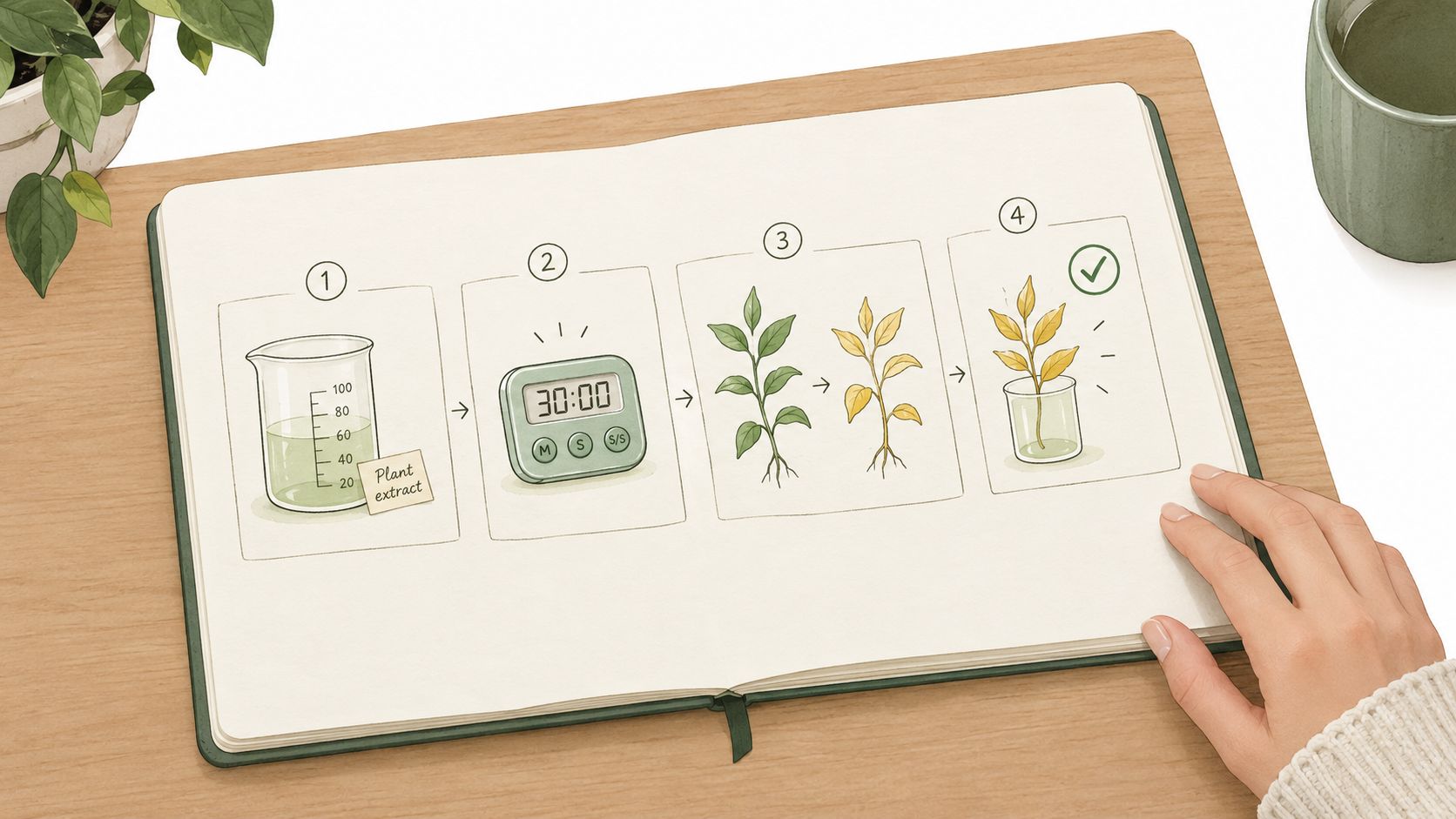
Records often fail during the bench moment: gloves are on, hands are occupied, and an observation remains in memory while the scientist handles something more urgent. Making the final entry longer won't recover an unrecorded event.
The workload matters. In 2024, 42% of laboratory scientists surveyed by SelectScience reported spending more than five hours per week on administrative, compliance, and validation tasks, including documentation.
Practical rule: Capture the fact while it exists. Improve its organization later.
A useful documentation system therefore needs more than tidy headings. It needs defined record components, an appropriate completeness tier, a manageable capture routine, visible corrections, and a deliberate handoff into the laboratory's official record.
The Parts of a Complete Experiment Record
The working checklist below gives each future question a place in the record. Its example entries are illustrative, not validated experimental instructions; exact fields should reflect the discipline, assay, and laboratory quality system.
Components of a complete experiment record (illustrative entries)
| Component | What to write | Example entry (illustrative) |
|---|---|---|
| Objective | The question the run answers, in one or two sentences, written before the run | Does compound X reduce signal at 10 µM? |
| Materials | Name, supplier, catalog number, lot, expiry, working concentration | Compound X; Supplier A; catalog CX-A; lot BX; expiry transcribed from attached label; working concentration 10 µM |
| Procedure | Protocol name and version, with each planned step | Reporter assay, version B; attached steps cover preparation, addition order, incubation, and acquisition |
| Observations | Raw, timestamped notes on what was seen, measured, or heard | 14:20, faint precipitate at bottom of tube 3 |
| Deviations | Any departure from plan, with reason and who decided | Replacement buffer used after visible particles were found; decision by operator AB; affected samples identified |
| Results | Raw data file names and processed outputs, kept as separate files | Raw: run_A_native.dat; processed: run_A_analysis_vB.csv; processing script attached |
| Conclusion | Interpretation, labeled as interpretation and linked to observations | Signal drop consistent with inhibition; repeat before claiming effect |
| Metadata | Operator, date and time, instrument settings, software version | Operator AB; acquisition date and start time; reader settings file; installed software version copied from instrument |
Give every component a distinct job
The objective establishes what the experiment can answer. A broad project aim isn't enough: an experiment comparing treatment conditions needs a narrower question than whether a pathway matters.
Materials identify what entered the experiment, not merely what appeared on a purchasing list. For a prepared solution, the record should distinguish the stock identity from the working concentration and connect the preparation to its source materials.
The procedure provides the baseline against which deviations can be understood. Copying an old entry and changing its title is risky when the underlying method has changed.
Observations preserve what the operator detected. A cloudy tube is an observation; precipitation caused by the compound is an explanation that needs support.
The WHO guideline on data integrity connects defensible documentation with attributable, contemporaneous, original, accurate, complete, consistent, enduring, and available records. In practical terms, a completed template still needs identifiable source evidence behind its entries.
Connect observations to outputs
A results section should identify the actual files, not merely state that data were saved. A figure needs a route back to the measurements and processing that produced it.
For laboratories moving between experimental notes and production documentation, Peptide Warehouse USA's resource on understanding peptide manufacturing records offers a related context for thinking about batch-level records. It shouldn't substitute for the laboratory's own experimental template or approved procedures.
The conclusion then states what the scientist thinks the observations mean, with uncertainty intact. Metadata makes the whole record attributable and technically interpretable.
The working order is deliberate: preserve raw facts first, then separate interpretation from evidence.
Minimum, Shared and Audit-Ready Record Tiers
A spreadsheet cell containing a signal value isn't a self-explanatory scientific result. Without the acquisition method, processing settings, creator, and associated sample, a collaborator can't determine whether it represents a biological difference or a handling change.
A research-data-management review identifies creation time, creator, method, file format, and software context as important metadata, and recommends documentation such as readme files and data dictionaries. The practical lesson is to treat the experiment record as a source-backed dataset, not isolated prose.
Set the intended use before work starts
These tiers are cumulative planning categories, not certifications. The record header should identify the intended tier before the run, so operators know which information must survive the handoff.
Record tiers by purpose
| Tier | Fields that must be present | When it applies |
|---|---|---|
| Minimum for replication | Objective, exact materials with lots, protocol version, deviations, failed attempts, timestamps, instrument settings | Any run another trained scientist might repeat |
| Shared with collaborators | Minimum tier plus sample identifiers, analysis assumptions, and file locations for raw data | Handoff inside a project or to an outside partner |
| Audit or regulated context | Shared tier plus attributable entries, full change history with reasons, and preserved original entries | GLP, GMP, or GCP work, checked against the lab's own quality system |
The minimum tier isn't permission to omit inconvenient outcomes. Failed attempts establish which conditions were tried and where the procedure stopped working. Without those entries, another scientist may repeat an unsuccessful approach without knowing it.
Sample identity and provenance also belong in the minimum record whenever they affect replication. The shared tier adds collaborator-facing identifiers and explanations that make the record understandable outside the operator's immediate context.
The shared tier must let a collaborator move from observation to analysis to figure. The NIH Data Management and Sharing Policy overview states that shared data should enable validation and replication of research findings; a usable handoff therefore needs more than final images and a methods paragraph.
More fields don't automatically create a better record. Each field should help someone repeat, interpret, locate, or review the work.
Audit readiness depends on the surrounding system
The audit tier needs laboratory-specific decisions about access, retention, review, and permitted corrections. A detailed note in an ordinary document doesn't become a validated electronic record just because it contains timestamps.
The practical questions in FDA data-integrity guidance for laboratory records can help frame a discussion with the laboratory's quality lead. The applicable quality system, rather than a generic checklist, determines what audit-ready means for that work.
How to Capture Deviations and Failed Runs as They Happen
Deviations are easiest to lose precisely when they happen. An operator notices a missed addition, resolves it, and continues, leaving the undocumented decision to be reconstructed later from memory.
The Agilent explanation of ALCOA+ defines contemporaneous recording as documenting data when work is performed and attributable recording as linking entries to their creator. It also emphasizes original records and completeness, including information that doesn't fit the expected outcome.
The visual below condenses the capture habits. The routine that follows adds two things the image can't show: who authorized the change, and how certain the observation was.
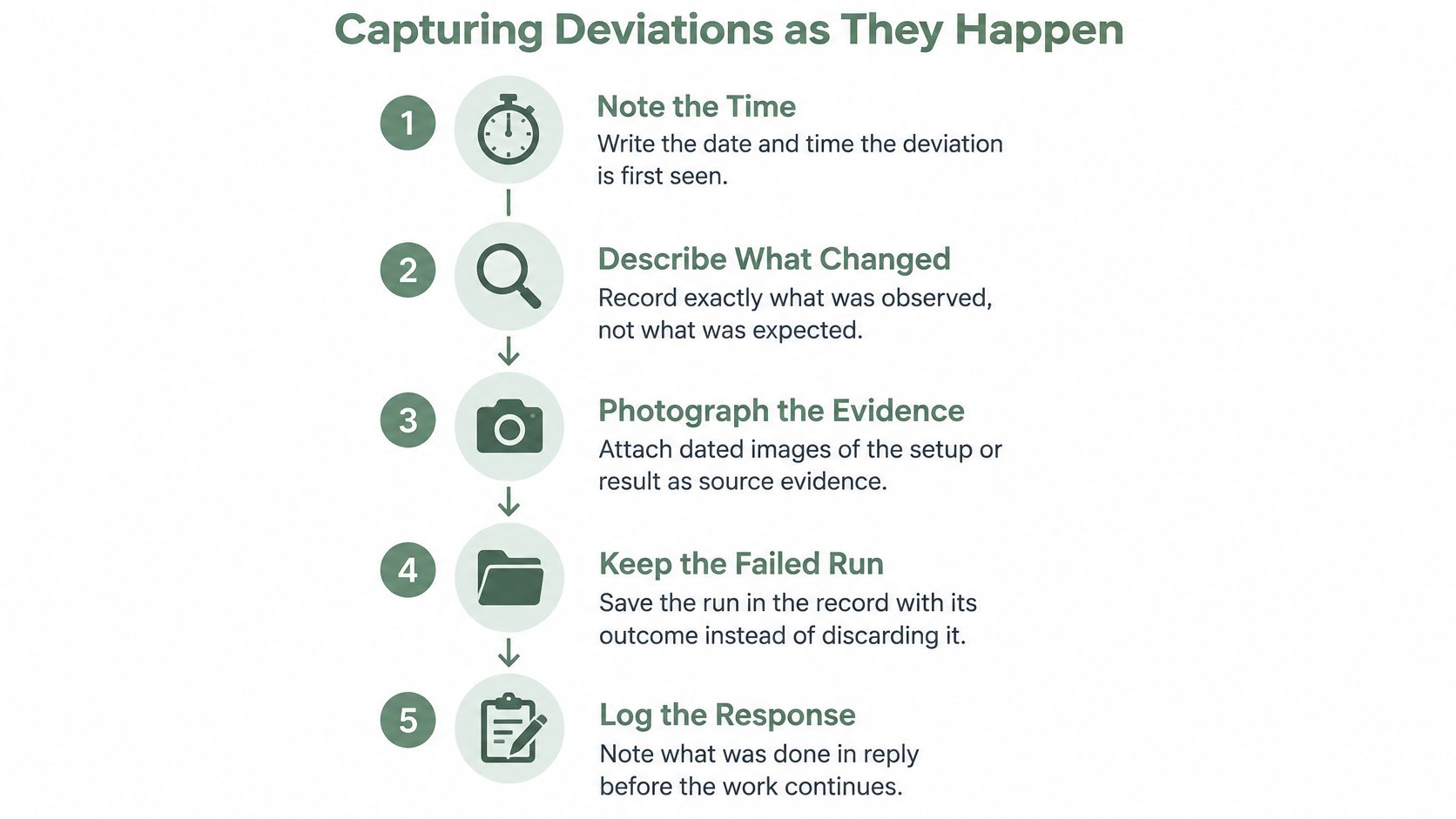
A bench routine that preserves the exception
- Record the time and change immediately. A short entry tied to the affected tube, sample, or step is more useful than a detailed recollection after cleanup.
- Describe the observation before its explanation. Visible particles and suspected contamination belong in separate statements because one is observed and the other inferred.
- State the response and reason. The record should identify what happened instead of the planned action, including a decision to stop.
- Name the decision-maker. When someone else authorizes the change, their identity belongs with that decision.
- Attach useful source evidence. A photograph, instrument output, or timer log should support a specific event rather than sit in an unrelated attachment folder.
- Mark uncertainty explicitly. An entry such as color unclear under hood light is more honest than assigning a confident color afterward.
- Keep later thoughts separate. A dated follow-up can add context without making the initial observation appear more certain than it was.
A voice note, typed note, timer event, or photograph can provide the initial capture, depending on the event and the laboratory's device rules. A photograph alone won't explain why an operator changed the procedure; a dictated note won't establish a reagent lot if the label was never checked. The tool's job is to get the entry down with its time and source attached. Verbex, an iPhone and iPad app covering bench notes, transcription, and dilution and curve calculations, can hold a timestamped record during the run; what a note means scientifically stays the operator's call.
Keep the unsuccessful attempt
A failed run needs its actual conditions, the point at which it became unusable, and any suspected cause clearly labeled as a hypothesis. A deviation captured at the bench becomes a field in that run's dataset; the same detail written up after cleanup is a reconstruction, and a collaborator reading the record later can't always tell the difference unless the entry says so. Guidance on documenting unexpected results should connect the failure to the next test so the run stays usable as evidence.
Correcting Records Without Erasing What Happened
Tidying an old entry can destroy useful evidence. A correction should add to the record, not silently replace what the operator originally wrote.
FDA guidance on electronic records identifies audit-trail information including changes, the individual responsible, the date and time, and, where appropriate, the reason. It also recommends searchable, sortable audit trails; static formats such as PDF should clearly correspond to the relevant records or data elements.
A timestamp isn't a complete audit trail
Under 21 CFR 11.10(e), as described in FDA guidance on computerized systems used in clinical trials, applicable regulated electronic-record systems must independently capture creation, modification, and deletion without obscuring earlier information, with audit trails retained at least as long as their associated records and available for agency review and copying.
That doesn't make every informal bench note subject to Part 11. It does explain why a timestamp on the latest document isn't equivalent to a protected history of changes.
Correcting common record errors
| Situation | Avoid | Do instead |
|---|---|---|
| Wrong concentration written down | Overwrite the original value | Add a dated correction with reason and initials, keeping the original visible |
| Reagent lot recorded from memory | Fill in a lot number that looks right | Correct from the label photo or stock record, marked as a correction with its source |
| Protocol changed mid-project | Edit the old SOP in place | Issue a new version number and cite the version in each record |
| Raw file reprocessed | Replace the raw data file | Keep raw data unchanged and save the new analysis as a named version |
| Conclusion revised after repeat | Delete the earlier conclusion | Add a new dated conclusion that links to the earlier one and to the new data |
Separate correction from reconstruction
A correction fixes a known error using identifiable evidence. Reconstruction attempts to recover missing information after the event, and the record should label that distinction.
If a reagent lot can't be established from a label, stock record, or other reliable source, the entry should remain unresolved. A plausible lot number is worse than an explicit gap because it gives later readers false confidence.
Review standard: A polished record should never appear more certain than its source evidence.
For a general explanation of how event histories support traceability, the SIX ERP guide to audit trails provides useful terminology. Laboratory-specific correction requirements still come from the applicable procedures and systems.
Visible notes make the distinction between original observations and later interpretation easier to inspect.
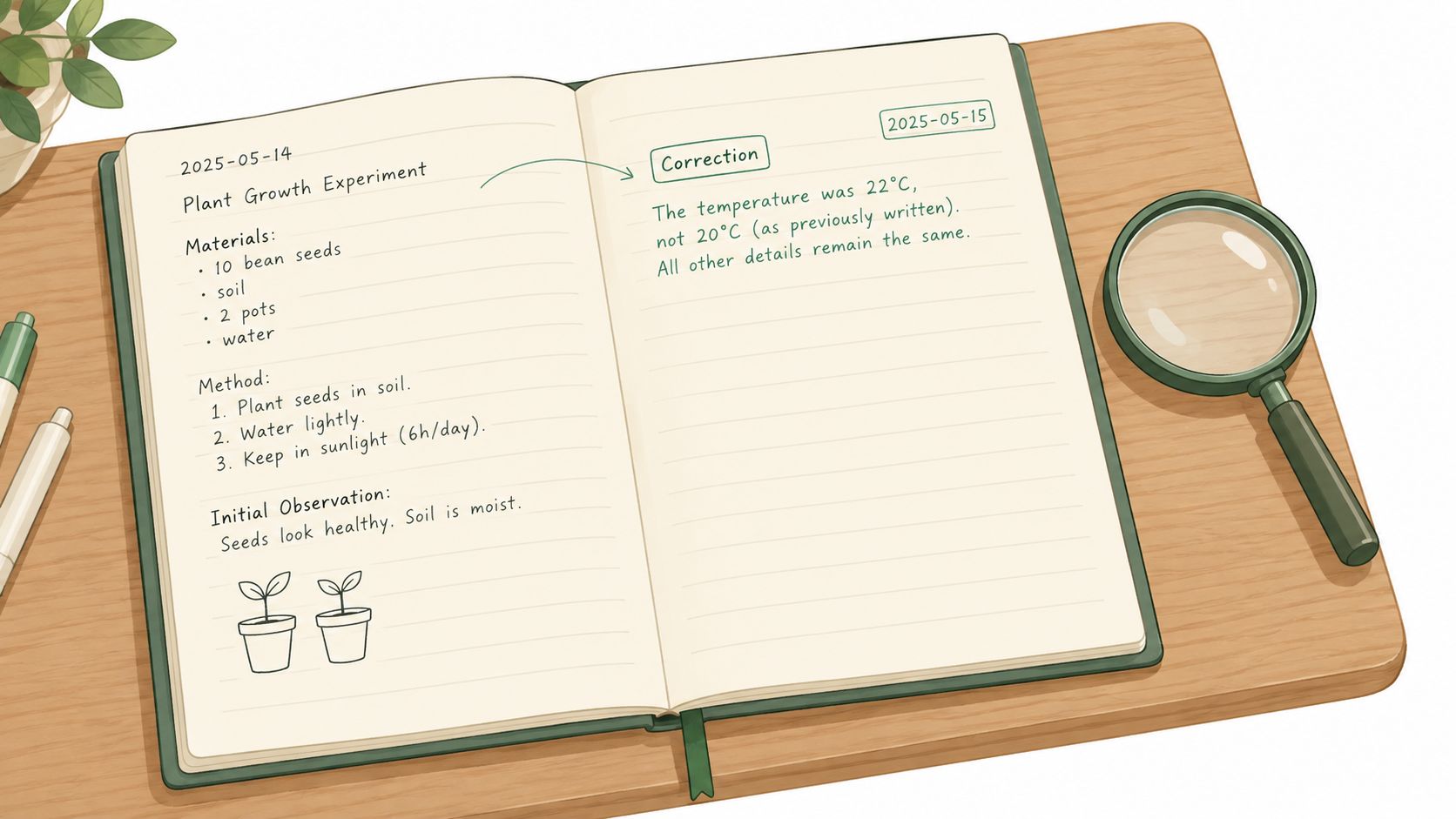
The laboratory should settle its correction rules before a disputed entry appears. Retrofitting an audit trail can't recreate a history that the system never retained.
Privacy, ELN Handoff and a Pre-Run Checklist
Privacy decisions belong in the record plan before the run starts. Unpublished results, human-derived samples, and commercially sensitive materials each need an owner, an access rule, and a reason for release; the minimum dataset for replication can stay intact while identifiers, donor details, locations, or proprietary formulations move to a restricted layer.
The IBEC research-data workshop materials address metadata, safe storage, preservation, and sharing as connected parts of data management. A practical default keeps working notes private, releases the authorized subset, and leaves enough context with that subset for a recipient to interpret it without seeing the whole notebook.
Map the record before exporting it
As of June 30, 2024, NIH Intramural Research Program policy required investigators to use electronic resources exclusively for documenting new and ongoing research. That requirement is specific to the intramural program, not a universal rule for every laboratory.
Treat ELN readiness as a mapping task rather than a copy task:
- Map sections: Identify where objectives, materials, observations, deviations, and conclusions belong in the receiving ELN.
- Test attachments: Establish whether raw files, label images, and other evidence can travel with the entry.
- Choose the export tier: Include the context the recipient needs and exclude information they aren't authorized to receive.
- Verify the format: Open a representative export in the actual receiving workflow before relying on it.
A clean handoff keeps raw readings, processed tables, and interpretation separate so later corrections attach to the right object. Privacy also requires practical decisions about device access, backup, retention, and approved storage. The considerations in local data storage for laboratory documentation help distinguish private capture from an adequate institutional preservation plan.
A checklist for the next run
Before the run
- Define the record: Put the objective, intended completeness tier, and access limits in the header.
- Identify inputs: Record materials, lots, expiry information, sample provenance, and protocol version.
- Prepare capture: Select a hands-busy capture method that fits local safety and device rules.
During the run
- Preserve exceptions: Apply the deviation routine to changes, interruptions, and unexpected observations.
- Retain evidence: Connect captures to the affected sample or procedural step.
After the run
- Review promptly: Check the record the same day where practical, resolving gaps from evidence rather than memory.
- Check decisions: Confirm that deviations include reasons and responsible people.
- Prepare the handoff: Keep raw and processed files distinct, verify references, and label conclusions as interpretation.
Verbex offers a free Lab Documentation Pack with 16 editable templates across 42 Word, Excel, and PDF files, including worked examples and working formulas, to help laboratories establish a usable experimental record. The templates are documentation scaffolds, not scientific, safety, legal, or regulatory advice, and their examples and formulas require local review and validation. Visit Verbal Experiment or Verbex to select a template for the next run and establish the required fields before bench work begins.