 Blog
Stock Solution Calculator: Formulas, Steps and Examples
A reagent bottle is beside the balance, the protocol specifies a stock concentration, and the calculator is waiting for a molecular weight. A stock solution calculator can determine the mass to weigh or the stock volume to dilute, but only after the scientist identifies the concentration basis and reagent form correctly.
The arithmetic is usually straightforward. A mass calculated with the wrong hydrate molecular weight or the wrong percent basis can produce a clear solution that looks normal and has the wrong concentration.
By Multimod Labs.
Table of Contents
- Stock Solution Formulas by Case
- Worked Examples for Molar and Percent Solutions
- Unit Traps That Ruin Stock Solutions
- How to Make a Stock Solution Step by Step
- Test the Calculator and Check the Numbers Before You Weigh
Stock Solution Formulas by Case
For a solid reagent specified in molarity, the starting formula is:
Mass in grams = molarity × final volume in liters × molecular weight
In an illustrative preparation of 0.5 M NaCl in 500 mL, using 58.44 g/mol, the calculation gives about 14.6 g. The volume represents the finished solution, not the amount of water initially poured into the vessel.
Choosing the concentration basis
A percent weight-per-volume preparation uses a different relationship:
Grams = (% w/v × final mL) / 100
Here, the percentage is entered as its stated number, not as a decimal fraction. Percent w/v means grams of solute per 100 mL of final solution.
For dilution, conservation of solute gives C₁V₁ = C₂V₂. Rearranging gives the stock volume required; subtracting that volume from the final volume gives the nominal diluent volume.
Stock solution formulas by case
| Case | Formula | Units and notes |
|---|---|---|
| Mass for a molar stock | g = M × L × MW | M in mol/L, L in liters, MW in g/mol |
| Mass for a percent w/v stock | g = (% w/v × final mL) / 100 | % w/v means grams per 100 mL |
| Stock volume for a dilution | V₁ = (C₂ × V₂) / C₁ | C₁ is stock, C₂ is target, V₂ is final volume |
| Diluent volume to add | V diluent = V₂ − V₁ | Same volume unit as V₂; assumes additive volumes |
| Dilution factor | Factor = C₁ / C₂ | Same concentration unit for both terms |
For example, a 10x stock requires one part stock and nine parts diluent to reach 1x. A tenfold dilution means ten total parts, not ten parts of diluent.
Concentrated liquid reagents
For a liquid specified as percent w/w:
Molarity = (% w/w × density in g/mL × 10) / MW in g/mol
As an illustrative input set, 37% w/w HCl with density 1.19 g/mL and molecular weight 36.46 g/mol gives approximately 12.1 M. Actual preparation requires the supplier's concentration and density, appropriate handling controls, and acid added to water.
Unit check: Every term should cancel to the intended output unit before any material reaches the balance.
Convert mM and µM to M when using a molarity-based mass formula. For buffered preparations, the buffer calculator guide provides related context, but pH adjustment remains a separate preparation decision.
The appropriate table row is the one matching the protocol's concentration basis, not whichever row has the fewest inputs.
Worked Examples for Molar and Percent Solutions
These examples are illustrative calculations, not preparation specifications for an unidentified reagent. Actual work requires the molecular weight, concentration, solvent, and chemical form recorded on the relevant bottle or supplier documentation.
Molar stock from a solid
Consider a target of 0.5 M NaCl in 500 mL, using an illustrative molecular weight of 58.44 g/mol:
m = C × V × MW
m = 0.5 mol/L × 0.500 L × 58.44 g/mol = 14.61 g
The unit cancellation is the useful check: mol/L multiplied by liters gives moles, and moles multiplied by g/mol gives grams. The scientist dissolves the calculated mass in less than the final volume, then brings the solution to 500 mL.
A reverse calculation checks the result:
(14.61 g ÷ 58.44 g/mol) ÷ 0.500 L = 0.5 mol/L
The molarity calculator offers another route for checking these relationships. Its inputs still need to describe the material being weighed.
Dilutions with matching concentration units
For an illustrative dilution from 1 M NaCl to 100 mM in 50 mL, the target first becomes 0.100 M:
V₁ = C₂V₂ / C₁ = (0.100 × 50) / 1.0 = 5 mL
The nominal diluent volume is 50 − 5 = 45 mL. For precision work, the scientist transfers the stock into suitable volumetric glassware and brings it to the final volume rather than relying only on separately measured additions.
A 10x TAE to 1x preparation in 1 L uses the same relationship:
V₁ = (1 × 1,000 mL) / 10 = 100 mL
That leaves a nominal 900 mL of water. The x notation works because stock and target refer to the same buffer formulation.
For 10% w/v glucose diluted to 2% w/v in 250 mL:
V₁ = (2 × 250 mL) / 10 = 50 mL
The nominal water addition is 200 mL. No molecular weight is needed because both concentrations share the same mass-per-volume basis.
Worked dilution examples
| Stock | Target | Final volume | Stock to add | Diluent to add |
|---|---|---|---|---|
| 1 M NaCl | 100 mM | 50 mL | 5 mL | 45 mL water |
| 10x TAE buffer | 1x | 1 L | 100 mL | 900 mL water |
| 10% w/v glucose | 2% w/v | 250 mL | 50 mL | 200 mL water |
A useful acceptance check is to redo one example by hand before relying on a calculator for a new preparation.
Unit Traps That Ruin Stock Solutions
The most consequential mistake often happens before multiplication: the concentration entered doesn't mean what the scientist assumes it means. A calculator can return a mathematically correct answer for the wrong question.
Mistakes that survive an arithmetic check
Molarity mistaken for percent w/v. In an illustrative specification, 10% w/v means 10 g per 100 mL of final solution, not 10 mol. The fix is to write the concentration definition beside the target before selecting a formula.
Hydrate mistaken for anhydrous material. As an illustrative comparison, copper sulfate has a molecular weight of about 159.6 g/mol in its anhydrous form and about 249.7 g/mol as the pentahydrate, a difference exceeding 50%. The fix is to match the complete chemical formula, including waters of hydration, to the bottle.
Purity treated as irrelevant. For an illustrative reagent with an applicable 98% mass-fraction purity, the corrected mass is the calculated pure-reagent mass divided by 0.98. That correction isn't automatically appropriate for every assay specification; the supplier's stated basis matters.
Salt mass confused with active-component mass. A protocol may specify the free compound while the bottle contains a salt. The fix is to establish which chemical entity the target concentration represents before choosing its molecular weight.
Solvent volume confused with solution volume. Adding solute to an already measured final volume of solvent doesn't establish the intended final solution volume. The fix is to dissolve first and make up to the mark afterward.
Prefixes and temperature overlooked. Confusing mM with µM, or mL with L, changes the calculation scale; warm solutions also complicate volumetric preparation. The fix is to normalize units explicitly and let the solution approach the glassware's calibration conditions before final adjustment.
A plausibility check before weighing
A rough estimate should precede the precise answer. If the displayed mass appears ten times too large or small, the scientist should inspect unit conversions before changing the target.
A clear solution proves that the material dissolved. It doesn't prove that the concentration is correct.
Verbex results, templates, and guides are aids, not scientific, safety, medical, or regulatory advice. Every number requires checking before action.
How to Make a Stock Solution Step by Step
For a routine, soluble solid in a compatible solvent, preparation separates into calculation, dissolution, final-volume adjustment, and documentation. Reactive reagents, hazardous solvents, sterile preparations, and unstable compounds require an appropriate local procedure rather than a generic mixing sequence.
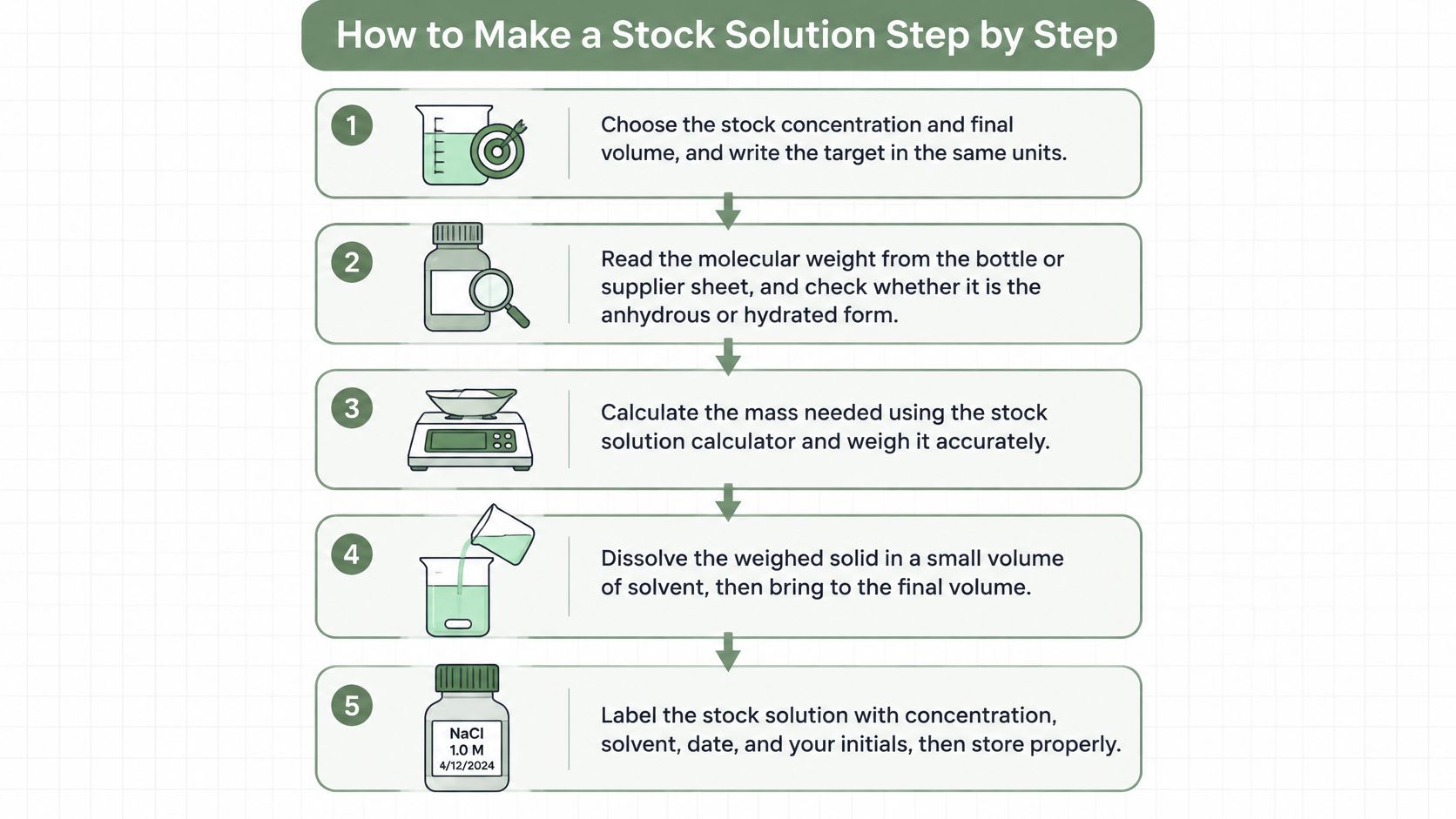
The preparation overview provides a visual reference for the bench workflow.
Preparation sequence
Define the target. The scientist records the stock concentration, final volume, and solvent, with concentration units written explicitly. This prevents an unstated assumption about the preparation basis from carrying into the calculation.
Identify the material. The bottle or supplier sheet provides the molecular weight and identifies the anhydrous, hydrated, or salt form. Recording the reagent identity and lot alongside those inputs makes later review possible.
Calculate and select a measurable mass. The mass is calculated using the matching formula, then rounded appropriately for the balance and required preparation accuracy. If the required quantity is below the balance's reliable working range, a larger preparation or an intermediate stock is preferable to unsupported precision.
Start with less than the final solvent volume. For an illustrative routine aqueous preparation, approximately 70 to 80 percent of the intended final volume provides room for the solute and subsequent adjustment. A clean beaker with adequate mixing space helps prevent splashing and incomplete dissolution.
Weigh, dissolve, and transfer quantitatively. The scientist records the actual mass, dissolves the solid completely with stirring, and transfers the solution into a volumetric flask. Rinsing the beaker and transfer equipment into the flask carries residual solute across rather than leaving part of the weighed amount behind.
Adjust the final volume and mix. Once dissolution is complete and the temperature is suitable, solvent is added to the calibration mark with the meniscus read at eye level. The capped flask is inverted several times so the final solvent addition doesn't remain as a less concentrated layer.
Label and store. The receiving bottle is labeled with the name, concentration, solvent, preparation date, initials, storage conditions, and an expiry or review date supported by the local procedure. Storage suitability depends on the compound and container, not on the calculator result.
The record must match the bottle
A common recording slip is copying the intended rounded mass instead of the actual stable balance reading. The record should preserve both values, and any concentration claim should reflect whether the actual preparation falls within the accepted tolerance.
The accompanying preparation video offers another format for reviewing the workflow.
The bench endpoint is a clear solution, where clarity is expected, in a fully labeled bottle. The notes should contain the calculated mass, actual mass, final volume, and any preparation changes.
Test the Calculator and Check the Numbers Before You Weigh
A stock solution calculator should first pass a case that can be checked independently. An illustrative test using 0.5 M NaCl, 500 mL, and 58.44 g/mol should return 14.61 g.
An impossible-dilution test is equally useful: a 1 M stock cannot produce a 2 M target by adding diluent. A suitable tool should flag that condition rather than present a negative diluent volume as a usable instruction.
Choosing a calculation route
Calculator options compared
| Method | Works offline | Shows working | Flags impossible inputs | Best for |
|---|---|---|---|---|
| Hand calculation with written working | Yes | Yes | No automatic warning | Training and one-off checks |
| Spreadsheet with visible formulas | Yes, with a local file and application | Yes | Only if checks are added | Repeated preps from one template |
| Web calculator | Only with explicitly supported offline operation | When equations and substitutions are displayed | Only with implemented validation | Quick cross-check |
| Phone calculator | Yes, for a standard local calculator | Usually no complete derivation | No concentration-specific checks | Arithmetic only |
Offline access matters when bench connectivity is poor. Confidential or unpublished details shouldn't be entered into an external tool without checking the laboratory's rules and the tool's handling of inputs.
Small quantities introduce a separate measurement question. Skin Perfection's resource on weighing tiny serum ingredients accurately offers related weighing context, but laboratory balance suitability and transfer procedures still require local assessment.
Pre-weigh acceptance checklist
- Recalculate independently. A second method should confirm the mass or dilution volume.
- Match units. Protocol units and formula units must describe the same concentration basis.
- Check chemical form. The formula, hydration state, and molecular weight must match the label.
- Review purity. An applicable purity correction uses the purity fraction, not the percentage number.
- Save the working. The formula, calculated mass, final volume, and solvent belong in the record before weighing.
For successive dilution steps, the serial dilution calculation guide addresses the additional transfer calculations. Each intermediate concentration needs its own check.
Illustrative failure: A scientist uses the hydrate molecular weight for an anhydrous reagent. An unexpected dose-response curve prompts review weeks later, and the preparation record allows the team to identify the incorrect mass input.
Verbex offers a solution preparation tool for mass and dilution calculations, separate from its documentation app; its deterministic tools check arithmetic but cannot establish whether experimental inputs are appropriate. Verbex for iPhone and iPad, free to download, is a private, on-device capture tool rather than a concentration calculator: typed or voice notes, timers, and images can preserve preparation details without an account, and the scientist reviews the organized record before exporting it into an existing ELN workflow.
The practical next step is to select a stock prepared this week, run the checklist, and save the calculation with its preparation record.
For a reusable preparation record, Verbex offers a free Lab Documentation Pack containing 16 editable templates across 42 Word, Excel, and PDF files, with worked examples and working formulas. Visit Verbal Experiment or Verbex to pair checked stock-solution calculations with documentation that preserves what was weighed, mixed, and changed.