 Blog
Molecular Weight Calculator for Molecules and Salts
A molecular weight calculator adds each element's average atomic weight multiplied by its atom count; the result in g/mol is also the conversion factor from moles to mass. For a useful weighing, the formula must describe the exact material in the bottle, including any counterions, waters of hydration, or polymer end groups.
A common bench problem starts with a target amount and a bottle label that names a salt or hydrate rather than the neutral molecule. The arithmetic may be tidy, but a correct sum for the wrong formula still gives the wrong mass. The useful habit is to write the bottle form first, choose the mass type that matches the task, then check the calculation before weighing.
By Multimod Labs.
Table of Contents
- The Formula and the Atomic Weights
- Calculate and Check a Small Molecule
- Isotopes Salts and Hydrates
- Monomer Oligomer and Polymer Masses
- From Molecular Weight to the Mass You Weigh
The Formula and the Atomic Weights
The working equation is MW = Σ (atom count × atomic weight). For caffeine, C₈H₁₀N₄O₂, the sum has four terms: eight carbons, ten hydrogens, four nitrogens, and two oxygens, each multiplied by its average atomic weight.
For one molecule, that same numerical result is its molecular mass in daltons. For an ionic solid, chemists more strictly call the result formula weight, because the solid is a lattice of ions rather than separate molecules. In either case, the value in grams per mole is the one used to convert an amount in moles into a mass for the balance.
Before multiplying, rewrite the complete formula. Expand parentheses, include counterions, and include waters of hydration or other stated solvates. In a formula such as CaCl₂, the subscript applies to chlorine only; in a grouped formula, a subscript outside parentheses multiplies every atom inside. A missing subscript or omitted water changes the result far more than a small difference between atomic-weight tables.
Freeze one table for the calculation
Use one consistent set of average atomic weights throughout a formula. The rounded values below are practical for preparative calculations; different published tables can differ slightly in the last decimal place. Mixing values from different tables halfway through a sum adds needless inconsistency.
| Element | Symbol | Rounded atomic weight (g/mol) | Watch for |
|---|---|---|---|
| Hydrogen | H | 1.008 | Exchangeable H in salts and hydrates |
| Carbon | C | 12.011 | Count every carbon in rings, chains, and protecting groups |
| Nitrogen | N | 14.007 | Amines, azides, and nitrate counterions |
| Oxygen | O | 15.999 | Water and solvates add more oxygen |
| Fluorine | F | 18.998 | Often one atom and easy to drop |
| Sodium | Na | 22.990 | Counterion, not part of the free acid |
| Phosphorus | P | 30.974 | Phosphates and nucleotides |
| Sulfur | S | 32.06 | Thiols, sulfates, and DMSO solvates |
| Chlorine | Cl | 35.45 | HCl salts and chloride counterions |
| Potassium | K | 39.098 | Counterion on acids and phosphates |
| Calcium | Ca | 40.078 | Divalent, so check the stoichiometry |
| Bromine | Br | 79.904 | Heavy; a missed Br is obvious |
| Iodine | I | 126.90 | Heavy; a missed I is obvious |
Practical rule: Keep the expanded formula and atom count beside the answer. That makes it easier to spot a dropped group than inspecting the final decimal alone.
For recurring lab calculations, a PepFlow dosing reference for routines can be a useful companion when planning amounts. It doesn't replace the formula check: the chemical form being weighed still determines which atoms belong in the sum.
Average atomic weights are for ordinary material with its natural isotope mixture. Monoisotopic masses answer a different question, especially in mass spectrometry, and shouldn't be substituted into a balance calculation.
Calculate and Check a Small Molecule
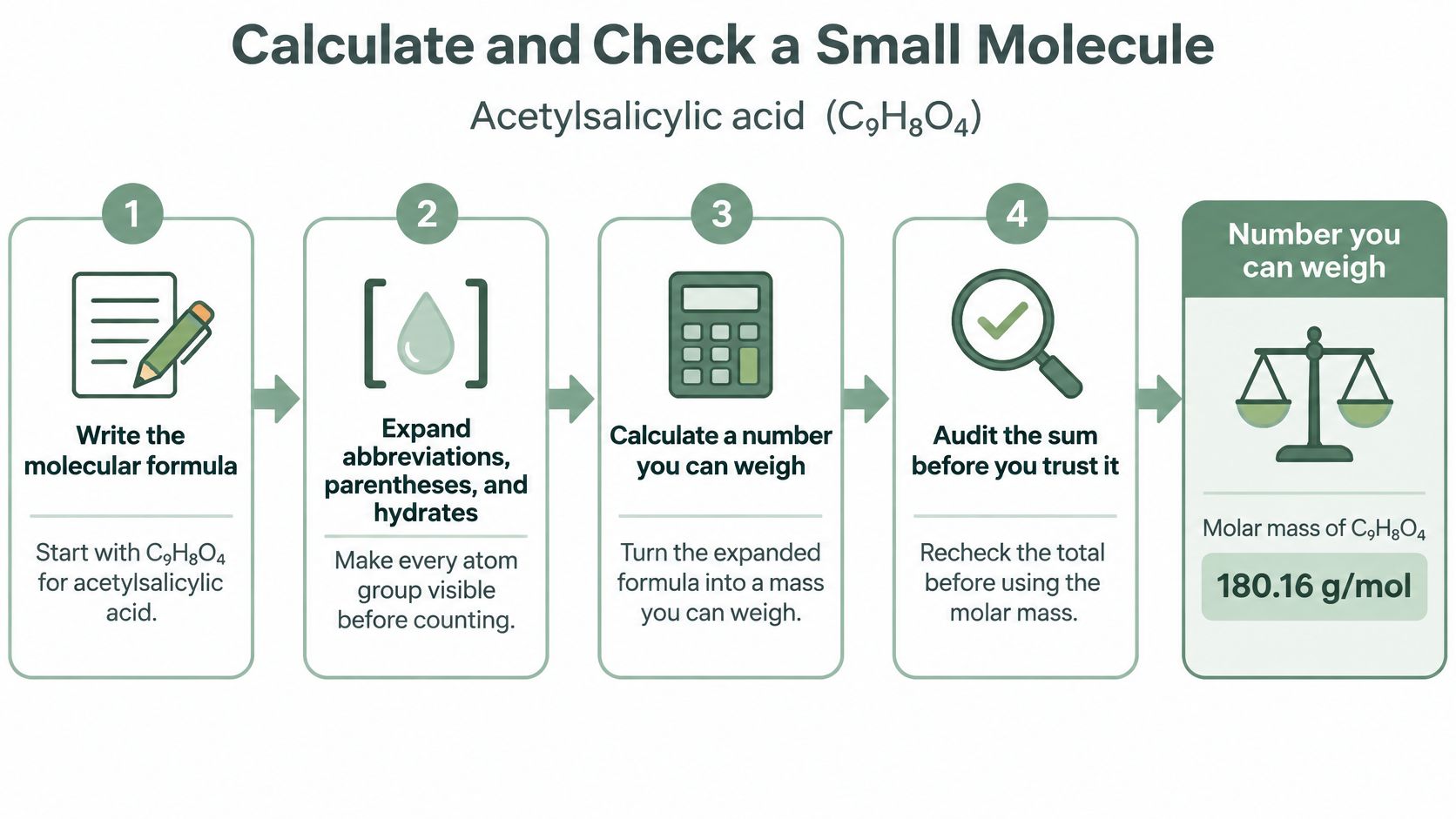
Acetylsalicylic acid, commonly called aspirin, has the formula C₉H₈O₄. A molecular weight calculator can help with the arithmetic, but the calculation is transparent enough to check by hand.
Write the formula, then count
Start with the stated formula and make sure it refers to the material being calculated. For this example, the formula is C₉H₈O₄, so the atom counts are nine carbon, eight hydrogen, and four oxygen. There are no parentheses, counterions, or waters of hydration to expand.
Use the same average atomic weights throughout: carbon, 12.011; hydrogen, 1.008; oxygen, 15.999. Multiply each count by its corresponding weight:
- Carbon: 9 × 12.011 = 108.099
- Hydrogen: 8 × 1.008 = 8.064
- Oxygen: 4 × 15.999 = 63.996
Add the three contributions: 108.099 + 8.064 + 63.996 = 180.159 g/mol. Round once at the end to 180.16 g/mol. Two decimal places are generally practical for a preparative balance calculation; extra decimal places in the sum don't make an uncertain formula more accurate.
Audit the result before using it
Add the terms again, preferably in a different order or with a calculator, and check that the atom count still matches the written formula. Stereochemistry doesn't change the count of each element, so it doesn't change this sum. The molecule's charge also doesn't alter the mass calculation for a routine bench weighing.
Then check whether the answer is chemically plausible. Many drug-like organic molecules fall in the broad neighborhood of 100 to 800 g/mol. A result near 18 for this formula, or a result about ten times too large, points to a likely counting or transcription error, such as losing a subscript or treating a water molecule as the parent compound. Familiar comparisons can help: acetic acid is near 60 g/mol, glucose near 180 g/mol, and many individual amino acids fall roughly between 75 and 200 g/mol.
A calculator can verify multiplication and addition. It can't tell whether the formula on screen matches the material in the bottle.
If a hand calculation and spreadsheet disagree, don't choose whichever answer looks more plausible. Rewrite the formula, expand every group, and compare the atom counts row by row. Keep the final atom count beside the rounded result so the calculation remains inspectable.
Verbex tools are deterministic calculators and document builders that check their own arithmetic, but they can't know whether the input values are right for a particular experiment. Formula selection and chemical form still need human review.
Isotopes Salts and Hydrates
The bottle form determines what goes into the sum. A free base, its hydrochloride salt, and a hydrated salt are different weighed materials with different formula weights, even when the label names the same active compound.
Average molecular weight uses standard atomic weights and is appropriate for weighing natural-abundance material. Monoisotopic mass instead uses the mass of the most abundant isotope of each element. That's the mass type used alongside a high-resolution mass spectrum. For an unlabeled organic molecule, it is slightly below the average molecular weight.
An isotope label must be included atom by atom. For example, a ¹³C or ¹⁵N substitution changes the mass of that labeled atom; adding a rough one dalton to an average molecular weight isn't an exact substitute for calculating the labeled formula.
| Case | What to enter | Effect |
|---|---|---|
| Average molecular weight | Standard atomic weights | Use for weighing natural-abundance material |
| Monoisotopic mass | Mass of the most abundant isotope of each atom | Use for high-resolution mass spectrometry; it sits slightly below the average for unlabeled organics |
| Isotope label | The labeled nuclide's mass, atom by atom | Changes the exact mass according to which atoms are labeled |
| Hydrochloride or other salt | Free form plus the counterion mass | Raises the formula weight by the counterion contribution |
| Hydrate | Anhydrous formula plus each water molecule | Adds 18.015 g/mol for every water in the formula |
A hydrochloride contains the counterion as well as the free base. One HCl contribution adds 36.46 g/mol to the free-base formula weight. For salts with other counterions, use the actual stoichiometry in the formula rather than assuming a one-to-one ratio.
Hydrates create a common balance error. Anhydrous sodium acetate, C₂H₃NaO₂, is 82.03 g/mol, while sodium acetate trihydrate is 136.08 g/mol. Weighing the trihydrate using the anhydrous value supplies fewer moles of sodium acetate than intended.
Keep purity separate: Purity doesn't change molecular weight. Once the correct formula weight is chosen, divide the theoretical mass by the purity expressed as a fraction to calculate the mass to weigh.
An unknown solvate or mixture has no single honest molecular weight until its composition is known. For concentration calculations, the molarity calculator is a relevant companion once the correct formula weight and material form have been established.
Monomer Oligomer and Polymer Masses
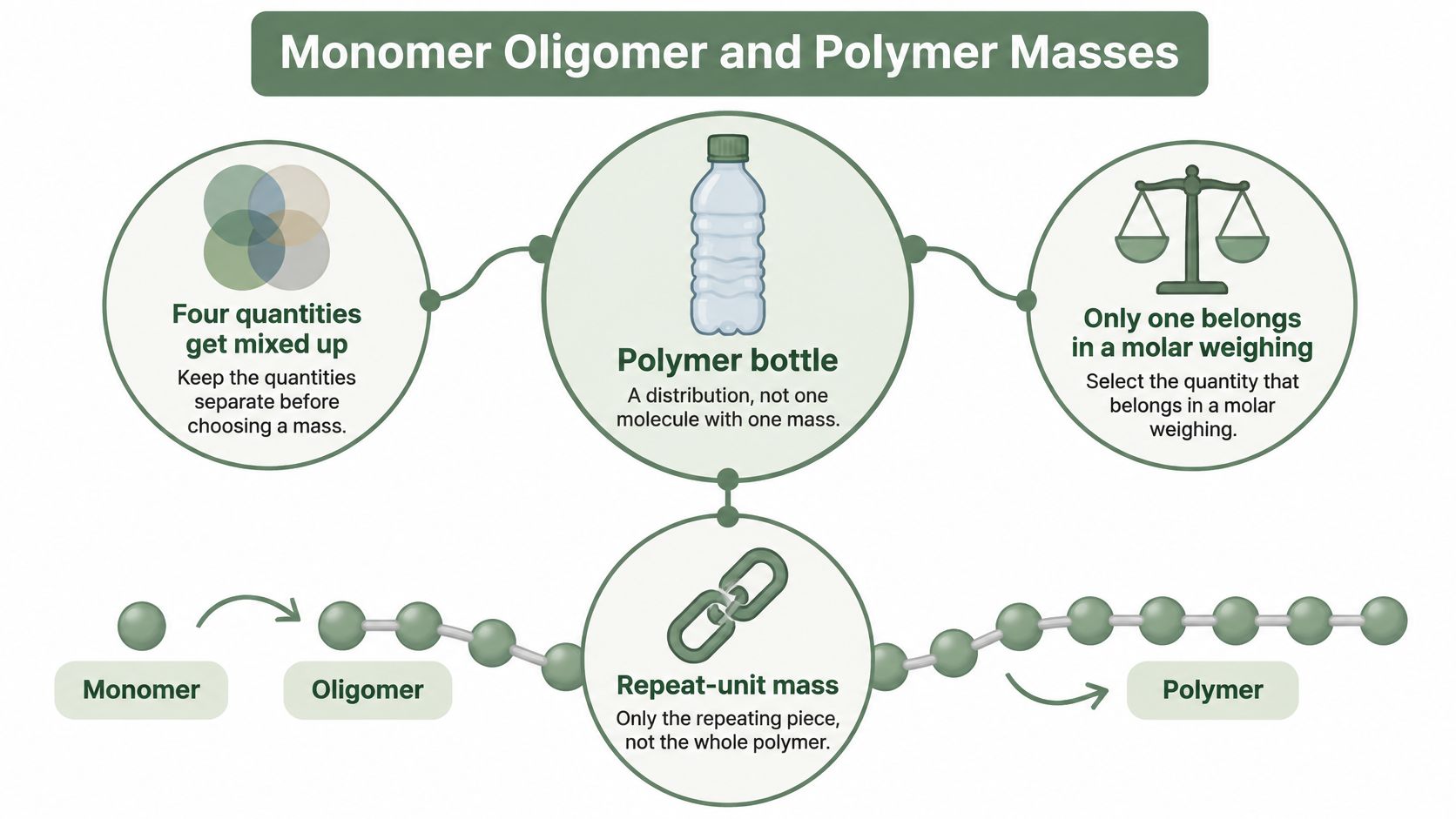
A polymer bottle usually contains chains of different lengths, not one species with one molecular mass. The key is to distinguish the mass of a repeat unit from the mass of a defined chain and from averages that describe a distribution.
For polyethylene glycol written HO-(CH₂CH₂O)ₙ-H, the repeat unit is C₂H₄O, about 44.05 g/mol. The two terminal groups contribute about 18.02 g/mol, so a defined chain has mass approximately 44.05n + 18.02 g/mol. At n = 5, that gives about 238.3 g/mol; the end groups account for nearly 8 percent of that short chain's mass. Ignoring them creates a real error for short oligomers, although their relative contribution shrinks as the chain gets longer.
Choose the quantity that matches the sample
Number-average molecular weight, Mn, is total polymer mass divided by the moles of chains. It is the relevant supplier value when a disperse polymer sample is dosed in moles. Weight-average molecular weight, Mw, gives greater weight to longer chains and appears in many viscosity and light-scattering results. It isn't interchangeable with Mn for converting a molar amount into a mass.
| Quantity | Relationship | Use it when |
|---|---|---|
| Repeat-unit mass | Sum of atoms in one repeating group | Comparing monomers or residues |
| Defined oligomer | n × repeat mass + end-group mass | The chain length n is a single known integer |
| Number-average Mn | Total polymer mass / moles of chains | Converting a molar amount of a disperse sample into mass |
| Weight-average Mw | Mass-weighted average of chain masses | The reported value came from a mass-weighted method |
| End-group correction | n ≈ (Mn − end mass) / repeat mass | The chains are short enough that ends are not negligible |
If a supplier gives Mn, an average degree of polymerization can be estimated as n ≈ (Mn − Mₑₙdₛ) / Mᵣₑₚₑₐₜ. That result is an average chain length, not a claim that every chain contains that exact number of repeat units. For a disperse sample, use Mn for mole-to-mass conversion, not Mw or the bare repeat-unit mass.
For a PCR workflow, the design primer for PCR is a related resource, but primer design and polymer mass calculations answer different questions. The mass entered for any polymer still needs to match the quantity the experiment uses.
From Molecular Weight to the Mass You Weigh
Once the correct molecular weight is in hand, the balance calculation is direct. For a molar solution, moles = concentration × volume, with concentration in mol/L and volume in liters. Then mass = moles × molecular weight.
For example, a target of 10 mmol/L aspirin in 0.010 L requires 0.00010 mol. At 180.16 g/mol, that is 0.0180 g, or 18.0 mg. If the material is 98% pure, divide 18.0 mg by 0.98: the mass to weigh is about 18.4 mg. Purity changes the mass correction, not the molecular weight.
A spreadsheet can apply mass = concentration × volume × molecular weight / purity when the inputs and units are set correctly. Before weighing, record the formula, atomic-weight source, molecular weight, salt or hydrate form, concentration, volume, purity, and calculated mass. Put the material form on the materials line so a later user doesn't substitute an anhydrous value for a hydrate.
For a related worked workflow, the stock solution calculator guide can help organize the concentration and volume arithmetic. Verbex offers a solution preparation tool that calculates the mass to weigh or the stock and diluent volumes to combine from a target concentration and final volume. Verbex for iPhone and iPad, free to download, can capture the materials line, a dissolution timer, and a bottle-label image in a source-backed record; it doesn't look up molecular weight from a structure. Completed records can be exported as PDF, DOCX, or Markdown for an existing documentation workflow.
When the calculation is performed, keep the working with the experiment while the bottle is still open. A resource for a different kind of calculation, working out an English Literature grade, illustrates the broader value of checking inputs and outputs, but chemical formula selection requires its own review. Verbex results, templates, and guides are aids, not scientific, safety, medical, or regulatory advice; every number needs to be checked before action.
For bench scientists who want to preserve the formula, bottle form, calculation, and observations together, Verbal Experiment or Verbex offers a private, on-device lab documentation app for iPhone and iPad. It helps capture voice notes, typed notes, timers, and images, then organize them into a record for review and export.