 Blog
SDS Gel Buffer Recipes and How to Prepare Them
A gel cassette is taped, the comb is in, and the protocol step says "prepare SDS gel buffer." There are three bottles in front of you: a litre of clear liquid already in the tank, a tube of blue solution in the fridge door, and a bottle of Tris-HCl at pH 8.8 that someone else made last month. The run is in forty minutes and none of them is obviously the one the step means.
The short answer is that four different solutions carry that name in a routine Tris-glycine SDS-PAGE workflow: the running buffer in the tank, the 2x sample buffer that goes on the protein, the stacking gel buffer at pH 6.8, and the resolving gel buffer at pH 8.8. They have different concentrations, different pH values and different jobs. Getting one wrong shows up as tilted bands, smeared lanes, or a dye front that never quite reaches the bottom.
What follows is the arithmetic and the reason behind each solution, in the order a bench uses them.
Table of Contents
- Which SDS Gel Buffer Your Protocol Needs
- Stacking and Resolving Gel Buffers Explained
- Prepare Running Buffer from Stock or Powder
- Sample Buffer Recipe and Loading Preparation
- Fixing Smiling, Smeared and Slow Gels
- Record Each Buffer Batch Before You Run
Which SDS Gel Buffer Your Protocol Needs
The name covers four solutions, and none of them substitutes for another. Ten minutes spent matching the line in the protocol to the right bottle saves the forty minutes of re-running the gel that follows a mix-up.
| Buffer | Main components | Working composition | pH | Where it is used |
|---|---|---|---|---|
| Running buffer (10x stock) | 0.25 M Tris, 1.92 M glycine, 1% SDS | 1x: 25 mM Tris, 192 mM glycine, 0.1% SDS | About 8.3 at 1x | Fills the tank during electrophoresis |
| Laemmli sample buffer (2x) | 62.5 mM Tris-HCl, 25% glycerol, 2% SDS, 0.01% bromophenol blue | 1x in sample: 31.25 mM Tris-HCl, 12.5% glycerol, 1% SDS, 0.005% bromophenol blue | 6.8 | Mixed with protein before heating |
| Stacking gel buffer | 1.0 M Tris-HCl | Stock buffer cast into the stacking layer | 6.8 | Poured into the upper gel layer |
| Resolving gel buffer | 1.5 M Tris-HCl | Stock buffer cast into the resolving layer | 8.8 | Poured into the lower gel layer |
Running buffer is the only one that goes into the tank. It fills both chambers, carries current between the electrodes and never gets mixed into acrylamide. Sample buffer is the only one that touches the protein: it denatures, adds density and carries the tracking dye. The two gel buffers are both cast inside the cassette, one above the other, and their job is to build two different pH environments into a single gel.
Bench rule: pouring a gel means the stacking and resolving buffers, loading samples means the sample buffer, filling the tank means the running buffer.
If a protocol step is ambiguous, read the next line. It almost always mentions a tank, a cassette or a tube of protein, and that settles it. When you're converting a recipe quoted in molarity into grams on a balance, the buffer calculator handles the arithmetic faster than a calculator and a scrap of paper.
Most labs don't weigh running buffer for every run. They keep a 10x concentrate on the shelf and dilute to 1x on the day, which is why the stock recipe looks so much stronger than what ends up in the tank. The default for most Tris-glycine gels is the Tris-glycine SDS system from Laemmli's 1970 method. Check which of the four the protocol names before anything gets weighed.
Stacking and Resolving Gel Buffers Explained
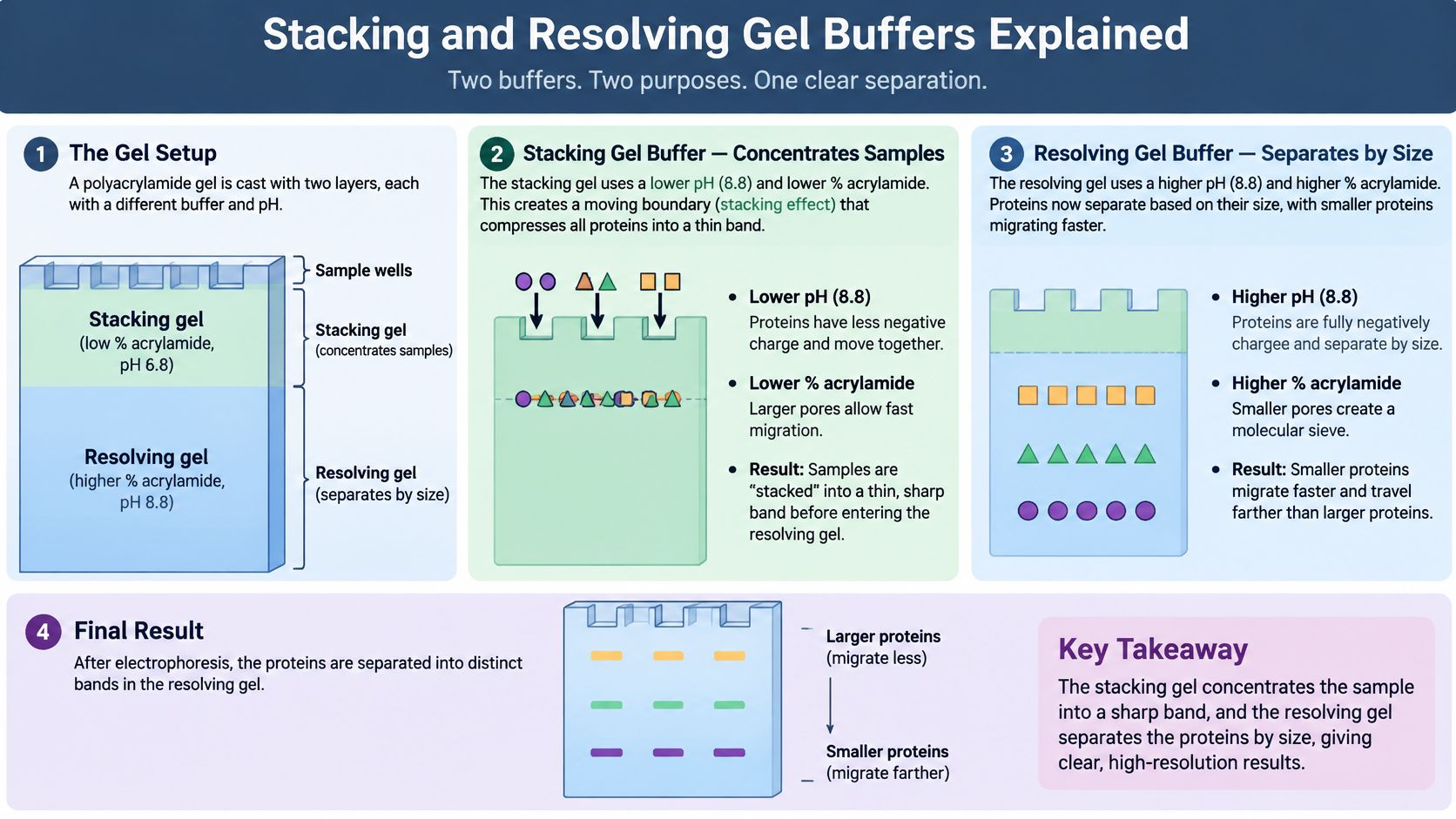
Two of the four are gel buffers, and they differ only in concentration and pH. 1.0 M Tris-HCl at pH 6.8 goes into the stacking layer; 1.5 M Tris-HCl at pH 8.8 goes into the resolving layer. A published SDS-PAGE protocol from the Freiburg iGEM team keeps the resolving and stacking recipes on separate lines from the 10x running buffer, which is the cleanest demonstration that one label can refer to chemically distinct solutions.
The ion front in plain terms
Inside the stacking gel, chloride from the Tris-HCl is the fast leading ion and glycine from the running buffer is the slow trailing ion. Apply a field and the chloride races ahead while glycine lags, and the SDS-coated proteins get squeezed into the narrow, low-conductivity zone between them. That's stacking, and it's what turns a sample spread across a deep well into a thin, even band.
The UCSF Mullins lab SDS-PAGE guide describes the same sequence: proteins are compressed between the moving boundaries, and once the stack reaches the resolving gel at about pH 8.8, glycine becomes more mobile, overtakes the protein zone, and the proteins separate primarily by size in the polyacrylamide matrix. SDS handles the other half of the job. It keeps proteins denatured and gives them a broadly similar negative charge-to-mass ratio, so size becomes the variable that decides how far each one travels.
Three habits keep the stack intact:
- Label with pH and date. A stock titrated to 8.0 instead of 8.8 moves where the stack breaks up, and the gel shows it as compressed or smeared bands rather than as an obvious mistake.
- Never substitute running buffer for a gel buffer. At 25 mM Tris, the running buffer is roughly 40 times more dilute than the 1.0 M stacking stock and 60 times more dilute than the 1.5 M resolving stock, so it can't establish the pH step the stack depends on.
- Follow the supplier's buffer to acrylamide ratio. Pore size comes from the acrylamide percentage and the buffer together. Adding extra buffer to make the mix easier to pipette changes the pore size along with it.
Don't carry a Tris-glycine recipe across to a Bis-Tris gel. The two chemistries use their own running and sample buffers, and a band pattern from one can't be read directly against the other.
Prepare Running Buffer from Stock or Powder
Most running buffer failures come from the dilution step, not the weighing. A 10x stock made correctly and diluted sloppily gives a tank of buffer that conducts badly, runs slow and heats up.
| Final 1x volume | 10x stock | Ultrapure water to add |
|---|---|---|
| 250 mL | 25 mL | 225 mL |
| 1 L | 100 mL | 900 mL |
| 2 L | 200 mL | 1.8 L |
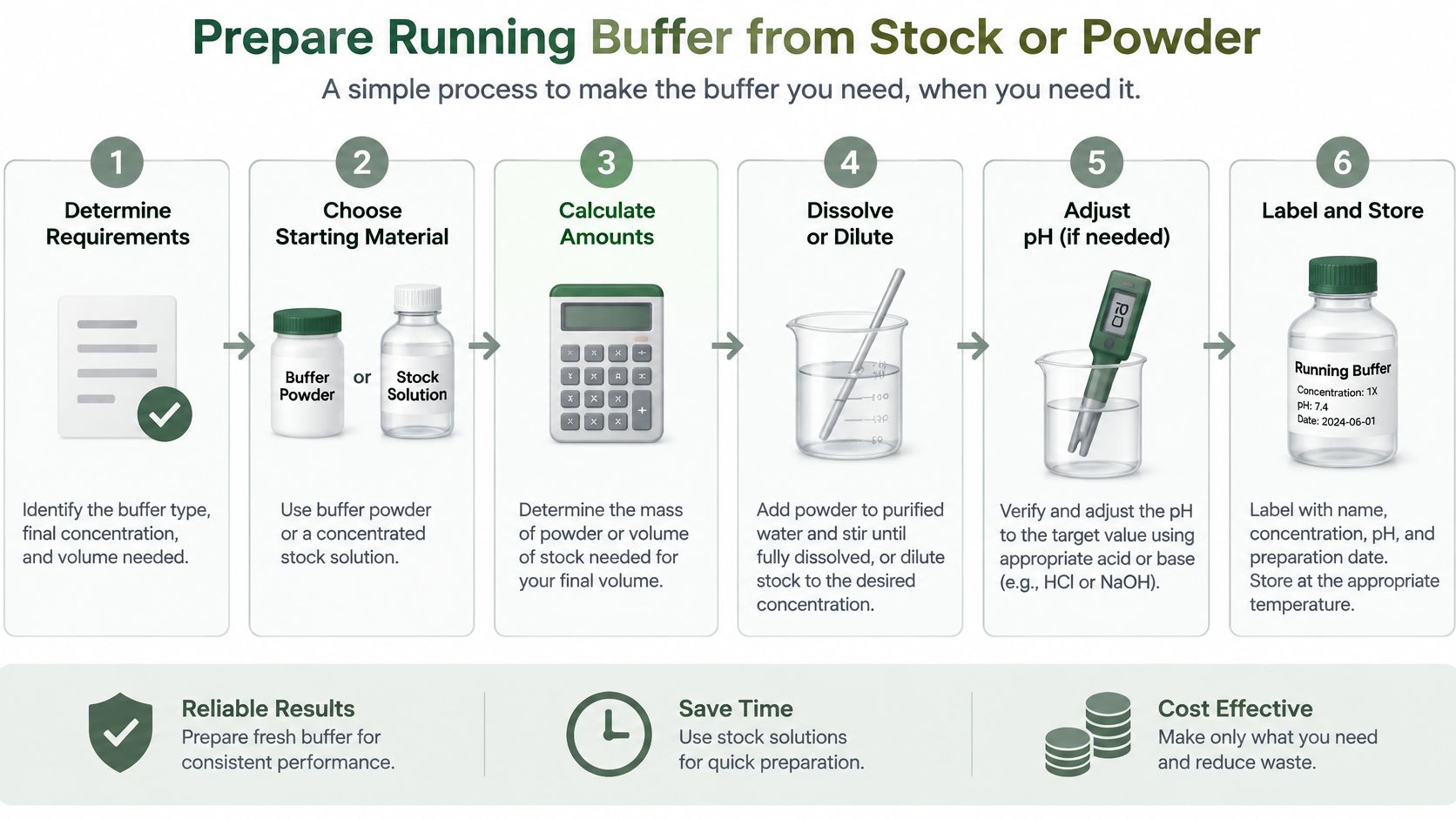
The six steps that follow keep the SDS from foaming over the rim of the cylinder.
Make 1 L of 10x stock
The Thermo Fisher one-dimensional SDS-PAGE protocol gives the concentrate as 29 g Tris base, 144 g glycine and 10 g SDS per litre, which dilutes tenfold to 25 mM Tris, 192 mM glycine and 0.1% SDS.
- Start with about 800 mL ultrapure water in a 1 L graduated cylinder or flask. Leave room for the solids.
- Add 29 g Tris base, then 144 g glycine, then 10 g SDS, stirring slowly. Fast stirring whips the SDS into foam that takes an hour to settle.
- Bring the volume to 1 L with ultrapure water. Weighing and final volume set the concentration; nothing else does.
- Store at room temperature. Cold storage precipitates SDS, so if the bottle has been in a cold room, warm it gently and mix before use, and check for crystals at the bottom.
- On the day of the run, dilute 100 mL of 10x into 900 mL of ultrapure water.
- Leave the pH alone. One manufacturer's running buffer specification states the 10x contains 0.25 M Tris, 1.92 M glycine and 1% SDS at approximately pH 8.6, and explicitly warns against adjusting it, because acid or base changes the ionic makeup and conductivity the separation depends on.
Smaller batches and the direct 1x route
Not every lab needs a litre. For 250 mL of 10x, weigh 7.25 g Tris base, 36 g glycine and 2.5 g SDS. For 500 mL, weigh 14.5 g, 72 g and 5 g. The arithmetic is a straight multiplication of the 1 L recipe, and writing it on the batch sheet beats scaling by eye, which reliably produces buffer that is either too weak or too strong and shows up as slow runs or a warm tank. A stock solution calculator does the same multiplication from a final volume and dilution factor when you'd rather check it twice.
Going straight to 1x without a stock is also legitimate. Per litre, weigh 3.0 g Tris base, 14.4 g glycine and 1.0 g SDS. It's more weighing per run and less forgiving of a forgotten ingredient, so most labs only do it when the stock has run out.
What to check before you fill the tank
Say a short gel series needs about 2 L of 1x. Measure 200 mL of 10x and make it up to 2 L with roughly 1.8 L of ultrapure water, then check the arithmetic before the pour. The working solution should contain 25 mM Tris and 192 mM glycine, and good buffer is clear and free of solids. Cloudy buffer, or buffer with a skin on the surface, gets discarded.
Sample Buffer Recipe and Loading Preparation
The 2x Laemmli sample buffer is a concentrate, and treating it as one prevents a lot of problems that get blamed on the gel. Bio-Rad's Laemmli sample buffer formulation gives the 2x composition as 62.5 mM Tris-HCl at pH 6.8, 25% glycerol, 2% SDS and 0.01% bromophenol blue. Per litre of 2x stock, that's about 20 g SDS, about 250 mL glycerol and 0.1 g bromophenol blue.
Mixed with protein in equal volumes, the sample ends up near 1x: approximately 31.25 mM Tris-HCl, 12.5% glycerol, 1% SDS and 0.005% bromophenol blue. That working composition is what the stacking gel was designed around.
- Mix equal volumes of 2x buffer and protein sample. Unequal volumes shift the final concentration away from 1x, so keep the two volumes equal to keep the sample at the working composition shown above.
- Add reductant only when the protocol calls for it. DTT or 2-mercaptoethanol breaks disulfide bonds and isn't part of every Laemmli recipe. Add it to the working tube, freshly, not to the stock.
- Heat, then cool. Thermo Fisher's overview of electrophoresis pairs Tris-glycine gels with a sample buffer of 63 mM Tris-HCl, 10% glycerol, 2% SDS and 0.0025% bromophenol blue at pH 6.8, and heats samples for roughly 3 to 5 minutes before loading. Those figures differ from the Bio-Rad recipe in glycerol and dye, not in the SDS or the pH.
- Spin briefly to collect condensation from the lid and to pull down anything that precipitated during heating.
- Load small. Keep the volume within what the well and the stack can take, since excess volume is the usual cause of broad bands from large proteins.
Each component earns its place. Tris-HCl holds the loading pH, SDS denatures the protein and coats it with negative charge, glycerol makes the mixture denser than the running buffer so it sinks into the well, and bromophenol blue gives a visible front to track.
The slip to avoid: adding DTT to the whole bottle of 2x stock. The stock then smells of sulfur, oxidizes over weeks, and every sample on the bench inherits yesterday's reductant.
A good sample is clear, evenly blue, and sinks when pipetted into a well. If it floats or beads at the surface, the glycerol is wrong or missing, and that lane will load poorly no matter how carefully you pipette.
Fixing Smiling, Smeared and Slow Gels
The most common complaint at the end of a run isn't a missing band. It's bands that curve upward at both edges, a lane that looks like it was painted with a brush, or a dye front that crawled for two hours and never reached the bottom. Those are three different problems, and only one of them is really about your samples.
| Symptom | Likely cause | Fix |
|---|---|---|
| Smiling bands | Incorrect buffer composition or excessive voltage heating the gel edges | Remake 1x from a correctly weighed stock and lower the voltage |
| Broad or dumbbell-shaped bands | Sample volume too large for complete stacking, especially for large proteins | Reduce the loaded volume or concentrate the sample |
| Streaking | High salt, particulates, membranes or DNA in the sample | Clarify by centrifugation and reduce salt by dialysis or gel filtration |
| Slow or uneven migration | Diluted, exhausted or reused running buffer | Discard it and prepare fresh 1x for each run |
| Buffer adjusted with acid or base | Altered ionic composition and conductivity | Prepare a new batch and leave the pH alone |
Two questions worth answering once
Should old running buffer be reused, or can the pH be adjusted to rescue it? No to both. The Jackson ImmunoResearch western blotting guide notes that several protocols explicitly say not to adjust the pH of prepared 1x running buffer, and some recommend against reuse altogether. The reason is that reuse changes ionic composition as ions are consumed and water evaporates, and a pH adjustment changes conductivity in a way the system wasn't designed for. Remake the 1x from a verified stock.
Distorted bands are usually a chemistry and heat problem wearing a loading-error costume.
Fixes in order of how long they take
- Minutes, no new reagents: drop the voltage by a quarter and cut the loaded volume for the next run. Smiling that comes from heating responds to this alone.
- Same day, one extra step: spin the sample at top speed in a microfuge and load the supernatant. Streaking from particulates often disappears here.
- Next run, one extra technique: desalt by dialysis or gel filtration when high salt is the culprit, since salt disrupts migration and resolution even when everything else is right.
- New batch: remake 1x. If the buffer is old, reused or of unknown dilution, nothing else you change will tell you anything.
Write the run conditions down as you go, including the buffer's age and anything that felt warm, so a repeat has something to compare against. Without that, a second occurrence looks exactly like the first.
Record Each Buffer Batch Before You Run
A buffer batch is a small experiment with a date on it, and it deserves the same record. Writing the batch up costs about two minutes at the balance. The return arrives weeks later, when a lane smears and nobody remembers changing anything.
- Name and final concentration. "10x Tris-glycine-SDS, 0.25 M Tris" tells the next person far more than "running buffer".
- Date made and who made it. Two people making the same recipe differently is a common and invisible source of variation.
- Weighed amounts with reagent lot numbers. Lot changes are the quiet variable behind a sudden shift in how a gel runs.
- Dilution factor used on the day. Record the exact stock volume and final volume, not just that a dilution happened.
- Measured pH, if you checked it. Include the meter's calibration date, because an uncalibrated reading is worse than no reading.
- Gel chemistry. Tris-glycine or Bis-Tris, and the acrylamide percentage.
- Run conditions. Voltage, current, run time, and any temperature symptom such as a warm tank or condensation on the lid.
That list looks long, but each entry is a single line written while the reagent is still on the bench. The habit that makes it cheap is contemporaneous experiment documentation, captured at the balance and the tank rather than reconstructed at the end of the week. A photograph of the reagent label at the moment of weighing takes five seconds and answers a lot of questions later.
Verbex is a private, on-device lab documentation app for iPhone and iPad that supports this way of working. It captures typed or voice notes with timestamps and images as source evidence, then organizes them into a source-backed record the scientist reviews, edits and exports as PDF, Word or straight to the lab's ELN. Its solution preparation tool calculates the mass to weigh, or the stock and diluent volumes to combine, from a target concentration and final volume, which earns its keep when you scale a 10x stock to a different bottle size. The tools check their own arithmetic but cannot know whether the inputs suit your experiment, and Verbex does not judge whether a recipe is right for your gel, so every number still needs your check.
A buffer batch that goes unrecorded is a buffer batch you'll make again next month, wondering what changed. The Verbex app is free to download and keeps the weighed amounts, the reagent lots and the run conditions in one source-backed record you can export when the ELN needs it. Start the record before the Tris goes on the balance, and the next smeared lane arrives with its own history already written.