 Blog
TAE Buffer Recipe 50x: Make and Dilute It Correctly
Keep the stock recipe separate from the working dilution. Dilute the stock 1:50, one part stock plus 49 parts water, to make 1x working buffer. That distinction prevents the common slip of treating the concentrate as run-ready buffer.
A usable bench record keeps three decisions attached to the bottle: which stock formulation was used, which pH convention applies, and how much working buffer the run needs. Record those before the gel, not after a poor result leaves the batch uncertain.
Table of Contents
- Recipe Quantities for 1 Liter of 50x TAE Stock
- Why Published TAE Recipes Disagree on pH
- How to Make 50x TAE Stock Step by Step
- How to Dilute 50x TAE to 1x Working Strength
- Storing, Labeling and Logging Each Batch
Recipe Quantities for 1 Liter of 50x TAE Stock
The standard recipe combines Tris base, glacial acetic acid, and EDTA stock, with water added to the final volume rather than measured as a full liter at the start. The Cold Spring Harbor Protocols TAE recipe specifies 242 g Tris base, 57.1 mL glacial acetic acid, and 100 mL of 0.5 M EDTA at pH 8.0 per liter, yielding the stock and working concentrations below.
Components of 50x TAE stock and 1x working buffer
| Component | Amount per 1 L of 50x stock | Concentration in 50x stock | Concentration in 1x TAE |
|---|---|---|---|
| Tris base | 242 g | 2 M | 40 mM |
| Glacial acetic acid | 57.1 mL | Approximately 1 M acetate | Approximately 20 mM acetate |
| EDTA, 0.5 M, pH 8.0 | 100 mL | 50 mM | 1 mM |
| Water | Added to 1 L final volume | Solvent, added to final stock volume | Solvent, added to final working volume |
Tris provides buffering capacity. Acetate supplies the counter-ion, while EDTA chelates divalent metal ions that can support nuclease activity. The concentrated formulation saves storage space, but the stock bottle and electrophoresis buffer aren't interchangeable.
Check the reagent form before weighing
A useful molecular cross-check comes from the published TAE formulation table: 242 g Tris base at approximately 121.14 g/mol supplies roughly 2 moles, while the conventional acid quantity supplies roughly 1 mole. The same formulation identifies about 18.6 g disodium EDTA dihydrate per liter of stock as an alternative EDTA input.
That EDTA alternative isn't permission to substitute an arbitrary EDTA powder by mass. The salt form and hydration state matter, and powder preparation introduces a dissolution and pH-adjustment step that a prepared EDTA stock has already undergone.
Bench check: The EDTA bottle's pH describes that reagent stock. It doesn't automatically specify the finished TAE stock's pH.
Before weighing anything, compare the reagent labels with the table. Confirm Tris base, not a different Tris reagent; confirm the acid is glacial acetic acid; and check the EDTA concentration and pH. A correctly transcribed recipe won't rescue the wrong starting material.
Why Published TAE Recipes Disagree on pH
Published TAE recipes don't all describe the same pH handling. The conventional unadjusted formulation is commonly associated with an expected pH near 8.5, whereas the pH-adjusted protocol on protocols.io specifies pH 8.0, filter sterilization, and storage at 20–22°C for six months.
A 2025 peer-reviewed protocol formulation lists 2 M Tris base, 5.71% (v/v) acetic acid, and 50 mM EDTA. That acid percentage matches the conventional volume-per-liter formulation, but the composition alone doesn't establish a pH-adjustment instruction.
Published 50x TAE variants and their stated targets
| Recipe variant | Acetic acid | pH target | Storage stated |
|---|---|---|---|
| Conventional unadjusted stock | 57.1 mL per liter | Not adjusted, expected near pH 8.5 | No storage condition established by the cited recipe summary |
| pH-adjusted protocol | Conventional acid quantity, with final pH adjustment | Adjust to pH 8.0 | Filter sterilize, store at 20–22°C for six months |
| 2025 peer-reviewed protocol | 5.71% (v/v) | Not specified in the cited formulation table | Not specified in the cited formulation table |
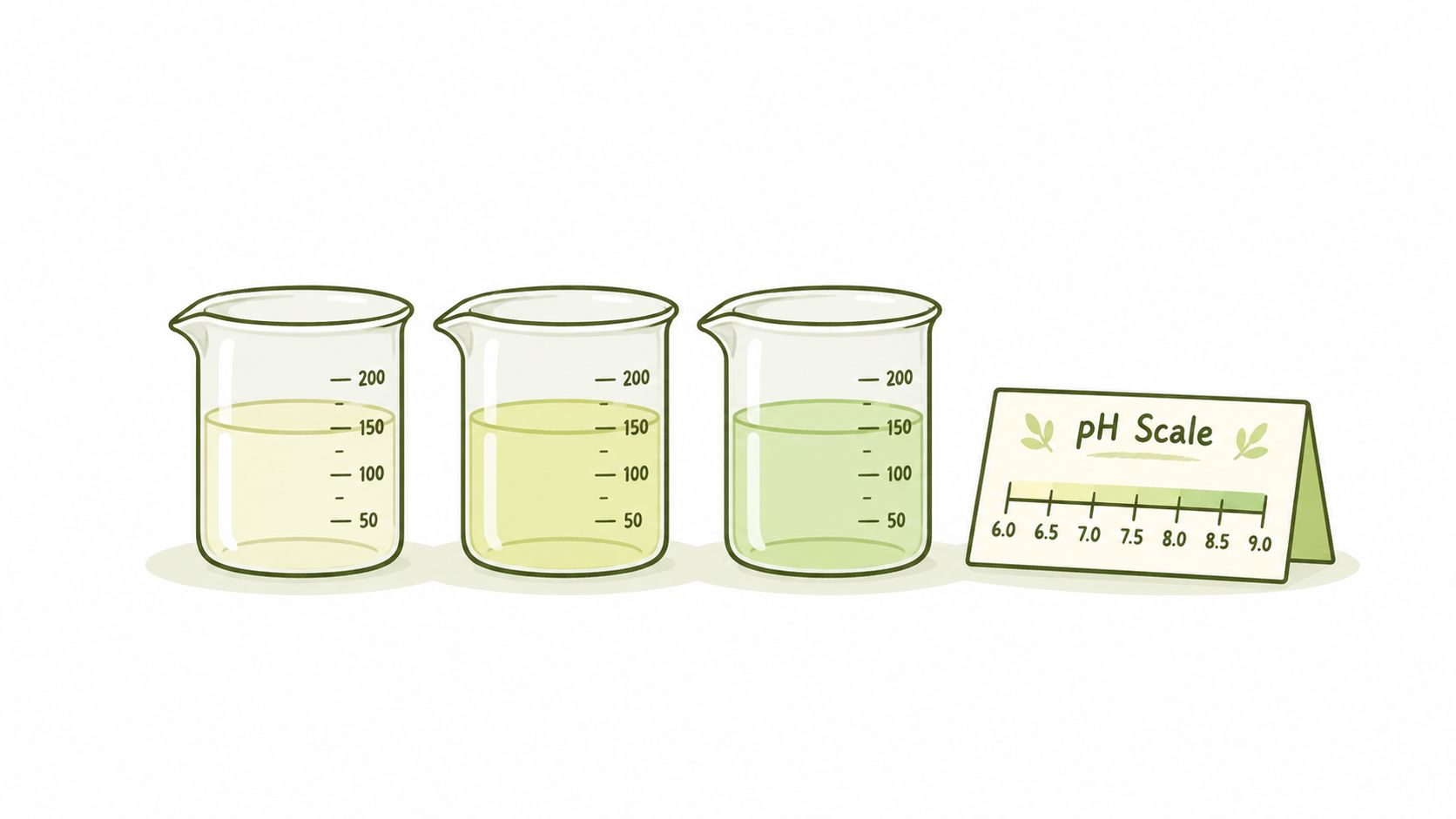
The pH reference image illustrates the measurement concept, not the expected appearance of TAE.
Choose the protocol before correcting the pH
Use the variant named by the downstream method or local protocol. Don't combine an unadjusted formulation with a pH target borrowed from another method. Adding acid to chase a target also changes the Tris-to-acetate balance, so pH adjustment isn't merely a label correction.
For ordinary TAE troubleshooting, it's more useful to examine buffer composition and measurement conditions than to attribute every migration change to DNA charge. A pH result without the solution concentration and measurement stage is incomplete.
If the reading looks wrong, check in this order:
- EDTA dissolution: Confirm that the EDTA stock was fully dissolved and correctly adjusted. EDTA preparation requires reaching approximately pH 8 for full dissolution.
- Acid addition: Check the recorded reagent identity and delivered volume before adding more.
- Final volume: Confirm that the preparation reached its intended final volume, not a starting-water volume.
- Measurement context: Record whether the sample was concentrated stock, partially prepared solution, or working buffer.
The buffer calculation guide can help check formulation arithmetic, but arithmetic doesn't choose the scientific variant. Put the selected pH target and measured value on the batch label, with the measurement context in the record.
How to Make 50x TAE Stock Step by Step
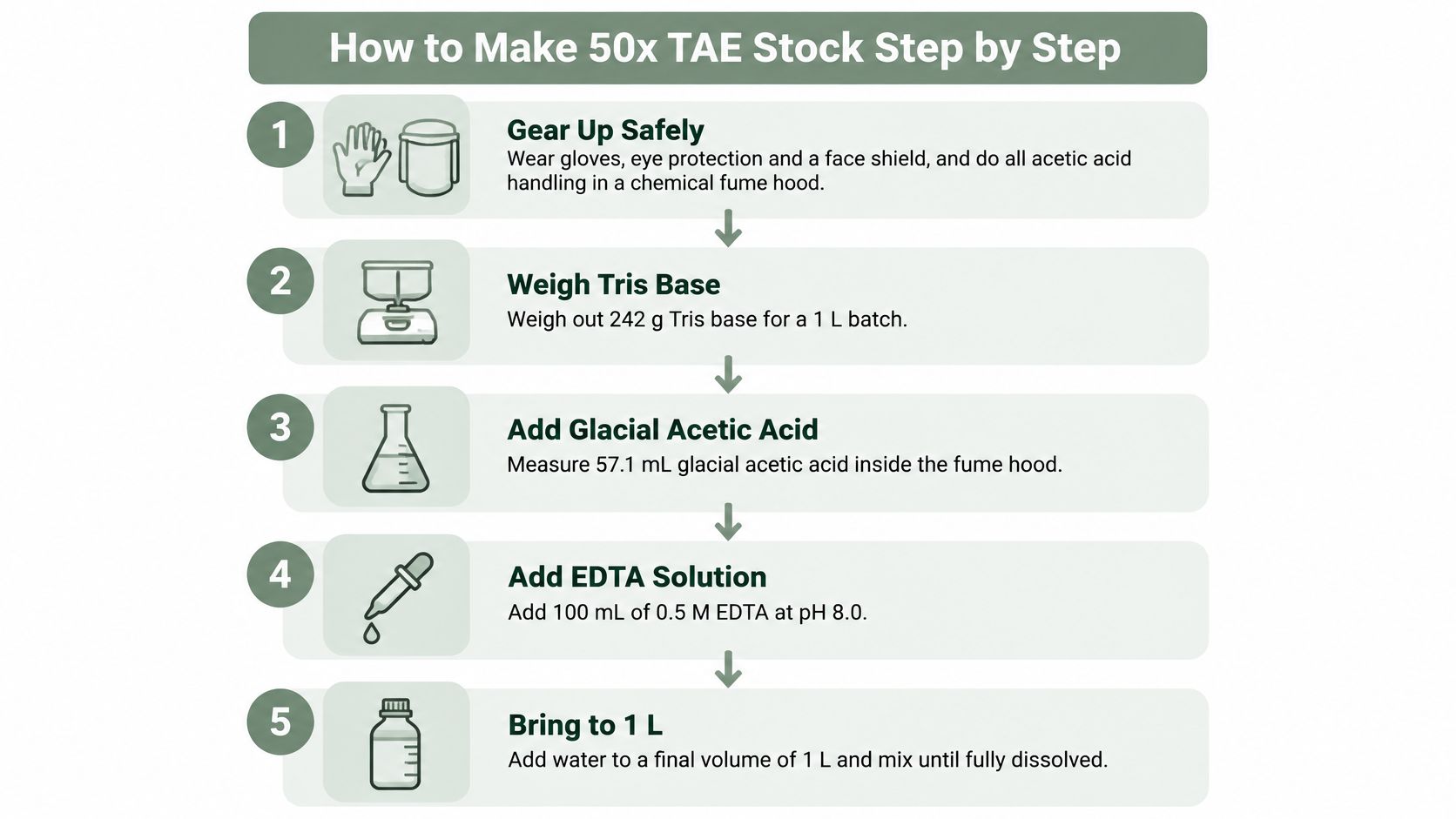
Prepare the stock in a vessel with enough headroom for stirring, then use suitable volumetric equipment to establish the final volume. The University of Michigan laboratory protocol starts with approximately 500 mL water, mixes the components, and then brings the preparation to 1 L.
The preparation flow is summarized below; the numbered procedure adds the safety and measurement checks.
Prepare, dissolve, then establish final volume
Set up chemical protection. Wear compatible gloves, a lab coat, eye protection, and a face shield for acid handling, and work in a chemical fume hood. The supplier safety data sheet identifies severe skin burns, serious eye damage, and possible respiratory irritation, with acetic acid exposure limits of 10 ppm time-weighted average and 15 ppm short-term.
Start with water below the final volume. Add the starting water to the preparation vessel and begin stirring. Starting with a full final volume of water leaves no allowance for the other components and makes the stock too dilute.
Weigh and dissolve the Tris base. Use the recipe-table mass and mix thoroughly, checking the vessel bottom for retained powder. Don't treat a spinning stir bar as evidence that everything has dissolved.
Add the glacial acetic acid slowly. Measure the recipe-table volume in the hood and add it to the aqueous preparation while mixing. Keep the reagent identity visible during this step so a dilute acid bottle isn't mistaken for glacial acid.
Add the prepared EDTA stock. Confirm its concentration, pH, and clarity before delivery. If the selected method calls for pH adjustment, take and record a preliminary reading before making up the volume, identifying it as a pre-final-volume reading rather than a finished-stock result.
Bring to the specified final volume. Add water to the final-volume mark, accounting for every component already added. Don't add a full final-volume quantity of water to the partly prepared batch.
Mix, inspect, label, and record. Confirm the finished pH when the selected protocol requires it, and document the measurement conditions. A usable stock should be clear, without undissolved crystals or residue.
A video demonstration can supplement the written procedure, but the selected laboratory protocol remains the controlling recipe.
Don't correct unexplained cloudiness by silently adding more acid. First identify whether the problem is dissolution, reagent identity, or a preparation error.
Clarity is a useful inspection criterion, not proof of correct concentration. A transparent solution can still contain the wrong quantities, which is why the weigh-out and delivered-volume record matters.
How to Dilute 50x TAE to 1x Working Strength
One part stock plus 49 parts water makes working-strength TAE. The Thermo Scientific electrophoresis buffer guide specifies this 1:50 dilution, producing 40 mM Tris, 20 mM acetate/acetic-acid component, and 1 mM EDTA.
The volumes below apply that dilution relationship. Use distilled or ultrapure water, measure the stock with equipment appropriate to the volume, and mix the completed working solution before dispensing it.
Stock and water volumes for 1x TAE working buffer
| Final volume of 1x TAE | 50x TAE stock | Water |
|---|---|---|
| 100 mL | 2 mL | 98 mL |
| 500 mL | 10 mL | 490 mL |
| 1 L | 20 mL | 980 mL |
| 2 L | 40 mL | 1,960 mL |
A practical published example appears in the 2024 Bio-protocol working-solution table, which combines 20.0 mL stock and 980.0 mL deionized water for 1 L working solution. The key distinction is the final solution volume, not the amount of water named on a bottle.
Catch the dilution errors before filling the tank
- Undiluted concentrate: A stock bottle belongs at the dilution station, not directly in the electrophoresis tank. Read the concentration label before pouring.
- Misread concentration factor: The stock designation is a fold-concentration instruction, not permission to use a much smaller dilution factor.
- Water volume mistaken for final volume: Adding stock to an already measured final-volume quantity of water changes both the total volume and the resulting concentration.
One numerical trap deserves explicit correction: adding 50 mL of this stock to 1 L water produces buffer above, not below, working strength. That follows directly from the dilution relationship underlying the table. It isn't the correct preparation for a liter of working buffer.
The stock-solution calculation guide provides a useful arithmetic check when the tank needs a different volume. Keep concentration units and volume units consistent rather than relying on a remembered bottle recipe.
Prepare fresh working buffer for each run rather than repeatedly recycling it. Electrolysis and evaporation can alter ionic composition and pH, and adding water back doesn't establish that the original formulation has been restored.
Final arithmetic check: Divide the desired final volume by the stock's fold-concentration to obtain the stock volume. Water supplies the remainder.
Storing, Labeling and Logging Each Batch
Store the concentrate under the conditions specified by the actual recipe variant, not a generic TAE shelf-life assumption. The storage period attached to a pH-adjusted, filter-sterilized preparation shouldn't automatically be assigned to an unadjusted batch made under different conditions.
Before dispensing, inspect the bottle against a light background. If crystals have formed, gentle warming and mixing may redissolve them where the local protocol permits; persistent cloudiness, unexplained residue, or suspected contamination calls for investigation or replacement rather than routine use.
Make the bottle distinguishable at a glance
The label should identify the buffer, concentration, preparation date, preparer's initials, stock ID, and recipe variant. Include the pH target and measured value, or explicitly identify an unadjusted preparation rather than leaving a misleading blank.
Keep stock and working-buffer labels visually distinct. A shared buffer name isn't enough when bottles can move between the preparation area and gel bench.
Consider an illustrative scenario: an unlabeled concentrate bottle is mistaken for working buffer, and the gel later shows smeared bands. The smear alone doesn't prove that buffer concentration caused the result, but the missing identity prevents a straightforward check of what entered the tank.
A good record narrows that uncertainty. It connects the preparation to the working dilution and then to the run, without pretending that documentation establishes the scientific cause of every failure.
Batch record to complete before the next gel
Use this template alongside the laboratory's controlled recipe. The batch-record documentation guide offers a broader framework for keeping planned actions separate from actual observations.
| Record field | Entry to capture |
|---|---|
| Stock identity | Bottle ID, buffer name, concentration, preparation date |
| Recipe identity | Protocol title or version, unadjusted or pH-adjusted variant |
| Materials | Reagent identity, relevant lot details, EDTA form and stock concentration |
| Actual quantities | Mass weighed and volumes delivered, including corrections |
| Final stock volume | Actual final volume and any deviation |
| pH record | Target, measured value, measurement stage, stock or diluted sample |
| Preparation observations | Dissolution, clarity, crystals, unusual appearance |
| Working dilution | Stock ID, stock volume, water volume, final working volume |
| Run connection | Gel or experiment identifier and working-buffer preparation date |
| Responsibility | Preparer and any review required by the local workflow |
Record deviations when they happen. A missed delivery, extra water addition, unresolved crystal, or uncertain pH measurement belongs in the record even when the final bottle looks normal.
Next step: Complete the stock identity and working-dilution fields before the tank is filled. That small checkpoint makes the record useful for the current run, not merely tidy afterward.
Verbex for iPhone and iPad, free to download, is one option for capturing this record through voice notes, typed notes, timers, and images. Voice and typed notes preserve timestamps and source context; a label photo can be attached as evidence, and the scientist selects the relevant section before capture, reviews the organized draft, and exports completed records as PDF, DOCX, or Markdown. Processing is on-device, with no account, cloud AI, cloud storage, advertising, analytics, or tracking; it's an ELN companion, not an official ELN or replacement for a validated system.
Verbal Experiment offers a free Lab Documentation Pack with 16 editable templates across 42 Word, Excel, and PDF files, including worked examples and working formulas. Visit Verbal Experiment or Verbex to choose a preparation-record template for the next TAE batch, then review and validate its examples and formulas locally before use.